Artificial intelligence is finding its way into travel agency offices, and the most interesting question is no longer whether it can write an itinerary. It is whether it can help an experienced advisor convert more enquiries, earn better commissions and keep customers coming back.
The distinction matters. A computer that produces a polished proposal in 30 seconds might save time. It does not, by itself, sell a holiday. That still requires the right product, an accurate price and a customer willing to book.
Yet the evidence suggests that agents are increasingly willing to put AI to work.
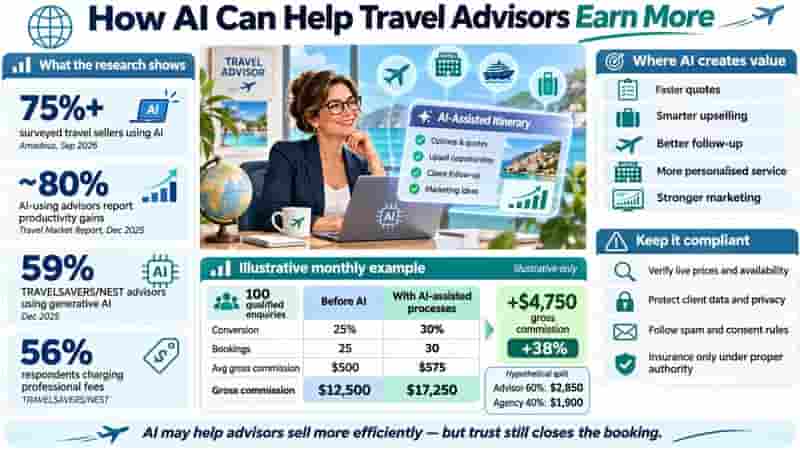
Research released by Amadeus on 29 September 2026 found that more than three in four travel sellers surveyed were using AI as part of their selling toolkit. The Global Travel Agent Report covered 756 agents across the Americas, Europe, the Middle East, Africa and Asia-Pacific. It identified research, content comparison, recommendations and productivity among the applications already in use.
A separate Travel Market Report study published in December 2025 found that nearly 80% of advisors already using AI reported improvements to workflow and productivity. Another survey of TRAVELSAVERS- and NEST-affiliated advisors in the United States and Canada found generative AI usage rose from 32% to 59% between surveys.
Those are different research groups, not an Australian industry census. None proves that a travel advisor earns more commission simply by opening an AI application. The figures show that the technology is moving into ordinary travel-selling work.
Where the money could be made
For most agencies, the first opportunity is faster, more consistent responses to enquiries. AI can organise a client’s preferences, draft a proposed itinerary, prepare destination background and produce a clear comparison of suitable holiday options. Advisors can then use verified supplier information to check availability, fares, taxes, conditions and commission eligibility before sending a quotation.
That matters when a consultant has six new enquiries and only enough time to deal properly with three. Faster preparation could make room for more conversations, without sacrificing the personal attention that wins business.
The second opportunity is selling a more complete holiday. A couple booking Europe might also need rail journeys, airport transfers, sightseeing, accommodation before a cruise and a specialist tour. If those products meet the client’s needs and carry supplier commissions, the advisor may earn more from the same booking.
It is not an invitation to sell the customer everything in the brochure. The best addition is the one that improves the trip. A poorly chosen upgrade might raise today’s invoice and lose next year’s customer.
Third comes follow-up. With an appropriately managed customer relationship system, AI can help identify unanswered quotations, past clients approaching their usual booking season and travellers who might be interested in a relevant new itinerary. It can draft useful messages for the advisor to approve. The opportunity is to convert genuine interest, not pester the entire customer database.
AI can also help agencies prepare cruise, luxury, group and corporate proposals, compare supplier inclusions, produce destination marketing and analyse which enquiries deliver profitable business. None of this removes the need for reliable live pricing or the advisor’s judgement.
What an extra five bookings might mean
Consider an illustrative agency receiving 100 qualified enquiries a month. At a 25% conversion rate and an average gross supplier commission of $500 per booking, it would earn $12,500 in monthly gross commissions.
Suppose AI-assisted processes, combined with better sales follow-up, helped raise conversion to 30%. Suppose relevant supplementary bookings also lifted average gross commission to $575. Thirty bookings would then generate $17,250, an increase of $4,750, or 38%.
Under a hypothetical 60/40 commission split, the advisor’s additional share would be $2,850 and the agency’s $1,900. These figures are arithmetic illustrations, not a forecast or evidence of a measured AI effect. Actual outcomes depend on contracts, product mix, booking cancellations, commission clawbacks and costs, including AI software and training.
There is another distinction worth making. Supplier commissions and agency professional fees are different income streams. An agency might charge for complex itinerary design or consultation, regardless of whether a particular supplier pays commission. In the TRAVELSAVERS and NEST survey, 56% of responding advisors said they charged professional fees. That figure relates to its surveyed North American network, rather than the Australian market.
AI could help consultants manage the work behind fee-based services. It does not decide whether a fee is justified, what a client will accept or how an agency should disclose it.
Who gets the benefit?
For a self-employed advisor, extra profitable bookings may increase personal earnings, subject to the host agency agreement. For a salaried consultant, higher agency revenue will not necessarily mean higher take-home pay unless bonuses or commissions are linked to results. Owners may benefit from improved productivity and retention, although profit must be measured after operating expenses.
A sensible incentive arrangement rewards verified net commission, repeat business and customer satisfaction. Rewarding the highest-priced recommendation alone would undermine the very trust the agency is paid to provide.
The safeguards are not optional
Travel businesses cannot treat AI-generated material as an authority on bookings. Flight schedules, entry requirements, hotel availability, insurance coverage and supplier conditions must be checked against current authoritative sources. AI can produce confident answers that are confidently wrong.
Privacy is another serious consideration. The Office of the Australian Information Commissioner recommends, as best practice, that organisations avoid entering personal information, particularly sensitive information, into publicly available generative AI tools. Most businesses with annual turnover of $3 million or less are exempt from the federal Privacy Act, but important exceptions apply. Every agency should assess its own obligations and use approved, secure systems rather than casually feeding passport or health details into a chatbot.
AI-generated marketing must also comply with Australia’s Spam Act. The Australian Communications and Media Authority requires applicable commercial emails and messages to have a lawful basis for consent, accurate sender identification and a functioning unsubscribe method. Automation is not a loophole.
The Australian Competition and Consumer Commission requires clear, accurate prices, including unavoidable or preselected fees in the displayed total. And travel insurance, as a financial product, must be arranged or advised only within appropriate licensing, authorisation, or other lawful arrangements. AI should never invent cover or make recommendations outside an advisor’s permitted role.
A practical 90-day test
Rather than purchasing a costly system and hoping for a miracle, an agency could begin with a controlled trial. During the first 30 days, measure the time needed to produce accurate quotes and the response rate to enquiries. During the next 30, test appropriate, supplier-verified supplementary recommendations and record average commission per completed booking. During the final 30, evaluate approved follow-up campaigns and repeat-booking results.
Measure conversion, realised commission, professional fees, customer satisfaction and net profit. Compare results with a credible baseline, allowing for seasonal demand and changes in enquiry quality. The objective is to establish whether the technology produces a commercial benefit, not merely attractive-looking paperwork.
Travel publishers and industry marketers may also see an opportunity. Relevant editorial coverage, clearly identified commercial partnerships and properly consented referrals could connect interested travellers with professional advisors. Whether that becomes profitable will depend on real leads, transparent arrangements and the quality of the resulting service.
The conclusion is less dramatic than some technology sales pitches, but considerably more useful. AI may give travel advisors more time to sell, a better understanding of each client’s needs and a stronger opportunity to earn. It cannot supply trust, accountability or destination experience by itself.
Those remain the advisor’s stock-in-trade. Unlike a hastily generated itinerary, they aren’t available at the click of a button.
By: Jill Walsh – © 2026.
Read Time: 6 minutes.
Author Bio:
 Jill Walsh has always kept a pen close and a suitcase closer. She started in media releases, then learned the trade by escorting press trips around the world, discovering which stories travel well and which need a sharper edit.
Before long, she wasn’t just promoting destinations; she was representing them, translating civic ambition and local pride into words people actually wanted to read. These days, semi-retired and happily so, Jill has traded departure boards for deadlines, joining old friend and colleague Stephen at EGT Media on a casual basis.
Her patch is the business end of wanderlust: balance sheets, route maps, tender wins and the numbers that quietly decide where travellers go. She writes with dry humour, clean prose and an old-school respect for facts, a steady voice when the market starts shouting.