

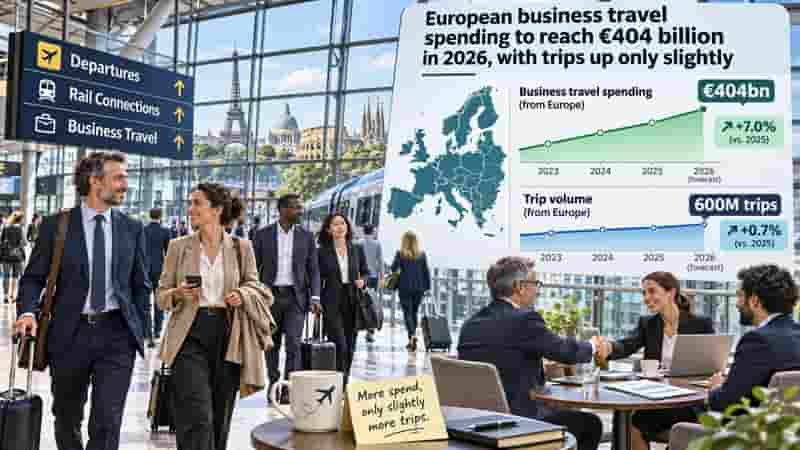
Europe’s business travel spending is heading towards €404 billion in 2026, but the rise in actual journeys tells a rather different story.
Europe’s business travel bill is on track to hit €404 billion this year. Yet the rush to the airport is growing only slightly.
New research from the Global Business Travel Association (GBTA) puts spending on trips from Europe up 7% in 2026. The number of trips is set to rise by just 0.7%, to about 600 million.
It is a striking gap. Firms are set to spend much more, but send few extra people on the road. For airlines and hotels, the bigger bill may sound like good news. For the firms paying it, the question is less cheerful. Are they getting more from each trip, or paying more for the same work?
Bigger Bills, But Not Many More Trips
GBTA released the new figures at its Europe conference in Vienna, held from 2 to 4 November with VDR and ABTA. Its 2026 Global Business Travel Index tracks how much firms spend on work trips and how often staff travel.
Europe is on course to make up 27% of the world’s €1.52 trillion business travel market. That puts it level with North America by value. Europe is also set to account for about a third of the 1.84 billion work trips forecast worldwide this year. North America is due to generate 492 million.
The key point is not just the size of the bill. It is what the bill buys. Taken together, GBTA’s two growth rates suggest average spend per trip will rise by about 6.3%. This is a rough measure drawn from the forecasts. It is not an official rate of travel inflation.
Higher fares and hotel rates can push up costs. So can longer trips or a change in where staff go. The GBTA figures do not prove that the gap comes entirely from price rises. They do show why firms have good reason to check their travel costs.
GBTA chief executive Suzanne Neufang said the market has shown “remarkable strength and staying power”. Yet the group’s warning is as plain as it is timely. Firms want to make sure “every trip delivers value”.
A full seat may please an airline. A full expense claim is not always such a joy for the boss.
Germany Still Leads Europe’s Big Five
Germany tops the region’s business travel league, with spending set to hit €79.9 billion. The UK comes next at £50 billion. France follows at €45 billion, Italy at €39.5 billion and Spain at €26.5 billion.
These five markets make up about 62% of Europe’s total forecast spend. That is where much of the demand sits for airlines, hotels, meeting venues and travel agents.
Western Europe is set to spend €354.9 billion. Central and Eastern Europe account for the other €49.1 billion. Yet the smaller group is growing faster. GBTA puts its 2026 growth at 10.8%, against 6.5% in the West.
One point is worth keeping in mind. These trips start in European markets. Not all trips are within Europe. The cash can flow to other parts of the world too. That is good news for places hoping to win a share of Europe’s work travel market.
Why People Still Travel for Work
The client meeting remains king. Sales calls and account meetings are the top reason for business trips in the GBTA survey. Training, project work, and major events follow.
Video calls have their place. They have not put the business traveller out of a job.
Among those polled, 74% said they expect to make the same number of trips, or more, in 2026 than last year. More than half, 53%, took one or two trips of at least 80 kilometres in 2025. A further 36% took between three and 10.
Most work travel was close to home. Of trips recalled by those in the survey, 63% were within their own country. The other 37% went abroad. Some 43% were day trips. The rest were overnight trips, with an average stay of 3.6 nights.
Cars also played a large role. Among people asked about their 2025 trips, 43% used a car, 34% flew, and 25% took a train. Some people used more than one type of transport, so the figures are not meant to add up to 100%.
And work need not mean work alone. Some 55% said they planned to add a leisure break to a work trip in 2026. That could help hotels and local tourism firms. It does not, of course, mean the boss pays for the beach days.
London Shows Where the Money Goes
The value of a work trip does not end at the hotel desk. A second GBTA Global Cities Economic Impact Study looks at what business visitors mean for major cities. It uses data from 2024, not the 2026 forecasts.
In London, business visitors spent £11.2 billion that year. GBTA estimates this supported about £18 billion in total economic output, £4.8 billion in local GDP, and 98,051 jobs.
Paris recorded €12.1 billion in direct visitor spend. That was linked to €19.7 billion in output, €7.4 billion in GDP and 90,472 jobs.
Amsterdam, Frankfurt and Madrid were also among the five top European cities in the study. The effects spread well beyond flights and rooms. Think of taxis, cafés, food firms, venue staff and local shops.
These are modelled estimates of jobs and wider economic effects. They are not a count of jobs that exist only for business visitors. Nor can output and GDP be added together: they are two ways of looking at parts of the same activity.
What This Means for Australian Travel Buyers
For Australian travel firms with clients in Europe, the lesson is clear. A larger budget does not mean a matching jump in bookings. Travel managers will need to watch fares, trip length, and the return from each journey. The same goes for local firms hoping to attract more European business guests.
GBTA sees more growth ahead. It expects European spending to reach €425 billion in 2027 and €471 billion by 2030. Those are forecasts, not money in the bank. A shift in costs or the world economy could change the outlook.
The research has a broad base. GBTA’s index covers 72 countries and 44 industries. Its 2026 report also uses a survey of more than 4,700 business travellers, carried out in May. This year’s report introduces a new way to count trips, so long-term volume trends need careful comparison.
Europe is not short of people willing to travel for work. What it may lack is a cheap way to send them.
The industry’s task is to make the extra spend count. The buyer’s task is to make sure the invoice tells the whole story.
By: Michelle Warner – © 2026.
Read Time: 6 minutes.
Author Bio:
 Michelle Warner has always carried stories the way others carry passports lightly, faithfully, and with purpose. She learned her craft in newsrooms, shaping sentences with care, before swapping deadlines for departures as a flight attendant with some of the world’s great airlines. Years aloft sharpened her eye for character and deepened her fondness for the small, dignified rituals of travel, the quiet kindness of strangers, the poetry of arrival, the patience learned between time zones.
Now grounded by choice, Michelle has come home to writing with the same calm authority she once brought to turbulent cabins. Her prose blends an editor’s discipline with a traveller’s wonder, tinged with humour and reverence for travel’s golden age. Each piece feels like a handwritten boarding pass, gracious, observant, and unmistakably alive.













