

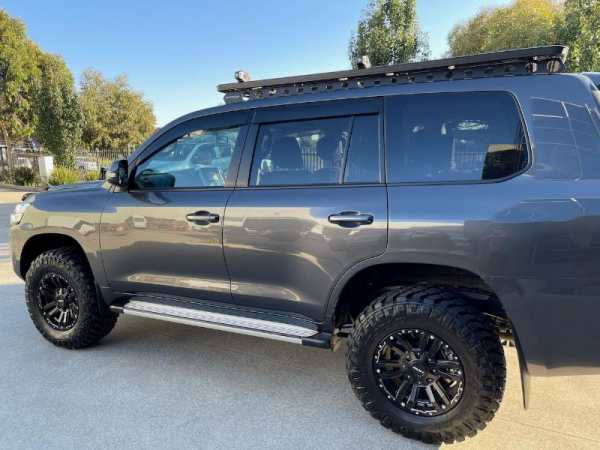
A 4WD that’s perfectly legal at home could be breaking the rules in another state, and most owners have no idea.
That’s the warning from Australian-owned 4WD accessory supplier OCAM 4×4 Accessories, which says every state and territory has its own rules on how high you can lift a 4WD, what makes a bull bar legal and when you need permission to modify.
It comes as Queensland police recently warned drivers that some popular add-ons, like reflective window covers, can land them a $402 fine.
OCAM 4×4 Accessories director Peter Gorgievski said the patchwork of rules can catch out even the most careful of drivers.
“We fit out 4WDs for people heading interstate all the time, and state-to-state regulations can trip them up,” he said.
“They’re not doing anything wrong intentionally, the rules are just different everywhere you go.”

Get to know lift limits
How high you can legally lift a 4WD without an engineer’s sign-off depends entirely on where the vehicle is registered.
The Northern Territory is the most relaxed at 100mm, while NSW, Victoria and Queensland allow 75mm. South Australia, Tasmania, the ACT and Western Australia all cap it at 50mm.
| State or territory | Legal lift (no engineer) | The catch |
| NT | 100mm | Measured from the roof, and a wheel alignment report is needed |
| NSW, VIC, QLD | 75mm | No more than 50mm can come from the suspension |
| SA, TAS, ACT | 50mm | Anything higher needs an engineer’s sign-off |
| WA | 50mm | Requires inspection |
How high you can lift a 4WD in each state and territory. Source: State and territory transport authorities. Analysis by OCAM 4×4 Accessories.
Bigger tyres count towards the limit too, but only by half. A tyre that’s 50mm taller lifts the car by just 25mm, because the axle sits in the middle of the wheel.
Mr Gorgievski said that’s where a lot of owners go wrong.
“People see 75mm and think they can bolt on a 75mm lift kit,” he said.
“But that 75mm is the suspension and the tyres together. If you put bigger tyres on top of a big kit, you’ll go over the limit without even realising it.”
Even how the lift is measured changes from place to place.
“In the Northern Territory, for example, it’s measured to the roof, so everything underneath counts: suspension, body lift, tyres, the lot,” Mr Gorgievski said.
“Same car, same tape measure, and you can get a different answer depending on where you are in the country.”
Fines for an illegal 4WD lift, by state and territory
| State/territory | On-the-spot fine | Offence(s) police can issue |
| NSW | $144–$241 | Vehicle not complying with dimensions or tyre standards ($144); unsafe or unserviceable vehicle ($241) |
| VIC | $523–$836 | Vehicle exceeding permitted dimensions ($523); modified vehicle not complying with standards, or unsafe vehicle ($836) |
| QLD | $172–$518 | Defective light vehicle ($172, 1 pt); defective vehicle that is unsafe ($345, 3 pts); owner allowing a non-compliant modification ($518) |
| ACT | $279–$619 | Non-compliant dimensions or tyres, or modification without certification ($279); non-compliant suspension ($336); unsafely maintained vehicle ($619) |
| WA | $100 | Altering a vehicle without approval, or vehicle not complying with standards |
| SA | $533 | Light vehicle in breach of vehicle standards (plus $108 levy) |
| TAS | $213–$852 | Breach of vehicle modification standards ($213); non-compliant modified vehicle ($266.25); unsafe and unroadworthy vehicle ($852) |
| NT | $60 | Driving an unsafe motor vehicle |
On-the-spot fines for light vehicles as at September 2026. No state or territory has a fine written specifically for this modification, so police use general vehicle standards offences. Where more than one offence could apply, the min–max range is shown. Source: State and territory transport authorities. Analysis by OCAM 4×4 Accessories.
The bull bar trap
Bull bars are one of the most popular 4WD add-ons, but there’s more to them than bolting on a lump of steel.
They have to meet an Australian safety standard, and on newer vehicles, they also need to accommodate factory-fitted technology such as parking sensors, cameras and radar systems used for features like automatic emergency braking.
“On a modern car, there’s radar and cameras sitting right behind where the bar mounts,” Peter says. “Fit the wrong bar and you might not find out you’ve blinded your safety systems until the day you need them.”
Mr Gorgievski said many of these problems can be traced back to poorly designed sensor mounts or incorrect positioning of relocated cameras and radar units.
“A bull bar might physically fit your vehicle, but that doesn’t necessarily mean it’s compatible with all its safety features,” he said.
“That’s why it’s important to choose a bull bar specifically engineered for your vehicle, with proper provisions for its factory sensors, cameras and radar systems, and to ensure it’s installed correctly.”
If your bull bar covers a drivers’ number plate, fines can climb even higher, reaching $1,200 in WA.
Fines for a non-compliant bull bar, by state and territory
| State/territory | On-the-spot fine | Offence(s) police can issue |
| NSW | $144–$577 | Non-compliant headlights or other standard ($144); non-compliant frontal protection system ($241); dangerous frontal protrusions ($434, 3 pts); number plate obscured ($577, 3 pts) |
| VIC | $209–$836 | Fitting projecting in a way likely to injure ($209); number plate not displayed correctly ($418, 3 pts); vehicle not complying with standards ($836) |
| QLD | $172–$552 | Defective light vehicle ($172, 1 pt); defective vehicle that is unsafe ($345, 3 pts); number plate not clearly legible ($552) |
| ACT | $279–$619 | Non-compliant protrusions or lights, or illegible number plate ($279); unsafely maintained vehicle ($619) |
| WA | $100–$1,200 | Vehicle not complying with standards, including protrusions ($100); number plate obscured ($1,200) |
| SA | $533–$606 | Light vehicle in breach of vehicle standards ($533); number plate obscured by a device ($606) (plus $108 levy) |
| TAS | $159.75–$852 | Lights obscured ($159.75); fitting likely to cause injury, or number plate obscured ($213); unsafe and unroadworthy vehicle ($852) |
| NT | $30–$60 | Number plate not clearly visible ($30); faulty headlights ($50); driving an unsafe motor vehicle ($60) |
On-the-spot fines for light vehicles as at September 2026. No state or territory has a fine written specifically for this modification, so police use general vehicle standards offences. Where more than one offence could apply, the min–max range is shown. Source: State governments/OCAM 4×4 Accessories.
Bull bars must meet Australian Standard AS 4876.1-2002 and, on newer vehicles, accommodate factory-fitted cameras, radar and parking sensors. Picture: OCAM 4×4 Accessories
The one mod that’s illegal everywhere
While most rules change at the border, one stays the same everywhere. Wheel spacers, which push the wheels further out for a wider look, are banned in every state and territory unless the car came with them from the factory.
“Spacers come up constantly,” Mr Gorgievski said. “People want the wheels sitting out a bit further and don’t realise it’s the one thing that’s illegal in every single state.”
Fines for fitting wheel spacers, by state and territory
| State/territory | On-the-spot fine | Offence(s) police can issue |
| NSW | $144–$241 | Vehicle not complying with standards ($144); unsafe or unserviceable vehicle ($241) |
| VIC | $836 | Modified vehicle not complying with standards, or unsafe vehicle |
| QLD | $172–$518 | Defective light vehicle ($172, 1 pt); defective vehicle that is unsafe ($345, 3 pts); owner allowing a non-compliant modification ($518) |
| ACT | $279–$619 | Modification contrary to standards ($279); non-compliant road wheels ($336); unsafely maintained vehicle ($619) |
| WA | $100 | Fitting wheel spacers without approval (listed by name in the regulations) |
| SA | $533 | Light vehicle in breach of vehicle standards (plus $108 levy) |
| TAS | $213–$852 | Breach of vehicle modification or wheel standards ($213); non-compliant modified vehicle ($266.25); unsafe and unroadworthy vehicle ($852) |
| NT | $60 | Driving an unsafe motor vehicle |
On-the-spot fines for light vehicles as at September 2026. No state or territory has a fine written specifically for this modification, so police use general vehicle standards offences. Where more than one offence could apply, the min–max range is shown. Source: State governments/OCAM 4×4 Accessories.
Are changes coming?
Change for 4WD enthusiasts could be on the way. The National Transport Commission agreed in 2022 that the rules should be the same nationwide, and in 2024 it backed a plan to update to the national rulebook for vehicle modifications.
Until then, Mr Gorgievski urged owners to check their state’s limits before ordering parts, find out whether an engineer’s sign-off will be recognised if they move interstate, and in WA, get approval before they start.
“One set of rules would make our job easier and our customers safer,” he said. “Until then, our advice is simple: check before you build, not after.”













