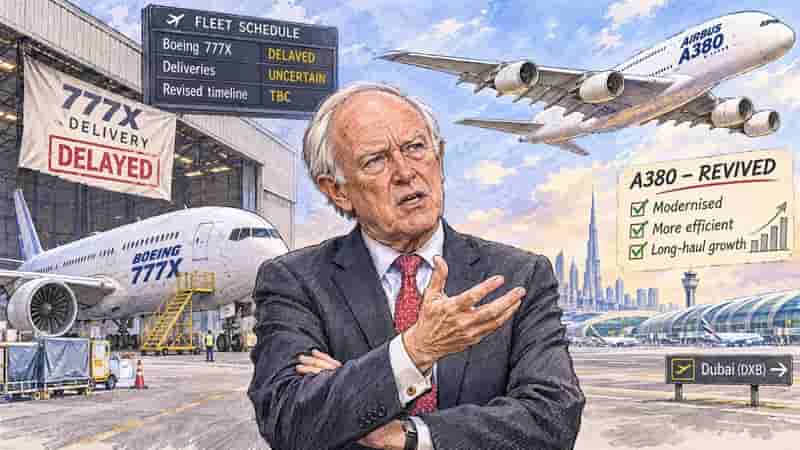
Emirates president Sir Tim Clark has delivered another broadside at Boeing over the long-delayed 777X, while urging Airbus to consider bringing back a thoroughly modernised A380.
For the Dubai airline, these are two sides of the same problem: passenger demand is strong, new aircraft are arriving too slowly, and the giant double-decker that helps Emirates move large numbers of travellers through its hub is no longer in production.
In an interview with Aviation Week’s Window Seat podcast, published on 29 October 2026, Clark questioned Boeing’s ability to deliver the 777-9 reliably and expressed frustration over engine availability. He also outlined how a redesigned A380 could serve Emirates for decades.
The Boeing timetable that keeps moving
Emirates has been waiting years for the 777X, an aircraft intended to play a major role in renewing and expanding its long-haul fleet. The first customer delivery has slipped repeatedly, and no 777-9 had been delivered by early November 2026.
Clark said Emirates told Boeing years ago, both verbally and in writing, that it would not accept certain early-production aircraft. He identified jets built in 2018 and 2019 that have remained on the ground for years, raising questions about their suitability for the airline’s fleet.
He said the carrier had some visibility over the first few deliveries but lacked a reliable schedule for the larger stream of aircraft it needs. Engine supply from GE Aerospace, whose GE9X powers the 777X, was among his concerns.
The airline boss was not inclined to dress up his frustration. In the interview, he described the situation as “totally unacceptable”.
Boeing’s published position is more definite, at least at programme level. In its 27 October third-quarter results, the manufacturer said 777-9 certification flight testing was progressing and that it still expected first delivery in 2027.
During its earnings call, Boeing said production was running at approximately one aircraft per month and was expected to remain at that rate for much of 2027. That indicates its current manufacturing plans, although it does not answer Clark’s questions about when Emirates will receive individual aircraft.
Boeing’s filing with the US Securities and Exchange Commission recorded 570 undelivered firm orders for the 777X as of 30 September 2026. Clark referred to a figure approaching 700 during the interview, but the numbers should not be presented as interchangeable.
The filing also identified an engine durability issue, first detected in 2025, that Boeing and its supplier were working to resolve and certify with US regulators.
Seven A380s grounded, and another engine headache
The 777X is not Emirates’ only engine concern.
Clark said seven of the airline’s A380s were grounded while awaiting engine overhauls. According to his account, work contracted to take 85 days was taking more than 350 days in some cases. Those are maintenance delays affecting aircraft already in service, separate from the GE9X supply and certification issues on the 777X.
Keeping the existing fleet productive has become especially important. Emirates is investing heavily in cabin upgrades rather than leaving its older aircraft to look their age.
In July, the airline reported completing refurbishments on 100 aircraft: 47 A380s and 53 Boeing 777s. More were scheduled to follow under its US$5 billion retrofit programme. The entire fleet has not yet been refurbished.
Clark’s case for a new superjumbo
Clark believes Airbus walked away from the A380 too soon. He argued that new engines, improved aerodynamics, redesigned wings and contemporary aircraft systems could give a successor a substantially better economic case.
He floated a possible 25 per cent reduction in operating costs. That is Clark’s estimate, not a manufacturer-verified performance figure. He suggested Emirates could replace its existing A380s and potentially buy another 100 aircraft if Airbus produced a suitable new version.
It remains a substantial if.
Airbus ended A380 production in 2021 and has announced no programme to relaunch the aircraft. The company continues to support the superjumbos already flying, but Clark’s wish list is not an order book.
The economics are complicated. Emirates operates a high-volume hub model that can fill very large aircraft; many other airlines found the A380 harder to use profitably. Building a new version would require investment, certification and enough customers to justify restarting production.
Clark has said Emirates could operate its current A380 fleet until around 2041, subject to the aircraft’s usable service life. That gives the airline time, but it does not conjure a replacement.
For travel agents and passengers, the immediate consequence is straightforward: Emirates must keep meeting demand with the aircraft it has while waiting for the ones it has ordered.
Boeing says the 777-9 is approaching delivery. Clark wants firmer dates. And Airbus, for now, has not returned the A380 to the drawing board.
In aviation, a grand plan is useful. An aircraft turning up on schedule is better.
 John Alwyn-Jones is one of those rare figures who can make the business of travel sound positively adventurous.