


New research finds British travellers are warming to AI hotel recommendations, but most still want a human hand on the booking.
An AI tool can find a tempting hotel in seconds. Getting a guest to hand over the booking is another matter.
New UK research from Aven Hospitality shows that AI is winning a place in hotel search. But the old rule still holds: guests want to know what they are paying for, and who is taking their money.
Of 1,000 UK adults who had stayed in a hotel in the past year, 31 per cent said they had booked a hotel suggested by AI. That does not mean an AI tool made the booking. In fact, most of those guests want to keep that last step in their own hands.
Among people who had booked an AI-suggested hotel, 71 per cent plan to use AI to find rooms but book for themselves. Just 29 per cent want it to handle both tasks.
That gap matters. For hotels, a place on an AI shortlist is worth little if guests drop off before payment.
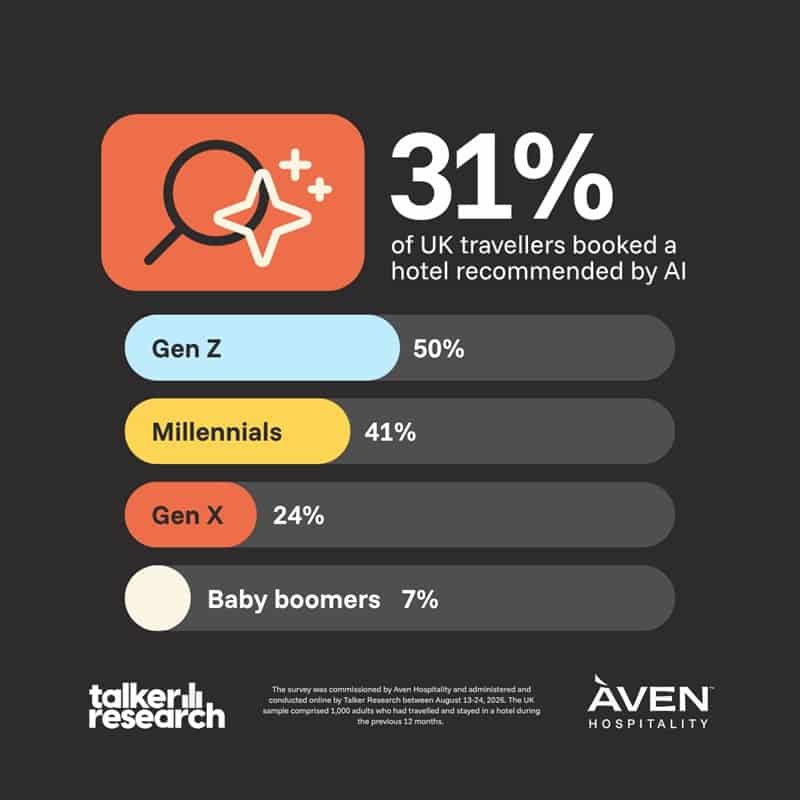
AI-recommended bookings by age group
Young guests lead the charge
Half of Gen Z guests in the survey had booked a hotel suggested by AI. The share was 41 per cent for millennials, 24 per cent for Gen X and just 7 per cent for baby boomers.
Yet the older ways of finding a room still have a pulse. Search engines were a usual source of hotel tips for 46 per cent of those polled. Tripadvisor drew 42 per cent and online travel agents 40 per cent.
Two-thirds (66 per cent) had used AI to look for travel options. Nearly half (48 per cent) said they used it often.
Why the appeal? Among those who had booked a hotel suggested by AI, 52 per cent liked the time saved. Another 49 per cent valued a more personal match. For 46 per cent, it made it easier to weigh up choices.
And 16 per cent said it had found hotels they might never have spotted. That is good news for a small property trying to be seen among the big brands.
A smart guide, but not the guest’s wallet
Trust has its limits. Of those who booked an AI-suggested hotel, 97 per cent said the suggestion was very or fairly accurate.
But faith in a good tip is not the same as faith in a tool that takes a payment.
Asked which tasks they would most trust an AI agent to do, 23 per cent of UK respondents chose finding cheaper options. Researching hotels drew 21 per cent. Only 12 per cent chose booking a room.
“AI is changing how travellers find hotels, but discovery is only part of the journey,” said Noreen Henry, chief revenue officer at Aven Hospitality.
Her point puts a clear duty on hotels. The room shown in an AI answer must match the room on sale. So must the rate, rules and list of facilities. A guest should not need a detective’s badge to find the truth.
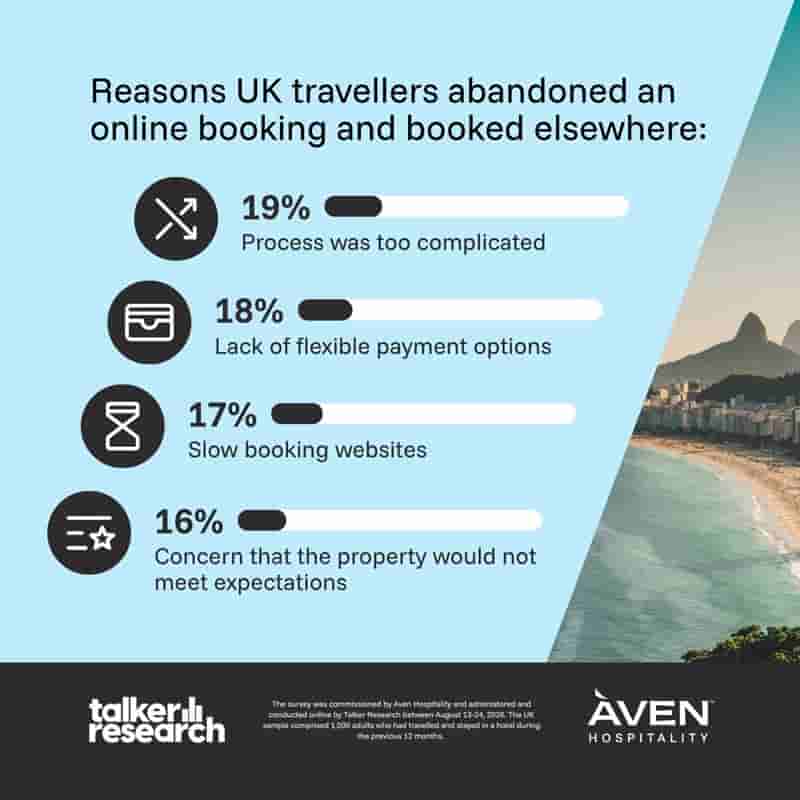
Booking abandonment
The old booking headaches have not gone away
The survey also found that bad websites can still send a guest to a rival.
Some 19 per cent of UK guests said they had quit an online hotel booking and booked elsewhere because the steps were too hard. Payment choice was an issue for 18 per cent. Slow sites put off 17 per cent, while 16 per cent doubted a hotel would live up to its claims.
Then there is the awkward business of turning up to find the promised pool, restaurant or other amenity is not there.
Some 13 per cent had booked a stay for an amenity that was not on offer. A further 12 per cent said they had booked a hotel that was falsely advertised or did not meet their needs.
Among those who had faced a travel let-down, 21 per cent went on to check details with hotels themselves.
The fix is not glamorous. Keep room details and rules current on every channel. Make rates clear. Keep the site quick, the payment steps simple and the phone number easy to find.
Aven has also urged hotels to give AI search tools access to clear, up-to-date hotel data. That may help them show the right rates and facilities rather than a polished but wrong answer.
A warning worth reading in Australia
These are UK survey results, not a measure of how Australians book. And as Aven is a hotel technology firm, its own research deserves clear attribution. It does not prove that AI tips lead to more sales.
Still, the message is useful for Australian hotels and travel advisers who serve guests from abroad. AI may win the first glance. Clear facts, fair terms and an easy booking path must win the sale.
The guest, it seems, is happy to let the machine find the keys. Handing over the credit card is a different question.
By: Prae Lee – © 2026.
Read Time: 4 minutes.
Author Bio:
 You can tell a great deal about a person by how they meet a Bangkok morning. Prae Lee doesn’t charge into it; she glides, unhurried, as if time itself has agreed to behave. She carries a calm assurance, the sort earned by knowing both your roots and your destination.
A graduate of Chulalongkorn University, she took her business degree with quiet pride, then polished it further in Singapore and Australia. Travel didn’t change her. It refined what was already there: curiosity, discipline, grace.
Back in Bangkok, she slipped modern life into the family business, mastering social media with an instinct for listening and selling with Thai gentleness.
Prae never seeks attention, yet everything she touches grows brighter.
Now with Stephen’s EGT Media, she writes with authenticity, drawing on culture, travel and a rare, steady confidence.











