

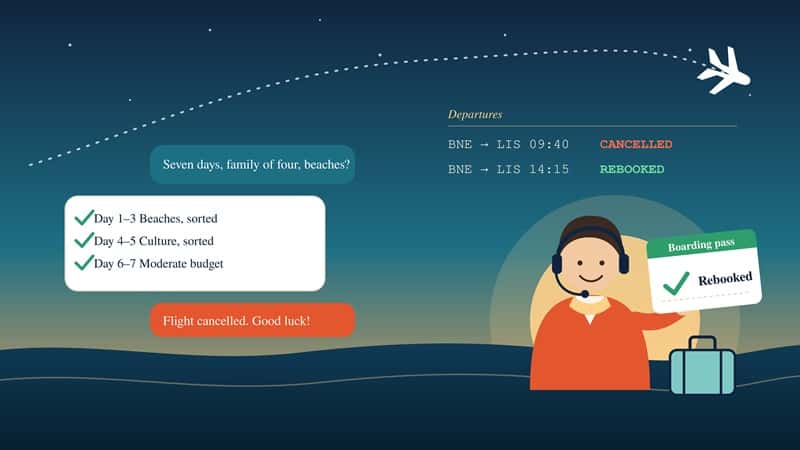
A few years ago, a traveller planning a trip would search several websites, read reviews and perhaps visit a travel agency for advice. Today, many start by typing a question into an AI assistant: “Plan a seven-day trip for a family of four, with beaches, culture and a moderate budget.” Within seconds, they receive an itinerary.
For travel agencies and tour operators, this raises an uncomfortable question. If AI can plan a trip for free, why would anyone pay an agent?
I have worked in the tourism industry as a tour manager since 2017, and I now help businesses, including tourism businesses, adopt AI. I believe AI is not the end of the travel agency. It is the end of the travel agency that only provides information.
What travellers are actually doing
The shift is real. Phocuswright research published in 2025 found that about one in three U.S. travellers already used generative AI for travel, and at least 78% of them found the results helpful for planning or during their trip.
But trust is limited. The same research found that only around a third fully trusted GenAI responses. In a Booking.com survey cited by L.E.K. Consulting in January 2026, only 6% of consumers said they fully trusted AI with their travel, and 91% had at least one concern.
Most importantly for agencies, L.E.K.’s own research, based on surveys carried out in September 2025, found that 85% of travellers who used an agent would keep using them even if they also used AI tools.
In other words, travellers use AI for inspiration and research, but many still want a person they can rely on when money, time, and safety are at stake.
Where AI beats the traditional agent
It is important to be honest about what AI does well:
- Inspiration: suggesting destinations, activities and itineraries in seconds.
- Basic information: visa rules, weather, local customs and typical costs, although these must still be checked.
- Availability at any hour: answering questions at midnight, on weekends and in many languages.
- Comparison: quickly comparing options that would take a person hours to research.
An agency that competes only on these points will struggle. Travellers will not pay for information they can get instantly for free.
Where agents still win
From my experience leading groups, the value of a good agent or tour operator lies elsewhere:
- When a flight is cancelled, a hotel is overbooked, or a guest falls ill, travellers want someone who will take responsibility and solve the problem. AI cannot rebook a stranded family or argue with a hotel manager.
- Local knowledge and relationships. Agents know which hotels deliver what they promise, which guides are excellent and which routes are realistic. Relationships with suppliers often mean better rooms, faster help, and solutions not available online.
- Complex trips. Multi-country tours, group travel, special events, honeymoons and accessible travel involve many moving parts. Mistakes are expensive, and travellers value an expert who coordinates everything.
- For many travellers, especially families, older guests and first-time visitors to a region, knowing that a real person is looking after them is part of what they are buying.
- Curated experiences. AI can list attractions. A good agent knows which experiences fit a particular traveller and how to put them together into a trip that feels personal.
How agencies should use AI themselves
The agencies that will thrive are not those that ignore AI, but those that use it to become faster and more personal. Practical uses include:
- Instant responses to enquiries. An AI assistant on WhatsApp, Instagram or the website can answer common questions, collect travel dates, budgets and preferences, and pass a well-organised enquiry to a consultant. Fast first responses win bookings.
- Faster itinerary drafts. Consultants can use AI to create a first draft of an itinerary, then refine it with their own knowledge, supplier relationships and local insight.
- Personalised proposals. AI can turn a consultant’s notes into a polished proposal with clear descriptions, day-by-day plans and practical tips.
- Pre-trip communication. Automated messages can send checklists, documents, weather updates and meeting details at the right time.
- During-trip support. AI can answer simple questions, while urgent issues are passed immediately to a person on duty.
- After-trip follow-up. Thank-you messages, feedback forms and suggestions for the next trip can be sent automatically.
- Back-office efficiency. Invoices, payment reminders, supplier confirmations and booking records can be automated, freeing consultants to spend more time with clients.
Change the message, not just the tools
Agencies also need to explain their value differently. “We can find you a good hotel” is no longer enough. Stronger messages focus on what AI cannot offer:
- “We handle problems so you don’t have to.”
- “We know these places personally.”
- “One contact for your whole trip, before, during and after.”
- “Plans built around you, not around a search result.”
Some travellers will now arrive with an AI-generated itinerary. Rather than seeing this as competition, agents can offer to review it, point out what is unrealistic, suggest better options and book it properly. This turns AI research into a reason to talk to an expert.
A note on accuracy
AI can produce confident but incorrect information about visas, entry rules, opening times and prices. Agencies that check and guarantee their information have a clear advantage. Every itinerary that leaves the agency should be reviewed by a person who knows the destination.
The future travel agency
The travel agency of the future will look different. It will respond within minutes, communicate on the channels travellers prefer and use AI to handle routine work. But at its heart, it will still be about people: experts who know destinations, suppliers who trust them and travellers who know someone is looking after them.
AI has made information cheap. It has made trust, judgement and care more valuable than ever. Agencies that build their business around those qualities, and use AI to deliver them faster, will not be replaced. They will be chosen.
By: Ali Yaghoubi, Founder and Director, Techsign Ltd.
Read Time:5 minutes.
Author Bio:
 Ali Yaghoubi is the Founder and Director of Techsign Ltd. (Techsignature), a UK-based AI automation and consulting company that helps small and medium-sized businesses bring AI into their daily operations.
He has led AI adoption projects for businesses in Malaysia, focusing on workflow automation, customer engagement, and practical, people-first AI. He has also worked in the tourism industry as a tour manager since 2017.











