

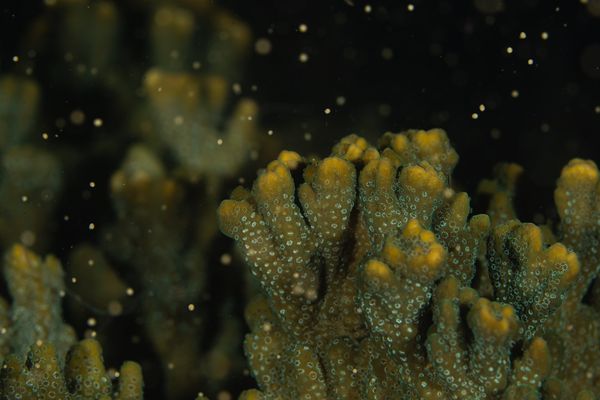
The waters off Magnetic Island welcomed new life last night (30 October 2026), when millions of coral egg and sperm bundles rose towards the surface in what is likened to an ‘underwater blizzard’, kicking off the Great Barrier Reef’s annual coral spawning event.
This year’s spawning marks the 45th anniversary of the revolutionary observations by Professor Peter Harrison and fellow researchers at Magnetic Island in 1981, whereby mass synchronised coral spawning was recorded for the first time, transforming scientific understanding of coral reproduction on the Great Barrier Reef and reef systems around the world. In what proved to be a landmark year for the Great Barrier Reef, 2026 also marks 45 years since the Great Barrier Reef was added to the UNSECO World Heritage List.
The Great Barrier Reef’s biggest annual ‘hookup’ occurs across just a handful of nights each year, when corals simultaneously release billions of egg and sperm bundles into the ocean in a visually spectacular display often described as an underwater snowstorm.
Guided by environmental cues including water temperature, the lunar cycle and darkness, coral spawning creates the next generation of corals and helps sustain reef ecosystems. The phenomenon not only stimulates new coral growth across the reef but has also provided the foundation for decades of scientific research into coral reproduction, restoration and recovery.
Distinguished Professor Peter Harrison of Southern Cross University witnessed the world’s first recorded mass coral spawning at Magnetic Island more than four decades ago as PhD student and has since dedicated his career to advancing scientific understanding of coral reproduction.
Reflecting on the 45-year anniversary of the mass coral spawning discovery at Magnetic Island, Professor Harrison said witnessing this incredible event on mass for the first time was a truly spectacular and career defining moment.
“I vividly remember the first time I saw mass coral spawning at Magnetic Island in the early 1980s,” said Professor Harrison.
“I was overwhelmed with the scale of the event. So many different types of corals were releasing eggs and sperm together, and the eggs sperm bundles filled the area and floated to the surface creating one of nature’s greatest underwater spectacles.
“Inspired by the discovery of the mass coral spawning, I began to think about how we could apply that understanding to regenerating corals at scale on damaged reefs. As a result of that we developed what is now known as coral IVF, where we use the natural reproduction process of corals to generate larvae in floating reef pools which are then settled back on to damaged sections of the reef to kick start recovery.”
Since this incredible discovery, Professor Harrison has become a world leader in coral reproduction and restoration, with his coral IVF technique being implemented to renew the Great Barrier Reef and in other reef regions across the world. His contribution to marine science has also earned him a place among the Museum of Underwater Art’s Ocean Sentinels at John Brewer Reef off Townsville, an underwater art installation celebrating distinguished scientists and conservationists helping to protect and shape the future of the Great Barrier Reef.
Speaking ahead of last night’s spawning event, Professor Harrison said that while the Great Barrier Reef faces ongoing climate-related pressures, coral spawning is an important reminder of the reef’s ability to continually create new life, and of its national and global significance as the world’s largest reef system.
“Mass spawning is incredibly important for the Great Barrier Reef because it’s through these reproductive events that the corals generate billions of larvae, some of which survive and settle onto reefs to regenerate the coral populations, which then ultimately build the reef environment,” said Professor Harrison.
“The Great Barrier Reef is a world heritage icon and it’s Australia’s responsibility to manage it effectively. I hope people recognise when they see the Great Barrier Reef just how important it is nationally and internationally, because it is the largest coral reef system on our planet.”
Among those to witness last night’s coral spawning at Magnetic Island was Aquascene Magnetic Island owner and Master Reef Guide Steph Hinks, who said that even after spending most of her life living on Magnetic Island and exploring its reefs, she still feels privileged to observe one of the world’s most spectacular natural events.
“Witnessing that amazing coral spawning is pretty spectator, it’s a real privilege and super special, and almost a bit surreal. You’re seeing these little parcels being expelled out of the coral and for a moment you’re caught in a little trance,” said Mrs Hinks.
“We’d been waiting for a little while, you never really know when it’s going to happen, so patience is key, and then once it starts it’s like quick it’s happening, quick!
“What it does is it gives us hope. There are all these baby corals about to spread themselves out there and create beautiful new colonies.”
Coral spawning continues to underpin many of the conservation, restoration and research initiatives taking place across the Great Barrier Reef. Along the length and breadth of the reef, researchers, marine scientists, tourism operators, Traditional Owners and local communities support reef stewardship, contribute to scientific studies and create meaningful opportunities for visitors to connect with the world’s largest coral reef.
Together, these efforts build on the landmark scientific discovery made at Magnetic Island in 1981, which transformed the world’s understanding of coral reproduction. Forty-five years on, the annual coral spawning remains a powerful demonstration of the Great Barrier Reef’s scale, resilience and beauty.











