

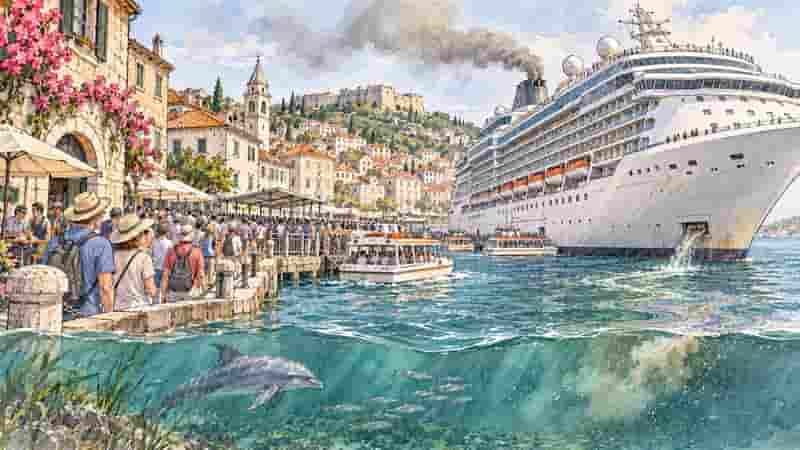
A cruise holiday can be wonderful. A gleaming ship, blue water stretching to the horizon, excellent food and someone else making the bed. What’s not to like?
Quite a lot, actually, if we look beyond the brochure.
I am not suggesting we abandon cruising. Far from it. I love what ships can offer, and I want the industry to prosper. But surely we owe it to ourselves, the places we visit and the generations who follow, to ask a few uncomfortable questions. With a record 37.2 million ocean cruise passengers in 2025, according to Cruise Lines International Association (CLIA), those questions are becoming harder to dodge.
Environmental pressure: what goes overboard matters
I remember when rubbish was thrown overboard with scarcely a second thought. We knew better than that, or should have. Thankfully, environmental rules and expectations have moved on. Quite right, too.
Take exhaust-gas scrubbers. They are often hailed as clever technology, and they do remove much of the sulphur pollution from ships’ exhausts. But open-loop scrubbers discharge used washwater into the sea, which may carry heavy metals and other harmful substances. Closed-loop systems recirculate water and may retain or discharge smaller amounts of treated bleed-off water, depending on the rules. Hybrid systems can do both.
In other words, cleaning the air should not mean dirtying the ocean. That seems a fairly modest request.
Research by the International Council on Clean Transportation estimated enormous washwater discharges across commercial shipping overall, not just cruising. Studies in the Baltic Sea have also linked open-loop scrubbers with hazardous marine pollution. The industry can alternatively comply with sulphur limits by burning suitably low-sulphur fuel; scrubbers are not compulsory.
I want to see the improvements, certainly. But I also want to know what happens to the pollution after it disappears from view.
Fuels: is ‘cleaner’ really clean?
Traditional marine fuels produce greenhouse gases and air pollutants. In a 2023 study, Transport & Environment estimated that 214 cruise ships emitted 509 tonnes of sulphur oxides and 19,125 tonnes of nitrogen oxides around European ports during 2022. LNG can reduce sulphur pollution, particulate matter and direct carbon dioxide emissions compared with conventional fuels. That is welcome. But LNG is mainly methane, a potent greenhouse gas, and unburned methane can escape through engines or along the supply chain.
So when a brochure announces a ‘sustainable’ ship, I become rather interested in precisely what that means. A greener-looking label is not the same as a proven climate benefit.
Cleaner fuels and new propulsion systems are being developed, including renewable fuels, batteries and hydrogen technologies. All come with costs, technical hurdles and questions about how their energy is produced. The International Maritime Organisation is aiming for net-zero greenhouse-gas emissions from international shipping by or around 2050. A splendid ambition. Now comes the difficult business of achieving it.
And let us not forget underwater noise from ships, which can disturb marine life. The sea is not an empty playground waiting for us.
Wastewater: the subject nobody orders with dinner
A ship carrying thousands of people is also a floating town. Toilets, showers, laundries and kitchens produce substantial quantities of wastewater, and it must go somewhere.
Modern treatment plants are a real advance. CLIA’s September 2026 environmental report says 249 of its 297 reporting ships had advanced wastewater treatment systems. I applaud that investment. But onboard equipment is not, by itself, proof of flawless operation.
Under MARPOL Annex IV, discharges depend on treatment, distance from land and local requirements. Approved treatment plants are treated differently from sewage that is merely disinfected or untreated; special waters can impose stricter standards. Ships must follow those rules, not whatever is most convenient after the evening show.
Concerned passengers can consult Friends of the Earth’s 2024 Cruise Ship Report Card, which evaluated 21 lines and 243 ships. It is an advocacy group’s assessment, with acknowledged limitations, but it asks questions worth asking.
I do wonder how many cruisers check a ship’s environmental record before deciding whether the balcony cabin is worth another $500.
Shore power: the plug without the socket
Here is some encouraging news, with a catch. CLIA says 193 member ships can use shoreside electricity, allowing engines to be switched off in suitable ports. Excellent. Unfortunately, only 40 cruise ports worldwide offer at least one compatible berth, CLIA says.
It’s like buying an electric car and discovering the nearest charger is three countries away. Ships, ports, governments and electricity providers need to move together, preferably before congratulating themselves too loudly.
Overtourism: when paradise says ‘enough’
I have seen the delight on people’s faces when they arrive somewhere extraordinary. I can also understand the frustration of residents watching thousands of visitors pour through their streets in a few hours.
Barcelona is pursuing higher taxes on short-stay cruise visitors, with a proposed phased rise to €24 by 2030 that received initial council approval in September 2026. Bruges has limited cruise calls at nearby Zeebrugge, Dubrovnik manages arrivals, and Venice prohibits larger ships from certain protected waterways.
These places are not theme parks. They are homes, workplaces and communities with their own lives to lead. Tourism should bring pleasure and prosperity to a place, not leave its residents counting the hours until we sail away. If a destination’s residents begin to dread the sight of a cruise ship, surely something has gone wrong.
Smarter schedules, fewer simultaneous arrivals, shoulder-season visits and honest consultation with locals would help. The quality of the visit matters far more than the number of passengers we can squeeze ashore before lunch.
Bigger ships, bigger bills
Growth comes at a price. As of August 2026, CLIA’s 45 member oceangoing cruise lines operated 327 ships. Meanwhile, Seatrade Cruise’s October orderbook recorded 81 firmly ordered vessels, representing nearly 222,000 lower berths and an estimated US$94.6 billion in construction investment, with deliveries stretching into 2039.
That is an astonishing commitment. But somebody must build the terminals, arrange transport, supply electricity and manage the crowds. And cruise companies, of course, must make profits and deliver returns to shareholders.
I am all for commercial success. I am less enthusiastic about pursuing it while expecting a small coastal town to absorb the consequences.
Who is tomorrow’s cruiser?
Then there is the old chestnut that cruising is only for elderly travellers in formal clothes. Really? Today’s choices range from family-friendly floating resorts to expedition ships and intimate luxury vessels. Some fares are excellent value; others are decidedly not, particularly once extras are added.
Younger passengers are increasingly part of the picture, but we should not assume they all want the same holiday. Neither do affluent guests, families, solo travellers or first-timers. Some want entertainment and waterslides. Others want quiet service, remote destinations and fewer fellow passengers. Both are perfectly legitimate.
The trick is not to sell every ship to everyone. It is to deliver what was promised, with good service and without treating the passenger as a walking onboard account.
My final thought
I believe cruising has a bright future. I also believe that future depends on facing its uncomfortable truths, not polishing them away with another sunset photograph.
Protect the seas. Respect the people who live in the destinations. Be honest about emissions and waste. Invest in ports as well as ships. And remember that passengers are individuals, not merely occupancy statistics.
Cruising has given generations of us immense pleasure. I would hate to see its success damage the very places and experiences that make it so special.
It all comes down to getting the balance right. I sincerely hope the industry does.
By John Alwyn-Jones – © 2026.
Read Time: 6 minutes.
Author Bio:
 John Alwyn-Jones is one of those rare figures who can make the business of travel sound positively adventurous.
A lifelong communicator with the polish of a broadcaster and the curiosity of a journalist, he’s spent decades shaping stories and strategies across tourism, aviation, and the cruise world. He’s led from the front as CEO, director, mentor, and advisor, and still brings warmth and wit to every boardroom and microphone.
Known for his sharp insight into global cruise lines and destinations, John has an old-school belief in professionalism, tempered with the sparkle of someone who’s genuinely seen the world. He’s not just in the travel business; he’s made it an art form.











