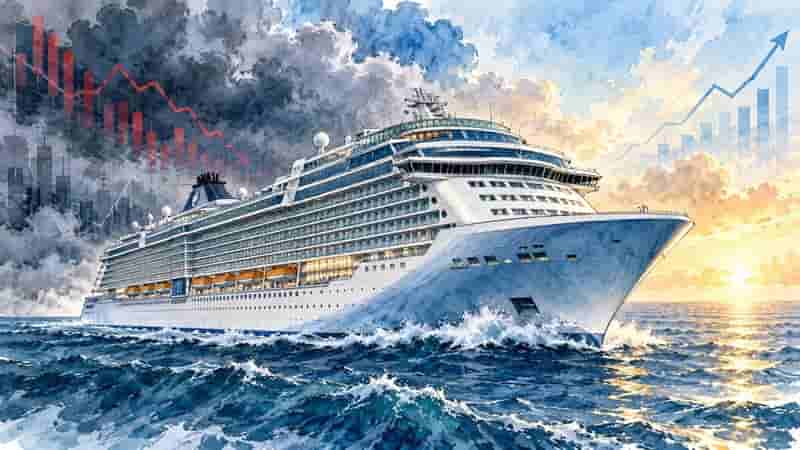
When a cruise company identifies more than US$600 million in annualised savings and cash benefits, it is reasonable to wonder whether the accountants have taken command of the bridge. At Norwegian Cruise Line Holdings (NCLH), the financial officers certainly have plenty to keep them occupied.
But does this formidable efficiency drive mean the company is struggling? The answer is more complicated than the savings figure suggests.
The owner of Norwegian Cruise Line, Oceania Cruises and Regent Seven Seas Cruises has identified another US$100 million in expected annualised benefits, principally through changes to guest and crew air travel arrangements and promotional offers. Together with approximately US$225 million identified during the preceding two quarters, that brings the 2026 total to US$325 million and the cumulative figure to more than US$600 million.
An important distinction: these are identified annualised savings and cash benefits, not US$600 million already removed from the accounts. The latest measures will take effect progressively through 2028 as existing guest bookings run their course.
Profits are real. So are the pressures.
According to NCLH’s third-quarter results, published on 29 October, quarterly revenue reached US$2.9 billion and net profit under US accounting rules was US$491 million, up from US$419 million a year earlier. Adjusted earnings before interest, tax, depreciation and amortisation (EBITDA) reached US$937 million, exceeding management’s forecast.
The company also raised its full-year 2026 adjusted EBITDA guidance to approximately US$2.55 billion. That hardly paints the financial picture of a business with nothing left in the till.
Nevertheless, the warning lights are not imaginary. Third-quarter net yield, a key measure of cruise revenue performance per available capacity day, fell 6.7 per cent in constant currency. NCLH ended September carrying US$15.1 billion in total debt, with net leverage of 5.5 times adjusted EBITDA.
Its bookings for the next 12 months have improved but remain below management’s preferred range. First-half 2027 pricing is ahead of the comparable period last year, although bookings remain behind. Management expects overall net yield to grow 1–2 per cent in 2027, with greater improvement in the second half. That is a forecast, not a guarantee.
Fuel is another uncomfortable passenger. NCLH reported US$196 million in third-quarter fuel costs, while the price per metric tonne after hedging rose to US$819 from US$744 a year earlier. Running a cruise ship has never been cheap; keeping a fleet afloat while protecting margins is another matter altogether.
Where the savings are coming from
Chief executive John Chidsey and outgoing chief financial officer Mark Kempa described a programme covering transport, promotions, sourcing and shore-based operations in the company’s earnings call.
The company expects benefits from offering less subsidised airfare and making crew transport more efficient. NCLH is also examining outsourcing selected shoreside support functions, alongside further sourcing efficiencies and technology use. Those possibilities should not be confused with cuts already completed.
Chidsey is seeking better value from marketing expenditure, using data to identify which channels bring prospective passengers aboard. This does not mean the company previously had no idea where its marketing money went. It is a change in how management intends to spend it.
The commercial plan is not simply to save. Norwegian Cruise Line is preparing a January marketing push aimed at families, built around the idea of “cruise without compromise”: freedom, choice, and hospitality. Its premium ship-within-a-ship offering, The Haven, will feature more prominently, with Chidsey arguing that passengers need reminding it exists.
The company’s investment in Great Tides Waterpark at Great Stirrup Cay also underlines its determination to attract families and generate more revenue from its Caribbean itineraries. Saving money while encouraging guests to spend more is a familiar business ambition, although the execution is rather harder than the presentation slides suggest.
A new hand on the financial wheel
On 1 January 2027, current chief strategy officer Meghan Montana will succeed Mark Kempa as chief financial officer. Kempa, who has served the business for more than 25 years, will remain an adviser until June.
Montana has been involved in the company’s turnaround and global outsourcing work since joining in January 2026. Her appointment reinforces management’s focus on execution, but it does not, by itself, demonstrate financial distress.
Nor does the debt figure tell the entire story. Following October financing arrangements, NCLH estimated pro forma liquidity of US$2.1 billion as at 30 September and said it faced no significant debt maturities until 2029. That provides some breathing room, even if the interest bill remains an unwelcome travelling companion.
So, is Norwegian Cruise Line struggling? It faces weaker yields, a substantial debt burden, and the challenge of filling ships at attractive prices. Yet it is also profitable, has lifted its earnings outlook and is investing in its products and marketing. Both sides matter.
For passengers and travel advisers, the real test will be whether efficiencies improve the business without diminishing the experience people pay for. A leaner operation is sensible. An operation that trims away its appeal is something else entirely.
For now, the accountants have certainly been invited aboard. Whether they can balance the books without taking the fun out of the cruise remains the question worth watching.
By John Alwyn-Jones – © 2026.
Read Time: 4 minutes.
Author Bio:
 John Alwyn-Jones is one of those rare figures who can make the business of travel sound positively adventurous.
A lifelong communicator with the polish of a broadcaster and the curiosity of a journalist, he’s spent decades shaping stories and strategies across tourism, aviation, and the cruise world. He’s led from the front as CEO, director, mentor, and advisor, and still brings warmth and wit to every boardroom and microphone.
Known for his sharp insight into global cruise lines and destinations, John has an old-school belief in professionalism, tempered with the sparkle of someone who’s genuinely seen the world. He’s not just in the travel business; he’s made it an art form.