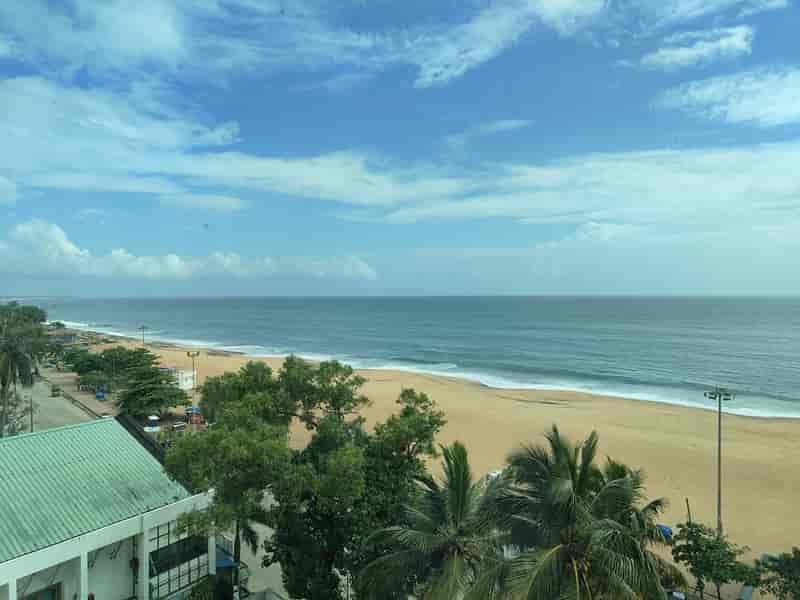
Coastline on one side and the UNESCO World Heritage Site of the Western Ghats on the other are the main characteristics of Keralam. My South Keralam tour along the coastline continued to Varkala after a pleasant experience of divinities, vibrant sunsets, amazing art and craft, an elaborate meal spread, and a peek into an island within the capital city.
We travelled for two hours to arrive at Varkala beach just before sunset. The sun emerged from behind the clouds, but rain was a welcome option after a humid afternoon. Swimming at Varkala Beach was restricted because of rough monsoon tides. We walked up the hill to Sri Janardhana Swami Temple, situated on a nearby hilltop.
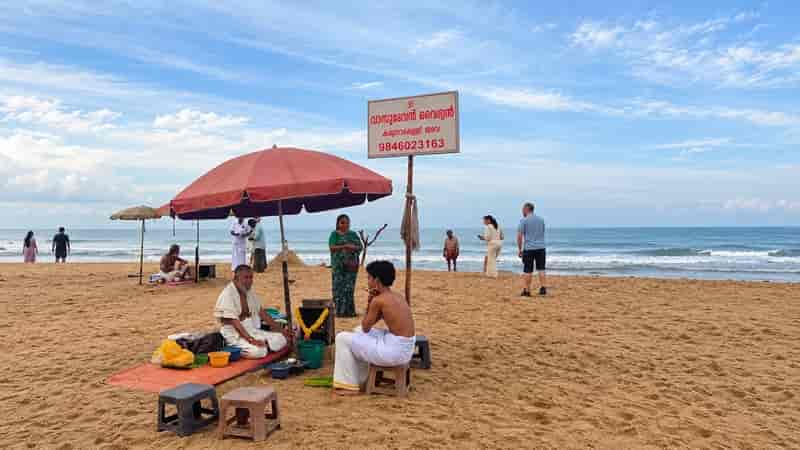
Papanasam Varkala Beach
Another ancient temple of God Vishnu had a different aura, with evening bhajans (prayer songs) and colourful murals on the gopuram (temple tower) shining in twilight. International members in our tour group seized the entry-for-all opportunity to learn about a few more nuances of Indian traditions. Like the young couple tying small cradles to the old cannonball tree, wishing for a baby. “It’s a kind of manifestation”, said guide Philip, “to openly ponder over a wish in a pious atmosphere”.
All rooms at Hindustan Beach Resort had sea views. I woke early to the bustle of beachside activity. The beach at Varkala is known as ‘Papanasam’, the sin-washer. Priests had laid their stalls along the beach path. Families came from across the country to pray for the salvation of departed souls. Many families had gathered at the dedicated big open hall by the beach. They invoked souls with prayers and offerings of rice and black sesame on banana leaves. Crows picked at the offerings. They left lamps and flowers floating on the sea. Fishermen on the other side went about their routine, selling the day’s fresh catch.
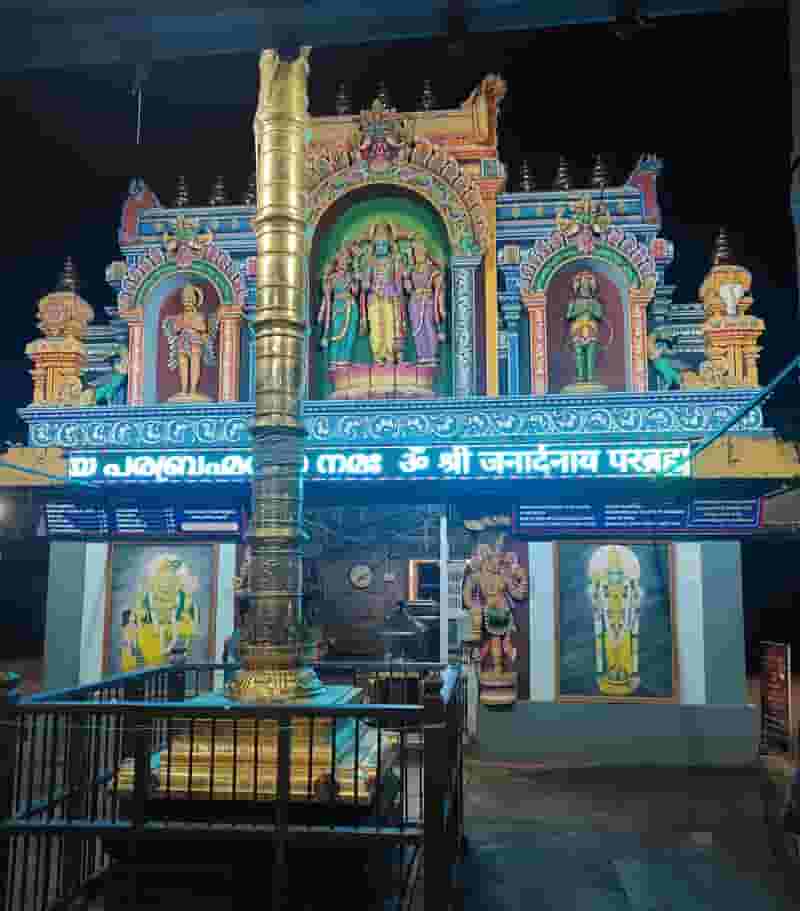
Shri Janardhanaswamy Temple, Varkala
A few yards from Papanasam beach, a cliff dropped straight into the Arabian Sea. On weather-friendly days, you can get a stunning view of the cliff and the coastline on a paragliding ride. Beyond the cliff, the beach has shallow waters and is popular for sunbathing and swimming.
An hour’s drive into the hinterland brought us to Jatayu Earth’s centre, a big, manmade attraction, where we were welcomed with a jasmine garland. The reception area had seating and a food court for guests waiting to board the Swiss-made cable cars that ferry them to the mega bird sculpture covering most of Chadayamangalam hilltop. A pleasant trek to the hilltop through the green, covered Jatayu Nature Park is also available via 826 skillfully etched stone steps.
Several thousand years ago, during the Ramayana, the divine bird Jatayu (vulture) valiantly tried to rescue Sita, wife of King Rama, who was being abducted by the demon Ravana of Lanka. The bird held its breath to pass the information to King Rama before succumbing to a wing injury on this hilltop. The rock-themed nature park dedicated to Jatayu is built as the first Public-Private Partnership (PPP) tourism initiative in the state of Keralam.
The surrounding green valley was a feast for the eyes. The manager at the Centre said: “The amphitheatre alongside Jatayu is let out for cultural presentations, exhibitions and folk performances.” A walk through a memorabilia shop led us to a shrine dedicated to the god Kodanda Rama. The grand Jatayu sculpture itself has five stories, and a museum is being planned within it. “By next year, we’ll have an audio-visual extravaganza using futuristic technology that will immerse visitors into this story of Dwapara yuga (the ancient era).” said the manager.
An adventure centre midway down the hill offers many activities, including jumaring, valley crossing, rappelling, shooting, and a walk across the Burma Bridge. Jatayu is said to have taken refuge in a cave down the hill after its encounter with Ravana. An Ayurvedic and Siddha healing resort is being constructed at that cave. A helicopter ride from within the campus offers a bird’s-eye view of the 65-acre attraction spread across four hills.
Clear sky and bright sun welcomed us to Quilon Beach Resort. Coffee time, with an uninterrupted view of the long beach through the cool room’s protruding floor-to-ceiling glass walls, was incredible. A kathakali performance at the hotel’s convention centre was a bonus. The vibrant dance drama presented a light-comedy episode from the Mahabharata, a popular Indian epic. We also witnessed an elaborate make-up session for the three characters, Bheema, his wife Droupadi, and his brother Hanuman, disguised as an old man.
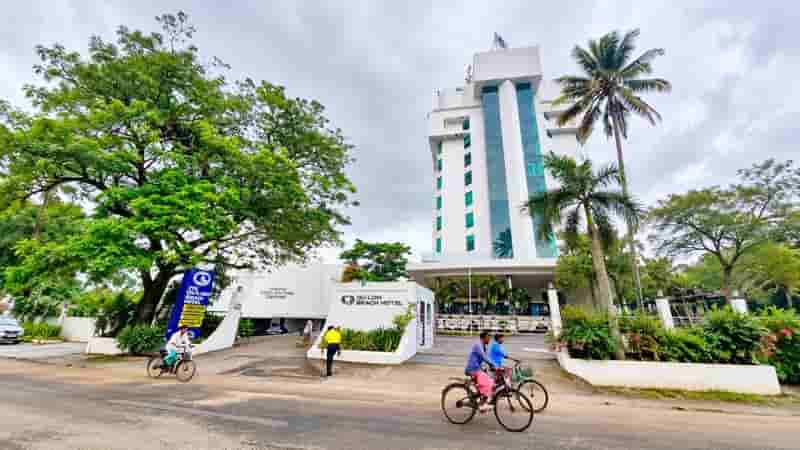
Quilon Beach Resort, Kollam
An early morning walk on the adjacent clean stretch of the beach was refreshing, with views of fishing boats and locals swimming in the sea. Kollam is currently a focus destination for the Keralam government, and Quilon Beach Resort makes an ideal base for exploring many interesting attractions. The city is the starting point for Ashtamudi Lake, a large backwater lake ideal for houseboat cruises and sunset rides. Sambranikodi Island is just 10 kms from Kollam. The Paravur-Muzhiris trail, an ancient spice trade centre, has an interesting museum with many edifices unearthed during excavation. Boats run by the Tourism Department can take you to some attractions along the trail.
Thenmala, India’s first planned eco-tourism destination, lies inside Shendurney Wildlife Sanctuary, 72 kms from Kollam, and offers a half-day excursion to experience tribal culture and shop from local artisans. Trekking trails are available at Rosemala, the scenic hill station near Thenmala.
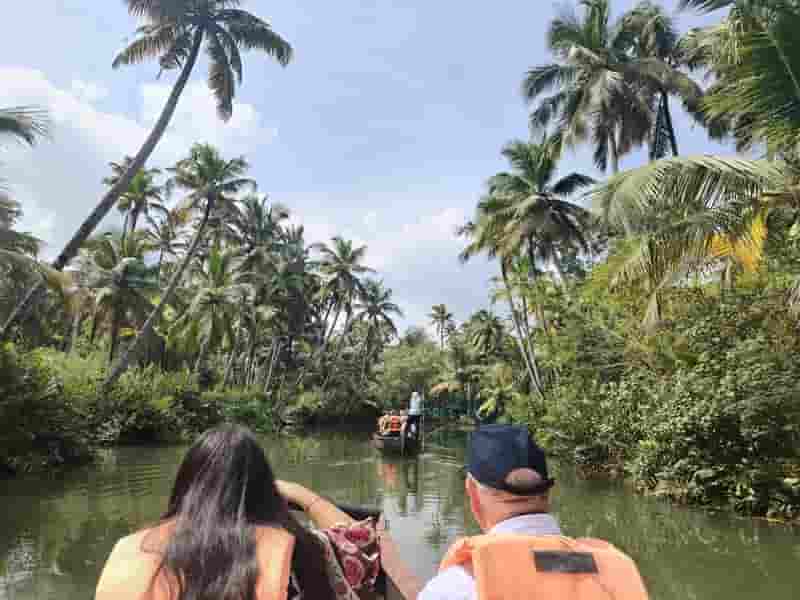
Row boat ride to Munroe Island
After checking out of Quilon Beach Resort, we travelled half an hour to the jetty for a boat trip to nearby Munroe Island. The slow rowboat along the canal offered a peek into the natural lifestyle of people living by the banks. We passed coconut farms, churches, temples, bungalows, and tiled-roof houses, and ducked under many low-lying crossover bridges to avoid banging our heads. Munroe Island came into view with a wide opening dotted and lined with mangroves. At one point, stepping into clear, shallow waters felt cool and fulfilling.
By: Madhura Katti – © 2026.
Read Time: 5 minutes.
Author Bio:
 Madhura Katti didn’t just choose travel; it chose her. Trained in hotel management in Bangalore, she quickly understood that journeys are about people, not places. By the nineties, she was writing on travel and food with a natural authority, later earning a Best Travel Writer award that surprised no one who had read her work.
Storytelling soon moved to film. Her documentary work with Indigenous India captured the spirit of a country in motion and won a National Award for Best Tourism Film.
After years with TTG Asia and Aviation International News, she brought her seasoned judgement to EGT Media, where she now guides coverage across India and South Asia, steady, perceptive, and unmistakably human.