

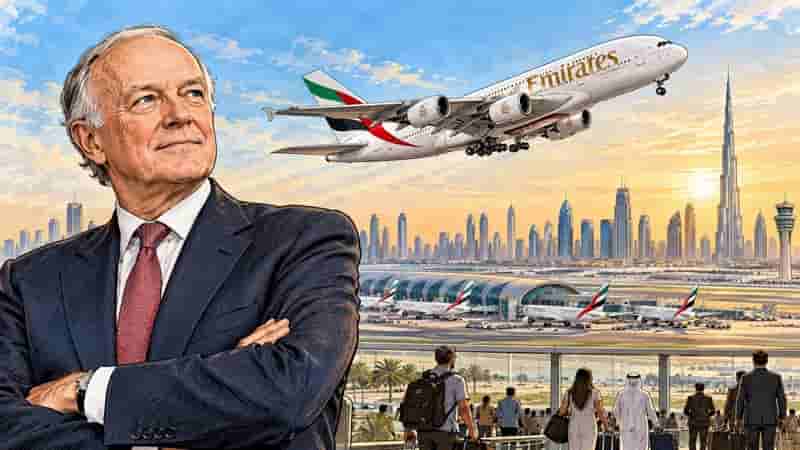
If Sir Tim Clark has learnt one thing from four decades at Emirates, it is that a crisis can ground aircraft, unsettle passengers and send fuel bills soaring, but it rarely extinguishes the desire to travel.
Speaking at Routes World 2026 in Frankfurt on Wednesday, 21 October, the Emirates president predicted a substantial rebound in international travel once the Iran conflict subsides. His assessment comes with an unexpected business detail: despite months of disruption across the Middle East, the Dubai airline reported stronger weekly revenue than in the comparable period last year.
According to Aviation Week’s report of his remarks, Clark said Emirates was operating at about 91 per cent of its capacity before the conflict, which escalated on 28 February. Missile threats, airspace restrictions, diversions and higher operating costs have disrupted the region’s air transport networks, but demand on important parts of Emirates’ global network has held up.
Strong revenue, expensive fuel
Revenue and profit are different. Clark said combined passenger and cargo revenue in the week before the conference exceeded the equivalent week in 2025. That measures continuing demand, not proof that the airline is making more profit on each flight.
Fuel is a particularly unforgiving expense. In Emirates’ financial year ended 31 March 2026, it represented 29 per cent of the airline’s operating costs. More expensive fuel is compounded when aircraft must take longer routes or carry additional reserves because of the security situation.
“Had it not been for the fuel, we would be ahead of last year,” Clark told the Frankfurt audience.
Emirates’ official 2025–26 results provide important context. The airline recorded US$35.7 billion in annual revenue, US$6.2 billion in profit before tax and US$5.4 billion in profit after tax. The wider Emirates Group reported US$6.6 billion in profit before tax. Those full-year results should not be confused with Clark’s more recent weekly revenue comparison.
Why Clark expects travellers to return
Emirates has been familiar with regional uncertainty since its 1985 launch, during the Iran–Iraq War. Clark drew parallels with recoveries after the global financial crisis and the COVID-19 pandemic, arguing that postponed journeys can translate into renewed demand as confidence improves.
“There will be an end to this,” he said. His confidence is a forecast, however, not a guarantee of when the conflict will finish or how quickly travellers will return.
Industry figures show the scale of the challenge. According to IATA’s August 2026 passenger statistics, international demand for Middle Eastern carriers fell 14.2 per cent from August 2025, while capacity fell 9 per cent. Emirates’ resilience therefore sits alongside a much weaker regional picture.
Clark pointed to continuing demand from Asian markets, notably China, and questioned why some European airlines had not restored services to Dubai. His remarks underline the competitive advantage of a carrier able to redirect aircraft and sell connections across a large international network. They do not mean that regional security risks have disappeared.
Safety measures and passenger confidence
Emirates has adapted flight planning as conditions have changed. Clark described operations teams holding or repositioning aircraft and, on some Paris–Dubai services, carrying enough contingency fuel for a return to Paris if entering the region became unsafe. He said the priority was protecting passengers, crews and aircraft rather than minimising the additional fuel bill.
The airline has also tried to address a practical concern among travellers: what happens if a sudden airspace closure leaves them stranded overseas?
In June, Emirates introduced Comprehensive Travel Cover, a paid insurance option in selected markets. The policy offers specified protection for conflict-related medical expenses and other disruptions, subject to its terms. Separately, Emirates has described airline-managed hotel support and rebooking arrangements for affected customers.
The distinction matters for Australians. Australia was not among the countries listed for purchasing the insurance when Emirates announced it in June, although New Zealand was. Travellers should check current eligibility, exclusions and their own policy rather than assume every ticket includes the same protection.
A380s will stay, while Boeing deliveries remain uncertain
The conflict is not the only challenge facing Emirates. Aircraft availability and manufacturer delays continue to influence the carrier’s expansion plans.
TravelMole reported that lengthy engine maintenance has affected seven Airbus A380S, removing valuable seats from service. Emirates nevertheless expects to keep its superjumbos flying into the early 2040s, extending their useful lives while awaiting new wide-body aircraft.
According to Aviation Week’s fleet reporting, Boeing 777-9 deliveries are expected to begin in 2027, subject to certification and production progress. The smaller aircraft will enter the fleet well before the A380’s eventual retirement. Emirates is also interested in a stretched 777-10 because replacing the A380’s capacity isn’t as simple as swapping one aircraft for another.
Meanwhile, the airline is investing heavily in cabins. Its official retrofit update in July confirmed that it had refurbished 100 aircraft under a US$5 billion programme covering 219 A380s and Boeing 777s. The upgrades include Premium Economy seating and improved cabin products, keeping older jets competitive while new deliveries are delayed.
Dubai’s next airport and the longer game
Looking beyond the current conflict, Emirates is preparing for an eventual move to the expanded Al Maktoum International Airport, also known as Dubai World Central. The first major expansion phase is targeted for 2032, with capacity for about 150 million passengers a year; the ultimate development is designed for more than 260 million.
These are planned capacities, not numbers the airport handles today. Dubai Aviation Engineering Projects says the first expanded phase will include 190 contact stands. The timetable for transferring individual airline operations remains a separate question.
Clark also identified opportunities to add services across Africa, the Americas, India and smaller Chinese cities. New aircraft types could allow Emirates to serve destinations where an A380 would be too large. He sees artificial intelligence improving the efficiency of airline operations, although its commercial impact will depend on execution.
For tourism operators, airports and travel advisers, the message is encouraging but not without conditions. Emirates is maintaining a substantial flying programme and investing for future demand. The pace of any post-war revival will still depend on security, reliable airspace access, consumer confidence and the cost of operating flights.
For Australians, those considerations are immediate. As at 25 October 2026, Smartraveller advises a high degree of caution in the United Arab Emirates and advises against travel to Saudi Arabia. The warning for Saudi Arabia specifically includes Riyadh’s King Khalid International Airport following recent security incidents. Travellers should confirm flights and transit arrangements and monitor official advice before departure.
Clark’s long-term argument is simple: people who have postponed travel will want to go somewhere again. Whether that demand becomes the dramatic surge he anticipates remains to be seen. For now, Emirates plans to have the aircraft, network, and seats ready when confidence returns.
By: John Alwyn-Jones – © 2026.
Read Time: 6 minutes.
Author Bio:
 John Alwyn-Jones is one of those rare figures who can make the business of travel sound positively adventurous.
A lifelong communicator with the polish of a broadcaster and the curiosity of a journalist, he’s spent decades shaping stories and strategies across tourism, aviation, and the cruise world. He’s led from the front as CEO, director, mentor, and advisor, and still brings warmth and wit to every boardroom and microphone.
Known for his sharp insight into global cruise lines and destinations, John has an old-school belief in professionalism, tempered with the sparkle of someone who’s genuinely seen the world. He’s not just in the travel business; he’s made it an art form.











