

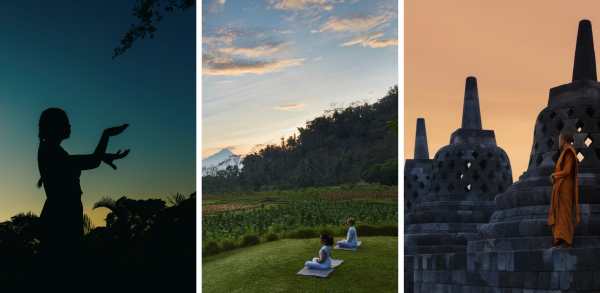
This festive season, Amanjiwo invites guests on a journey inspired by one of Java’s most enduring philosophies: Memayu Hayuning Jiwa, meaning ‘Towards a Harmonious Soul’. Beginning on 31 December, the two-day celebration honours the close relationship between self, community and the natural world, inviting guests to welcome the New Year with renewed intention.
Named ‘Peaceful Soul’ for the serenity of its setting in Central Java’s cultural heartland, Amanjiwo overlooks the 8th-century UNESCO Heritage Site of Borobudur, the world’s largest Buddhist temple. It follows that for generations, moments of transition in the region were marked through ritual rather than spectacle. True to Aman’s philosophy, Amanjiwo’s year-end programme follows this theme, offering a meaningful alternative to contemporary celebrations. Guided by local wisdom and timeless rituals, the Memayu Hayuning Jiwa experience encourages reflection on the year passed, gratitude for the experiences that have shaped us, and space to embrace what lies ahead.
The Five Principles
At the heart of Memayu Hayuning Jiwa are five elemental principles drawn from Javanese philosophy: pertiwi (earth), apah (water), bayu (air), teja (fire) and akasa (space). Each speaks to a different dimension of our relationship with ourselves and the world around us, offering a framework through which to experience the transition from one year to the next. Pertiwi grounds, encouraging connection with the earth beneath us. Apah invites reflection and purification, while bayu fosters connection with others and the wider world. Teja celebrates vitality, transformation and light, before akasa creates space for clarity, possibility and new beginnings. Woven throughout the programme, these guiding principles lead guests through a journey of presence, reflection, connection and release, culminating in a more harmonious relationship with self and surroundings.
The Journey to Soul
At the heart of the experience lies Borobudur, where guests are invited to experience a deeper connection to Java’s cultural and spiritual heritage. As daylight fades across the Kedu Plain, the celebration begins with a return to the rhythms of ancient Java. Arriving at Borobudur by a traditional andong (horse-drawn carriage), guests are invited to leave behind the pace of everyday life and become fully present in the temple’s timeless surroundings. Guided by pertiwi, they reconnect with the land beneath them, before blessings rooted in apah encourage gratitude, reflection and an appreciation for the journey already travelled. A bregada (royal guard) procession leads the way to the welcome cocktail reception, where ceremonial guards in traditional regalia draw on the customs of Java’s royal courts.
As evening deepens, the spirit of bayu comes to life around a shared table, where conversation, storytelling and the flavours of historic Javanese cuisine inspire meaningful connection. Drawing inspiration from the ancient reliefs of Borobudur, the evening celebrates the cultural heritage of Java through traditional performances and culinary traditions that have endured for generations.
Under the energy of teja, candles illuminate the night, gradually revealing Borobudur in shimmering light. Guests are invited to write wishes for the year ahead, while a sacred water blessing led by a Javanese spiritual practitioner draws upon water gathered from nine sacred springs, a ritual of purification long associated with life’s transitions. As midnight approaches, traditional chants offer blessings for peace, prosperity and wellbeing before wishes are entrusted to the fire. The arrival of 2027 is then marked by the resonant strike of a gong, its sound carrying across the night as a symbol of renewal and new beginnings.
With the first dawn of the New Year, the journey turns inward. Guided by akasa, guests gather beside the Progo River for Ruwatan, a traditional Javanese purification ceremony that invites the release of what no longer serves the soul. The experience culminates with a Bhakti Bumi ritual, as offerings are returned to nature and fish are released into the flowing river, honouring the connection between personal harmony and the wider world.
What begins as a celebration of Java’s enduring traditions ultimately becomes a journey of renewal. Through ritual, reflection and connection, guests are invited to restore harmony within, cultivate gratitude for the path travelled and embrace the possibilities of the year ahead.











