
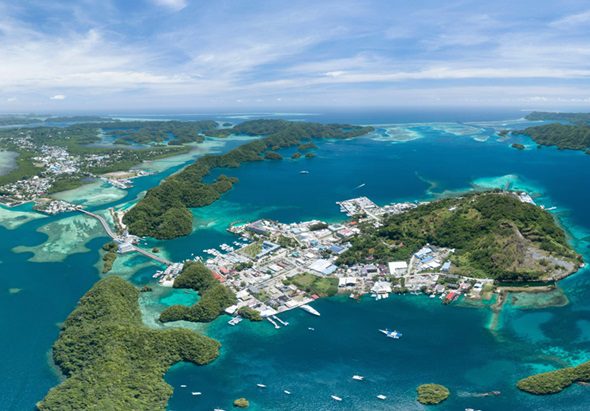
Six hours from Brisbane lies a spectacular island nation with world-class diving, luxury resorts and more natural beauty than most destinations could reasonably ask for. Qantas is adding flights, Australians are beginning to arrive, and Palau is finally making itself heard. So why has the travel industry been so slow to put it on the map?
Few things are more comforting to an Australian travel agent than a customer who walks through the door and asks for a week in Fiji.
The flights are familiar, the resorts are well established, the brochures practically sell themselves and, barring the occasional tropical downpour, everyone knows what they’re getting.
Bali is much the same, although with considerably more traffic, an astonishing number of villas and enough restaurants to keep even the most dedicated foodie occupied until their passport expires.
The Cook Islands have their admirers. Vanuatu offers a pleasing mixture of adventure and island charm.
And then there’s Palau.
Palau?
Exactly.
For all its extraordinary natural attractions, this small island nation in the western Pacific has somehow remained a relative stranger to the Australian holiday market.
That’s remarkable, given what it offers.
Hundreds of jungle-covered limestone islands rising from impossibly blue water. Coral reefs that attract divers from around the world. Luxury accommodation, fascinating wartime history, a proud island culture and an environmental conscience that puts many larger destinations to shame.
And, increasingly, a direct flight from Brisbane.
The ingredients are there. The question is whether Australia’s travel industry has noticed.
Six hours to paradise. Why the long introduction?
For years, Palau’s biggest problem was geography.
Not where it was, precisely, but how on earth Australians were supposed to get there without spending an unreasonable amount of their holiday sitting in an airport lounge.
A destination can possess the world’s most beautiful lagoon, but that becomes considerably less persuasive when the journey requires two connections and a lengthy acquaintance with an international transit terminal.
Qantas changed the equation in December 2024 when it began operating the Palau Paradise Express between Brisbane and Koror.
The nonstop flight takes approximately six hours.
That is hardly an expedition into the unknown. Australians routinely spend longer getting to parts of Asia, and sometimes considerably longer negotiating the traffic after they arrive.
The route is now getting another boost.
The Australian Government announced in September 2026 that the service would continue until 30 November 2027, with Qantas planning a second weekly return flight during the coming peak season.
The additional service is scheduled to begin on 2 December 2026 and continue through March 2027.
Australia’s International Air Services Commission subsequently allocated Qantas an additional 168 seats of weekly capacity.
The planned Wednesday and Saturday departures from Brisbane, with return services from Koror on Thursdays and Sundays, should allow travellers to arrange shorter holidays rather than remain tied to the original weekly pattern.
It is a modest change by the standards of the world’s busiest air routes.
For Palau, it could be rather important.
A second weekly flight does not turn the destination into Bali overnight. Nor does it provide the range of convenient departures Fiji offers.
But it gives Australian travel advisers something they previously lacked: greater flexibility.
In the holiday business, flexibility can make the difference between an interesting suggestion and a confirmed booking.
The Australians are coming. Quietly.
Palau is not about to be overwhelmed by Australian holidaymakers.
The visitor statistics make that clear.
Official figures recorded 2,831 Australian arrivals between January and August 2026.
A separate fiscal-year series recorded 2,420 Australian arrivals in FY2025. Because the periods differ, they cannot be used to calculate a straightforward annual growth rate.
Nevertheless, the figures show that Australia is already an identifiable source market for a destination that remains largely unfamiliar to mainstream Australian travellers.
According to the Australian Government, more than 15,400 passengers have travelled on the Qantas-operated Palau Paradise Express since it began in December 2024.
That number includes passengers on the route, not just Australian holidaymakers.
The Government also estimates that the service contributed $10 million to Palau’s economy in 2025 and helped lift total visitor expenditure by 26 per cent.
For a small island economy, those are meaningful developments.
For Australian travel advisers, they suggest a market worth investigating before everyone else discovers it.
It is a delicious irony to promote an unspoilt destination by encouraging more people to visit.
Palau understands that contradiction better than most.
Bali sells convenience. Fiji sells familiarity. Palau sells wonder.
Tourism marketing tempts us to describe every promising destination as the next Bali.
It is usually a dreadful idea.
Bali is Bali because it has spent decades building an enormous visitor economy, complete with international hotels, inexpensive villas, restaurants, nightlife, shopping, spas, and enough motorbikes to suggest someone has been breeding them.
Fiji is equally accomplished at what it does. Its resorts understand Australian families, its hospitality is deservedly celebrated and its established air connections make booking a holiday relatively painless.
The Cook Islands have perfected the art of slowing life down, while Vanuatu combines island hospitality with adventure, culture and the occasional reminder that the Earth remains geologically restless.
Palau has no particular reason to imitate any of them.
Indeed, its best chance of succeeding in the Australian market may be to resist the temptation.
This is not a destination built around endless shopping, celebrity restaurants or the latest fashionable beach club.
It is a country where the most spectacular attractions are largely underwater, where the islands themselves are works of geological extravagance and where visitors are expected to respect the environment rather than merely admire it.
For a traveller who has already done Bali three times and Fiji twice, that difference could be worth a great deal.
And for an experienced travel adviser, it is the beginning of a proper conversation.
Not, “Would you like the garden-view room or the ocean-view room?”
But, “Have you ever considered somewhere quite unlike anywhere you’ve been before?”
The Rock Islands: nature showing off shamelessly
Some places look magnificent in photographs and disappoint slightly in person.
The Rock Islands of Palau have the opposite problem.
Photographs struggle to explain them.
Hundreds of limestone islands rise from the water in shades of blue and green that would have a paint manufacturer reaching for the colour chart.
Their jungle-covered tops appear to balance on narrow limestone bases, shaped by centuries of erosion. Between them lie sheltered lagoons, coral gardens, beaches and waterways that seem designed for exploration.
The Rock Islands Southern Lagoon became a UNESCO World Heritage Site in 2012.
Covering about 100,200 hectares and home to 445 uninhabited limestone islands, the area is recognised for its natural and cultural significance.
UNESCO records more than 385 coral species in its marine habitats.
Those figures are impressive, but statistics are poor substitutes for travelling through the islands by boat.
One moment there is open water. The next, a narrow passage leads into a sheltered lagoon surrounded by towering green cliffs.
You can snorkel, explore coves, and watch sandbars appear almost theatrically from the sea.
For Australians used to the familiar beach-resort routine, the Rock Islands offer something quite different.
The hotel is where you sleep.
The destination is what you came to see.
The fish have the best accommodation
Palau’s reputation among serious divers is no recent invention.
Long before Australian holidaymakers began considering the destination, international diving enthusiasts were making their way to its reefs, walls and channels.
Blue Corner is among the best-known, attracting experienced divers with the prospect of reef sharks, large schools of fish, and dramatic underwater scenery.
German Channel is celebrated for manta ray encounters, while other sites offer coral formations, wrecks and a remarkable variety of marine life.
It is the sort of place where a diver might surface with a grin so broad that further explanation seems unnecessary.
However, there is a sensible qualification.
Some of Palau’s most famous diving locations have strong currents and demanding conditions. They are not playgrounds for the inexperienced.
Reputable operators, appropriate qualifications and proper planning are essential.
Fortunately, visitors do not need a scuba qualification to appreciate Palau.
Snorkelling can be exceptional, and boat excursions allow non-divers to enjoy the extraordinary scenery above the surface.
Then there is Jellyfish Lake, one of the country’s most unusual attractions.
Here, visitors may snorkel among golden jellyfish, subject to conservation restrictions and local conditions.
Scuba diving is prohibited, and visitors need the appropriate permit.
The Palau Visitors Authority has published a combined Rock Islands and Jellyfish Lake permit costing US$100 and valid for ten days. Advisers should confirm current charges and access before promising clients the experience.
Remember that Palau is not an aquarium.
Marine life does not appear on command, and environmental conditions can affect access to attractions.
That uncertainty is part of visiting a genuine natural environment.
The alternative, of course, would be to put the fish on a timetable.
One suspects they would object.
Luxury without the travelling circus
Palau’s accommodation industry is another area where Australian travel advisers may need to revise their assumptions.
It is not simply a destination for divers sleeping in basic rooms and rising before dawn to inspect the local reef.
There is genuine luxury here.
Palau Pacific Resort, one of the country’s established premium properties, offers beachfront accommodation, tropical gardens and resort facilities in a setting where relaxation requires remarkably little effort.
Its Pristine Villas and Bungalows include overwater bungalows, lagoon-view pool villas and pond-view pool villas.
For honeymooners or couples celebrating an important anniversary, this provides a distinctive alternative to more familiar island resorts.
Palau Royal Resort and Cove Resort Palau offer further resort choices, while Palau Central Hotel provides a convenient base for visitors who prefer to stay close to Koror’s services.
Smaller hotels, guesthouses and specialist dive accommodation expand the range, and dedicated divers can investigate liveaboard options.
But one point should be made before anyone starts promising clients the Pacific equivalent of Bali’s hotel industry.
Palau has nothing like Bali’s accommodation inventory.
Nor does it offer Fiji’s extensive network of established family resorts.
Its luxury properties are relatively few, and travellers seeking a particular standard or room category should book well in advance.
Holidays are also experienced differently.
In Fiji, many visitors are perfectly happy to spend a week within sight of the resort pool.
In Palau, doing so would seem like an expensive way to miss the point.
Much of the destination’s appeal lies beyond the hotel gates, usually involving boats, guides, marine permits and organised excursions.
That has implications for cost.
The room rate is only part of the holiday.
And while nobody should pretend Palau is necessarily a bargain compared with Bali, its appeal to the right traveller isn’t about finding the cheapest bed.
It is founded on finding an experience worth travelling for.
An island nation that expects visitors to behave
Tourism destinations have become remarkably skilled at talking about sustainability.
Green logos, environmental pledges, earnest brochures, and hotel notices explain that washing fewer towels may help save the planet.
Palau has taken it a step further.
In 2017, the country introduced the Palau Pledge, an initiative asking visitors to respect the nation’s natural environment and cultural heritage.
The message is not especially complicated.
Enjoy the islands, but do not ruin them.
Palau also restricts sunscreens containing certain chemicals considered harmful to coral reefs.
For travellers used to packing whatever’s on special at the chemist, that’s worth knowing before departure.
The country’s conservation approach provides a genuine point of difference, particularly for Australians increasingly interested in nature-based travel.
But it also raises an uncomfortable question.
Can a destination promote tourism growth while protecting the fragile environments that attract visitors in the first place?
More flights mean more visitors. More visitors mean greater economic opportunities for local businesses, but also more pressure on infrastructure, reefs, waste management and natural resources.
UNESCO has identified tourism management as an important consideration for the Rock Islands Southern Lagoon.
Palau’s challenge, therefore, is not simply to attract Australians.
It is to attract visitors who appreciate what makes the destination special and are prepared to help preserve it.
That is a more complicated proposition than selling another week beside a swimming pool.
It is also more worthwhile.
Peleliu: where the holiday takes a sobering turn
Palau offers more than coral reefs and attractive accommodation.
The islands have a rich cultural heritage, with traditional meeting houses, local customs and communities whose history extends far beyond the arrival of modern tourism.
Babeldaob, the country’s largest island, offers opportunities to explore landscapes, villages and cultural sites.
Traditional bai meeting houses, with their distinctive architecture and decorative designs, provide an introduction to Palauan cultural traditions.
Then there is Peleliu.
For visitors interested in military history, this small island offers an experience far removed from the usual tropical holiday.
Peleliu was the scene of exceptionally fierce fighting between American and Japanese forces during the Second World War.
Battlefield remains, memorials, and historical sites remind visitors of a Pacific conflict with an immense human cost.
A guided visit can be deeply moving.
Don’t treat it as another convenient item on a sightseeing checklist.
Rather, it offers perspective.
The same Pacific islands that today attract travellers seeking peace and beauty were once places of extraordinary violence and suffering.
That contrast gives Palau a historical depth that many visitors may not expect.
It also gives advisers another reason to look beyond the obvious marine attractions when designing itineraries.
Who should actually go?
Here is where the sales pitch needs a little discipline.
Palau is not for everybody.
It would be a poor recommendation for a family whose ideal holiday involves an inexpensive all-inclusive resort, a large children’s club and enough organised entertainment to keep the youngsters occupied from breakfast until bedtime.
Nor is it likely to satisfy someone whose primary interests are shopping, nightlife, and discovering ever-cheaper cocktails.
Bali and Fiji already serve those markets exceptionally well.
Palau’s strongest prospects lie elsewhere.
Consider the well-travelled couple who have visited Fiji several times, explored Bali extensively, and are beginning to wonder whether anything genuinely new remains in the Pacific.
Or the experienced diver who has long wanted to explore Palau’s celebrated marine sites but previously found the journey inconvenient.
Then there are photographers, nature enthusiasts, honeymooners, active older travellers and people who would rather return home with an extraordinary story than another shopping bag.
These are clients for whom Palau may offer something genuinely compelling.
The premium leisure market is particularly interesting.
A couple prepared to spend more for memorable accommodation, private excursions and unusual experiences may find Palau an appealing alternative to established luxury destinations.
But advisers must understand the product.
Some excursions involve boarding small boats, swimming, walking over uneven ground or spending extended periods outdoors.
Mobility, fitness, medical considerations and individual preferences all matter.
A good adviser should never confuse an attractive photograph with a suitable holiday.
That distinction has always separated professional travel advice from merely selling travel.
Seven nights, and not a shopping mall in sight
The obvious question is what visitors should actually do once they arrive.
Seven nights would provide a sensible introduction.
You have time to explore the Rock Islands, enjoy several marine excursions, visit cultural attractions, and spend a day discovering the country’s wartime history.
Qualified divers can arrange excursions suited to their experience, while non-divers can explore lagoons, snorkel, kayak or simply enjoy the scenery.
A visit to Babeldaob adds a cultural dimension.
Peleliu provides a historical one.
And a day or two at the resort is hardly an unreasonable indulgence when the surroundings are so attractive.
Don’t pack the itinerary too tightly.
Weather and sea conditions can influence boat excursions, while certain marine attractions are subject to conservation rules.
Divers must also allow appropriate time between their final dive and flying.
The additional Qantas service, scheduled to operate twice weekly during the peak season, should create opportunities for shorter stays.
But there is an argument for not rushing.
A four-night holiday might provide an excellent introduction.
Seven nights allows visitors to discover why Palau has such a devoted following among those who know it.
The small print before the big adventure
Palau is easy to visit, but it rewards preparation.
Australian passport holders can obtain a visitor visa on arrival for up to 30 days, subject to the relevant entry conditions.
Travellers need a return or onward ticket and a passport valid for at least six months.
They must complete the official free Palau Entry Form within 72 hours before arrival and retain the resulting QR code.
Palau uses the US dollar, so exchange rates matter when calculating the total holiday cost.
Arrange airport transfers in advance because public transport and taxi options at Palau International Airport are limited.
Australia’s Smartraveller advice recommends exercising normal safety precautions in Palau, while also highlighting health considerations, including an increase in tuberculosis cases.
Comprehensive travel insurance is important, particularly for diving and specialist marine activities.
And travellers connecting through Guam or other US territories should check the relevant transit and entry requirements.
None of this is especially alarming.
But it does reinforce why a knowledgeable travel adviser can be valuable.
A Palau holiday is not simply a matter of choosing a hotel and hoping everything else falls into place.
The best experience comes from planning.
Australia’s wholesalers have an opportunity. Will they take it?
A commercial question lurks beneath all this tropical splendour.
If Palau is so attractive, why is it not a more prominent feature of the Australian travel market?
Part of the answer is obvious.
Limited air access has historically made the destination harder to package.
Part is probably familiarity.
Australian travel advisers know Fiji. They know Bali. They know the resorts, airlines, wholesalers, and holiday products their customers expect.
Palau requires a little more work.
Advisers need to understand the geography, accommodation, excursions, conservation rules, and the type of traveller most likely to appreciate the destination.
That takes product education.
It also takes wholesalers prepared to develop sensible packages rather than simply offer an airfare and leave travellers to work out the rest.
The opportunity is not necessarily to compete with Bali on price.
It is to create attractive, well-organised holidays that combine flights, accommodation, transfers and experiences.
Premium couples, divers, nature enthusiasts and repeat Pacific travellers could all be promising markets.
However, the commercial argument needs evidence.
Which Australian wholesalers currently offer comprehensive Palau packages? What commissions are available to retail advisers? How do seven-night packages compare with equivalent holidays in Fiji, Bali and the Cook Islands?
Those questions deserve proper answers before anyone starts predicting a tourism boom.
The additional Qantas flights improve the opportunity.
They do not guarantee demand.
The difference between an interesting destination and a commercially successful one is often the travel trade’s ability to turn curiosity into bookings.
Perhaps paradise has been hiding in plain sight
The travel industry tends to chase the next big thing.
Sometimes it is a newly opened resort. Sometimes an airline route. Occasionally it is a destination that has been around for centuries but has only recently acquired the attention of a marketing department.
Palau is a little different.
Its greatest attractions have always been there.
The Rock Islands do not need renovating.
The reefs don’t need a celebrity endorsement.
The lagoons aren’t waiting for someone to invent a new name for turquoise.
What Palau needs is better access, greater awareness, and an Australian travel industry prepared to look beyond the familiar.
The first of those is improving.
The second is beginning to happen.
The third remains an opportunity.
No one suggests Australians should abandon Fiji, forget Bali, or stop visiting the Cook Islands and Vanuatu.
Those destinations have earned their popularity.
But travel, at its best, is not simply repeating a successful previous holiday.
It is discovering somewhere that reminds us why we started travelling in the first place.
Palau has the ingredients to do precisely that.
Six hours from Brisbane, a remarkable Pacific island nation awaits a better understanding.
The flights are improving. The scenery is extraordinary. The accommodation is there for those prepared to seek it out.
Perhaps it is time the Australian travel industry stopped asking whether Palau can compete with Bali and Fiji.
A better question might be whether it has the imagination to sell something different.
After all, the world is a rather large place. It would be a shame if Australians spent every holiday going back to the same swimming pool.
By: Karuna Johnson – © 2026.
Read Time: 17 minutes.
Author Bio:
 Karuna Johnson’s career only makes sense if you know she truly loves travel. Thai by birth and a dual citizen, she moves easily between worlds, equally at home sharing street food in Bangkok or sitting quietly through a Sydney boardroom meeting.
Educated in both Thailand and Australia, she speaks several languages and has applied them across destination management companies and hotels, spanning sales and administration. She’s the sort who keeps things running smoothly while others are still waking up.
Her journeys have taken her across Asia, Europe, and the United States, but it’s the smaller details that stay with her: people, customs, and the stories beneath every trip.
Worldly without being showy, Karuna brings a steady, thoughtful voice to Stephen’s EGT Media, exactly what travel needs.