

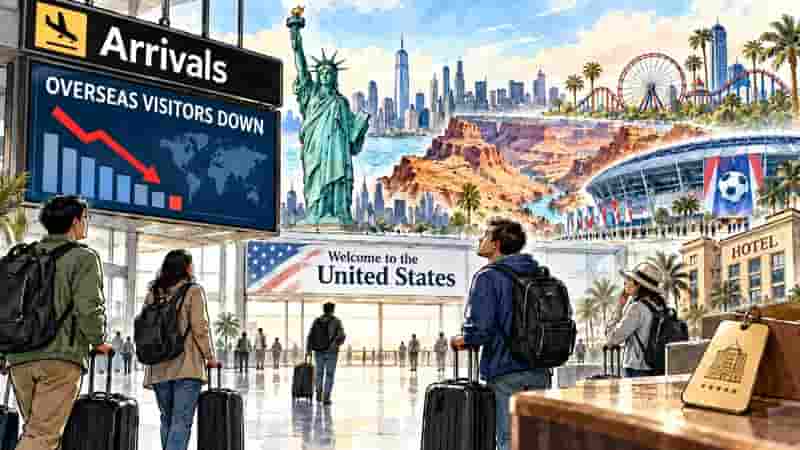
America’s famous attractions still draw crowds, but softer overseas arrivals, wary Canadians and a multibillion-dollar spending gap are testing the world’s biggest travel market.
America has never lacked reasons to visit. It offers New York’s bright lights, California’s beaches, Florida’s theme parks and national parks that make even a seasoned traveller feel small. Yet the world’s largest tourism market is finding that a famous name does not always fill an aircraft.
Overseas visitors are arriving in fewer numbers. European demand has weakened. Many Canadians are still taking fewer trips south than they did two years ago. And although the 2026 FIFA World Cup brought welcome business to hotels, it could not solve the wider problem.
The world has not misplaced its passport. It has more places than ever to use it.
A giant market, but fewer visitors from abroad
Research published on 21 September by Tourism Economics found that overseas arrivals to the United States fell 5.8 per cent in the eight months to August 2026, compared with the same period in 2025. Arrivals from Western Europe were down 8.8 per cent.
That is worrying for destinations that depend on long-haul guests. These visitors often stay for days or weeks. They book hotels, hire cars, visit attractions and eat out. A missing holidaymaker means lost business far beyond the airport gate.
However, it would be wrong to say all US tourism is in decline. The World Travel & Tourism Council (WTTC) says travel and tourism added US$2.63 trillion to the American economy in 2025 and supported 20.4 million jobs. Domestic visitor spending reached US$1.54 trillion.
That is an industry with serious muscle. The weakness lies chiefly in its struggle to win a fair share of the world’s growing international travel market.
WTTC reports that total international visitor numbers fell 5.5 per cent in 2025, even as about 80 million more people travelled internationally. Its estimate of international visitor spending in the US fell 4.6 per cent to US$176 billion.
There is the uncomfortable contrast. Global demand grew, but America did not capture enough of it.
The figures tell two different stories
Tourism numbers can be tricky. In official US data, overseas arrivals exclude Canada and Mexico. Total international arrivals include both countries. That is more than a technical detail. It can change the headline.
In July 2026, the US National Travel and Tourism Office (NTTO) counted 6.25 million international arrivals, just 0.1 per cent below July 2025. It sounds almost steady.
Look closer. Overseas arrivals fell 7 per cent in the same month. Canadian arrivals rose 7.6 per cent, while Mexican arrivals increased 8 per cent. Stronger traffic from America’s neighbours helped offset weakness from more distant markets.
This is why broad claims about a complete US tourism collapse miss the mark. The real picture is uneven. A destination popular with Mexican visitors may be doing well. A northern border town, or a city that depends on European holidays, may tell a very different story.
The price of losing market share
Tourism Economics has put a large figure on the lost opportunity: US$39.6 billion.
The research group estimates that America will forgo that amount in inbound visitor spending across 2025 and 2026, compared with what it might have earned if it had kept its 2024 share of global international travel spending.
It is vital to understand what this means. The figure estimates a hypothetical benchmark, not a recorded US$39.6 billion fall in tourism receipts. It measures the business America could have won, rather than cash that has vanished from its bank account.
Even so, the scale matters. Tourism supports hotel staff, restaurant owners, tour guides, retailers, transport firms and many other jobs. When travellers spend their holidays elsewhere, those businesses may miss out.
Government spending data add useful context. The NTTO says international visitors spent about US$20.4 billion on US travel and tourism-related goods and services in July 2026, down nearly 1 per cent from a year earlier. Spending for January to July was estimated at US$145.4 billion, broadly unchanged.
These government figures are not directly comparable with WTTC’s US$176 billion estimate for 2025. For that year, the NTTO reported more than US$250.2 billion in broader travel and tourism export receipts. Those accounts include international passenger fares, education, medical travel and certain short-term worker spending. WTTC uses a different visitor-spending framework. Readers should not mistake the difference between those totals for a sudden surge or collapse.
The point is simpler: the US remains a giant travel market, yet it can earn much more from foreign guests.
Canada’s cool response is only partly thawing
Canada has long been a valuable source of visitors for American resorts, shops and border communities. When that traffic weakens, the pain hits quickly.
Tourism Economics estimates that Canadian visits to US states fell 21.8 per cent in 2025, with some northern border states hit hard. Politics and public sentiment have shaped the debate. So have the exchange rate, travel costs and the ease of making a trip.
Signs point to a modest recovery. Statistics Canada reported that Canadian residents made 6.8 per cent more return trips from the US by air and car in September 2026 than a year earlier.
But compare those trips with September 2024 and the picture changes. Canadian car returns from the US were still 31.1 per cent lower, while air returns were 18.7 per cent lower.
Those figures are preliminary. Statistics Canada also warns that changes to the way NEXUS highway travellers are counted may affect comparisons with earlier years. The clear message is not that Canadians have stopped visiting; it is that the market has not returned to its former strength.
For tourism businesses near the border, that difference is hardly academic. A customer who once drove over for a weekend is hard to replace with a visitor flying in from halfway around the world.
Europe retreats as other markets grow
The overseas decline also hides some bright spots. While Western European arrivals fell 8.8 per cent through August, Tourism Economics reports that arrivals from South America rose 3.8 per cent over the same period.
Mexican arrivals grew 14.6 per cent in the six months to June, according to the research group. The dates matter here: these figures cover different reporting periods and should not be read as a single monthly ranking.
For US destinations, the lesson is clear. Marketing to everyone in the same way will not work. Different travellers face different costs, flight choices and reasons for taking a holiday.
Airlines, airports, and hotels need to understand which routes and source markets remain strong. A hotel can only sell a room once. If its usual guests are staying away, a bold advertisement alone will not make up the shortfall.
A World Cup win but no magic cure
The 2026 FIFA World Cup offered the United States a rare chance to show itself off to a vast global audience. Football fans arrived, crowds filled stadiums, and hotels enjoyed a lift.
According to Tourism Economics’ September World Cup study, hotels in US host markets earned an estimated US$634 million in extra room revenue on and around match dates. On US match dates, room revenue in host markets rose 36.3 per cent from the previous year, largely driven by higher room prices.
Yet the arrivals figures deserve equal attention. In June and July, overseas visitors from countries playing in the tournament fell only 1.1 per cent year on year. Arrivals from countries not taking part dropped 8.9 per cent.
The tournament clearly helped. It did not reverse the broader weakness.
A full stadium is wonderful for business. But a few weeks of football cannot fill every hotel room for the rest of the year. Tourism needs steady demand, not just a spectacular final whistle.
Is America still making visitors feel welcome?
The United States has lost none of its natural appeal. The Grand Canyon remains grand. Broadway has not forgotten how to put on a show. And the country’s many cities, parks and small towns still offer superb holidays.
But the journey matters as much as the destination.
Tourism Economics has identified negative travel sentiment, uncertainty around border and immigration rules, a strong US dollar, and broader economic pressures as barriers to growth. It has also linked some sentiment shifts to Trump administration policies and statements.
That does not prove why any one traveller changed plans. Some are worried about cost. Others have different priorities. Many still want to visit. The sensible conclusion is that the US faces a mix of challenges, not one simple cause.
There is also a practical cost. Eligible Australians using the Visa Waiver Program usually need an approved Electronic System for Travel Authorisation (ESTA) before departure. Under a US government notice, the fee for an approved ESTA rose to US$40.62 on 16 October 2026. Travellers should use the official ESTA website and check the latest rules.
Marketing is another concern. The US Travel Association says the maximum annual federal matching contribution available to Brand USA, the national tourism marketing body, was cut from US$100 million to US$20 million. The association has called for that support to be restored.
At a time when other countries are competing hard for visitors, America risks turning down the volume on its own invitation.
What Australian travel businesses should tell clients
For Australian travellers, none of this means the United States should be crossed off the holiday list. It remains a fine destination for city breaks, road trips, skiing, national parks, family holidays and major events.
But good advice counts. Travel agents should explain entry rules, check air connections, review travel insurance and give clients a sound estimate of the full trip cost. Currency movements can matter just as much as an airfare sale.
Australians should also consult Smartraveller’s US advice before booking and again before leaving. The Australian Government currently advises travellers to exercise normal safety precautions in the United States, while remaining alert to local risks and changes in entry conditions.
For the trade, the opportunity is to sell America on what it does best, not on vague promises. A great rail journey, a national park holiday or a carefully planned family itinerary can still be compelling value. Travellers simply need to know what they are buying.
Recovery is possible, but not automatic
Official forecasts offer reasons for hope. The NTTO projects 70.5 million total international visits in 2026, up 3.2 per cent from 2025. The US Travel Association forecasts a similar 70.6 million, but does not expect visitor numbers to return to 2019 levels until 2029.
These remain forecasts, not final arrival counts. And growth in the overall total will not, by itself, solve weakness in some overseas markets.
America still has the sights, the stories and the skills to win travellers back. It needs a clear offer: simple planning, fair value, reliable entry rules, and a welcome that feels genuine.
The Statue of Liberty has kept her torch aloft for well over a century. The harder task now is making sure the world still wants to follow the light.
By: Jason Smith – © 2026.
Read Time: 9 minutes.
Author Bio:
 Jason Smith didn’t learn travel from textbooks. He learned it in airports, taxis and hotel lobbies, watching the business unfold long before he played his own part. Half American, half Asian, he grew up around the quiet workings of tourism, where people come and go, and stories rarely stand still.
Bangkok came first, then formal study, then a career that carried him through Singapore, Malaysia and Vietnam. Each place left something behind. In the end, Thailand felt like home, along with a senior role in hotel sales.
Then everything stopped. Borders shut, planes grounded, and Jason found himself back in America with time to reflect.
Now, at Stephen’s EGT Media, he writes travel as it really is, not polished or perfect, but human, and all the better for it.











