

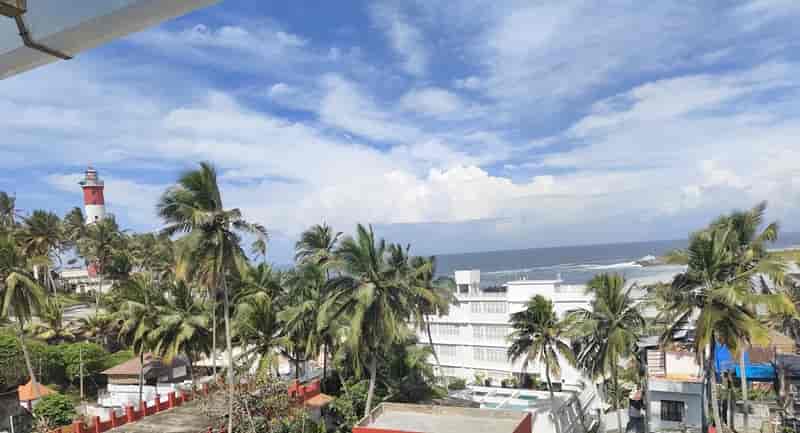
Southern Keralam, with capital Thiruvananthapuram, is less busy than Kochi, its commercial hub, and has its own charm, with its unique estuary, long beaches, nature, history, culture, traditions, and, of course, Ayurveda. A pre-KTM26 Fam tour was an indulgence in its quiet beauty and attractions, including the mega manmade Jatayu Centre, which presents ancient history with futuristic technology.
South Keralam tour part I: Temple, Cave, Leaf, Craft, Cliff and Island, all in Keralam’s capital
Thiruvananthapuram is not a city you finish. You circle it. Ancient, rich Padmanabhaswamy Temple; a sumptuous spread on a banana leaf; a 58-foot Shiva on a cliff; a craft village where mirrors are made of metal; a calming sunset by the beach; and a floating cottage where the river forgets to meet the sea. Here is how I did it in two days, all within 60 km, with no rush.
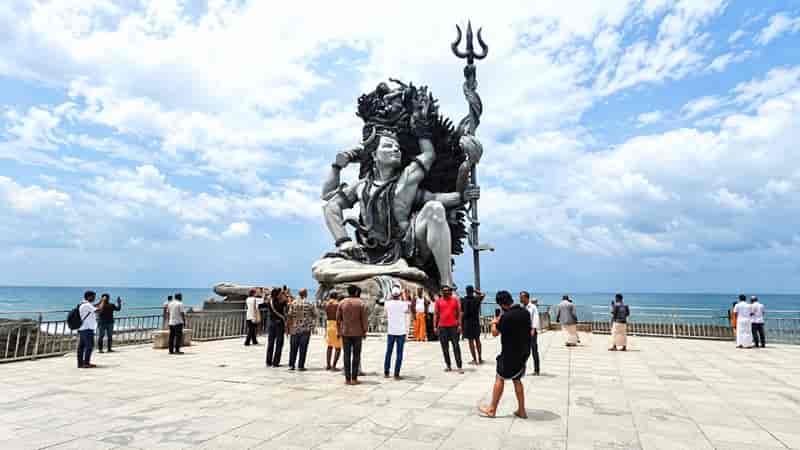
Shiva Seaside Monument Plaza
I woke early for a personal visit to Shree Anantha Padmanabhaswamy Temple, which gave its name to Thiruvananthapuram, the state capital of Keralam. ‘Thiru’ is a revered address for ‘Ananta’ (the lying position of God Vishnu), and ‘Puram’ means town. Morning smells of Jasmine and oil drift through the fort walls, leading me to the temple. At the gate, they stop visitors wearing shorts, jeans, or pants. I rented a mundu, a white wraparound with a gold border. No phones inside, gladly. I walked barefoot on cold stone, inhaling a mixture of jasmine and lamp smoke, and then encountered the lord through three doors, face in one, body in the next, feet in the third. Shree Padmanabhaswamy, reclining on a divine serpent, massive, black. It’s a rare ancient temple in India where all three major deities- God Vishnu, known here as Ananta, holding a lingam representing God Shiva, and the creator God Brahma seated on a lotus flower rising from Vishnu’s naval- are depicted within one sanctum. Historic records date back the temple’s existence to the pre-Christian era. The vaults on the other side hold unimaginable amounts of treasure- ‘enough to run the government for 25 years, without collecting taxes,’ according to our guide, Philip. Well, the treasure is left for now, well-guarded and quiet.
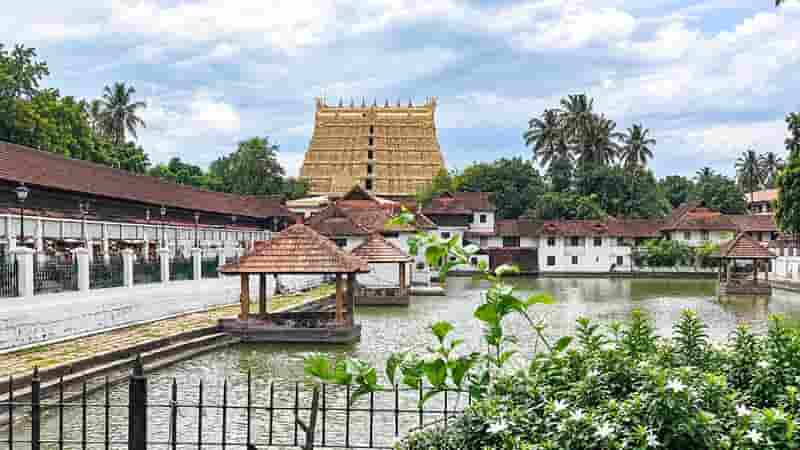
Shree Padmanabha Swamy Temple, Thiruvananthapuram
Our tour started at Kerala Arts & Crafts Village (KACV), Vellar, near Kovalam beach, where we stayed the night before. This is where crafts are made and sold. Uralungal Co-op (ULCCS) designed and runs it as an inclusive shared space to revive and replenish the state’s craft culture. KACV is supported by Keralam Tourism. We saw wood craft in one hut, mural painting in next, Aranmula Kannadi – mirror made from metal polished for 10 days, Nettur Petti -wooden jewel box with secret locks, we try on the Peruvamba musical instruments. We heard the loom clack at Balaramapuram and Chendamangalam handlooms. We were amazed by products made from coconut husk, palm leaf, bamboo, coir, and reed crafts. They agreed to courier the grass mat and jute bags that I bought. We ended at the open-air court under the cool, hanging roots of the age-old banyan tree to watch fine pottery emerge from clay. KACV has hosted G20 sessions, film festivals, and musicals, and it’s a hot spot for cultural events. It has an art gallery, amphitheatre, design lab, and a café. KACV spans 8.5 acres of natural surroundings; it has 33 studios, 100+ artisans, and many national awardees living and working there, making it feel like a whole village.
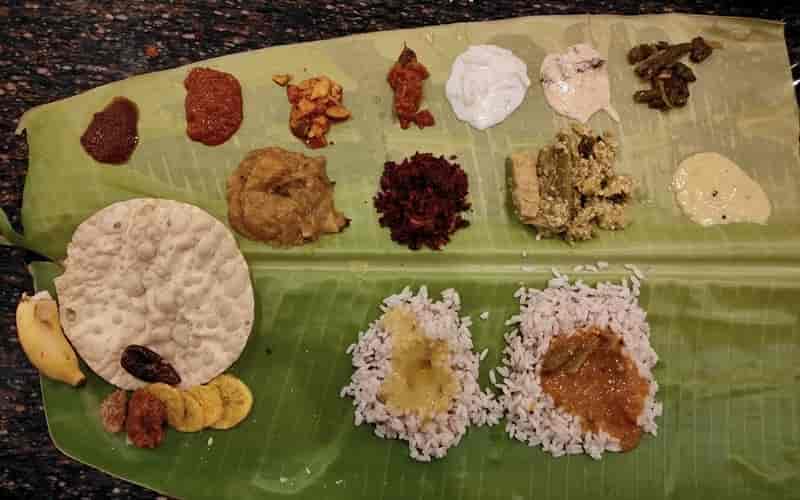
Sadya meal at Mother’s Veg Plaza
After a mindful experience, it’s time for lunch. Mother’s Veg Plaza at Bakery Junction satiated us with traditional Sadya, a festive meal. They laid out a banana leaf and started by serving salt, pickle, pachadi, thoran, avial, olan, banana chips, pulissery, pappadam, parippu with ghee, brown rice, sambar, and rasam. It was followed by sweet payasams, ada pradhaman and palada, then boli with more ghee. 30 items in all. As we tried to keep pace with the service, locals at the next table guided us on what best mixed with what. “Trivandrum sadya is less sweet, more tangy, like mother’s food”, one commented. We all ate like those at the same wedding. All this cost less than $3 per person.
A post-lunch walk was essential. Guide Philip suggested a stroll at the nearby Shree Padmanabhaswamy temple complex, a quiet place when the temple is closed to devotees. Non-Hindu friends from abroad were amazed by its antiquity, grandeur and serenity as we clicked photos of the temple and its huge pond.
We couldn’t visit the nearby Napier Museum because it was Monday, a holiday for all government tourist attractions in India. The Museum building itself, in Indo-Saracenic architecture, is an attraction, with many sections housing a rare collection of cultural and historical artifacts and paintings from the Travancore royalty.
While sipping coffee back at Sagara Samudra Beach Hotel, the setting sun and the lighthouse drew me to nearby Kovalam Beach. The tide was rough, and bathing was restricted. I sat quietly by the bay, enjoying the vibrant sunset colours and the fishing boats returning with fresh catch. 10 men moved in the same rhythm as they pulled the net on the beach. Kovalam has three crescents: Lighthouse (south), Hawa (middle) and Samudra (north). I was at the less crowded north, which had many rocks. One can climb 142 steps of the lighthouse for a full view of the curve.
Day two at Thiruvananthapuram started with a visit to Aazhimala Shiva temple by the bay. 58-ft Gangadhareshwara is seated on a rock 20 ft above the adjoining Arabian Sea, holding Ganga in his locks. The temple dates to the 8th century, and the statue is 6 years old. Another new addition is the cave underneath, with many intricately carved sculptures of Indian deities, a kind of “know different Gods and their physical characteristics” tour. For the intrigued, having a well-versed local guide here helps acknowledge Hindu ethnicity.
The boat ride to Poovar Island Resort took us to Kerala’s key attraction: backwater waterways passing through lush greenery. The only way to reach beautiful Poovar Island near Kovalam is by waterway: motorboats, shikaras, or ferries. It’s part of the backwaters formed at the estuary, where the Neyyar River joins the Arabian Sea after traversing 56 kilometres from its origin. It’s an amazing experience to see the unique flora and fauna adapted to brackish water, a mix of freshwater draining from the land and salty seawater.
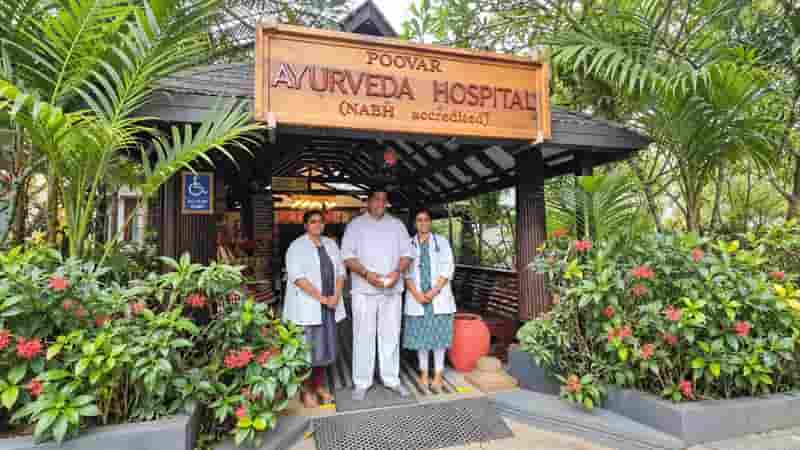
CEO Jaykumar with Doctors at Poovar Island Resort
Our small boat waded through coconut palms and mangroves for ten minutes. As the Neyyar River widened into the sea and golden sand shone ahead, we cruised past the floating cottages to the Poovar Island Resort. Walking under the canopy of trees spread on the 23-acre island was soothing. Jaykumar, CEO of Poovar Island Resort, said: “We have been maintaining this sustainable and eco-friendly resort for 25 years. We avoid plastic, employ locals and recycle used water to the garden where we grow our own vegetables and guests also partake in gardening. 80 percent of our electricity requirement is met by solar power.” The resort has 102 accommodation units, 32 of which form part of the exclusive Poovar Ayurveda Village, with an in-resort hospital. Mr Jaykumar added: “We are recognised by National Accreditation Board for Hospitals & Healthcare Providers (NABH) and get long staying Ayurveda seekers from across India and the world. Food for these guests is based on their diet prescribed by inhouse doctors.” Of the four restaurants at the resort, Prana is an exclusive restaurant serving dietary food. The other restaurants cater to short-stay guests with a choice of tasty food. The resort is also a popular destination for weddings and events. Learnt that honeymooners preferred to stay at the resort’s floating cottages, 16 in all. Beautiful sunsets and the water lapping under the bed make it special, while morning fishermen rowing past the balcony are the only traffic at these cottages. Poovar Island Jetty is 30 km from the airport.
Look out for a peek through Varkala and Jatayu in part II of my South Keralam tour.
By: Madhura Katti – © 2026.
Read Time: 7 minutes.
Author Bio:
 Madhura Katti didn’t just choose travel; it chose her. Trained in hotel management in Bangalore, she quickly understood that journeys are about people, not places. By the nineties, she was writing on travel and food with a natural authority, later earning a Best Travel Writer award that surprised no one who had read her work.
Storytelling soon moved to film. Her documentary work with Indigenous India captured the spirit of a country in motion and won a National Award for Best Tourism Film.
After years with TTG Asia and Aviation International News, she brought her seasoned judgement to EGT Media, where she now guides coverage across India and South Asia, steady, perceptive, and unmistakably human.











