

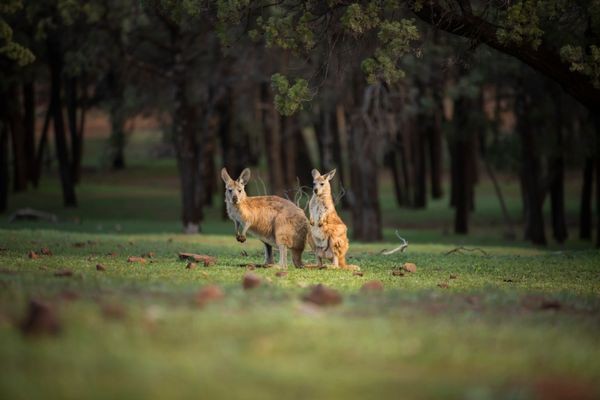
This World Kangaroo Day, 24 October, Discover Aboriginal Experiences reveals where travellers can glimpse Australia’s most recognisable animal – and discover the First Nations stories, knowledge and cultural connections behind it.
Few animals say Australia quite like the kangaroo. Recognised around the world for its distinctive way of moving, it has become shorthand for a continent. But seeing one in the wild is only part of the story.
For First Nations peoples across Australia, kangaroos can be guides to food and water, figures in ancient rock art, Totems, performers in story and ceremony and an important source of food. Even the word kangaroo has First Nations origins – derived from gangurru, the Guugu Yimithirr name for the eastern grey kangaroo in Far North Queensland.
And on First Nations-guided experiences around the country, travellers have the chance to encounter kangaroos on Country while learning why these animals have held cultural significance for generations.
“The kangaroo is one of those animals that instantly makes people think of Australia, wherever they are in the world,” says Nicole Mitchell, Executive Officer of Discover Aboriginal Experiences (DAE). “There’s something pretty special about seeing one in the wild, but when you’re on Country with a First Nations guide, that encounter can become part of a much bigger story.”
“Kangaroos are connected to food, art, ceremony, knowledge and Country in different ways across Australia. World Kangaroo Day is a great excuse to look beyond the icon – and perhaps spot a few along the way.”
In Tropical North Queensland, that might mean following tracks through Kuku Yalanji Country with Juan Walker of Walkabout Cultural Adventures. Kangaroos and wallabies are among the wildlife visitors may encounter on his guided experiences through the landscapes around Port Douglas and Mossman Gorge, but Walker also reveals what their tracks and behaviour can tell those who know how to read them.
“We can follow their tracks and learn whatever the kangaroo is taking and eating on a particular track, and know it’s good to also eat,” says Walker. “They’re our explorers, telling us what’s on that land and what we can learn from that land like where the food and water sources are.”
Head north into Queensland’s Cape York Peninsula and kangaroos can be encountered in another form. On a Jarramali Rock Art Tours experience in Quinkan Country, Kuku Yalanji guide Johnny Murison leads visitors to sandstone galleries where images of animals offer a glimpse into culture and life on Country.
“The animal figures include kangaroos, but you’ll also see crocodiles, emus, echidnas, barramundi, catfish and birds,” says Murison. “I can show you the whole structure of our society by looking at that gallery.”
On North Stradbroke Island / Minjerribah, just off the coast of Brisbane / Meanjin, kangaroos roam on Quandamooka Country. Joining a Yura Tours experience with Quandamooka guide Elisha Kissick offers the chance to spot them while exploring an island landscape of beaches, bushland and culturally significant places – with wildlife encounters given context through the stories of Country. Kangaroos are wild, of course, so sightings are never guaranteed.
Further south, kangaroos are a familiar presence around Discovery Resorts – Wilpena Pound in South Australia’s Ikara-Flinders Ranges National Park, where the surrounding mountains are home to abundant native wildlife. Here, visitors can explore Adnyamathanha Country and discover a landscape in which wildlife, geology and culture are closely connected.
In Queensland’s Bundaberg region, Taribelang Bunda Cultural Tours offers another perspective on the relationship between kangaroos and landscape. Guide Bec Domaille shares stories passed down by her Aunties about what the Country around today’s city once looked like.
“Before colonisation, the roundabouts here in town were billabongs. There would be emus and booroo (kangaroos) everywhere,” she says.
Not every kangaroo encounter requires one to hop into view. Near Cairns / Gimuy in Tropical North Queensland, the Pamagirri Aboriginal Experience at Rainforestation Nature Park brings native animals into cultural performance, with musicians imitating the sounds and movements of kangaroos and kookaburras – before visitors are invited to have a go themselves.
Kangaroo can also be encountered through food. It has long been an important food source for First Nations peoples, with traditional practices involving ceremony and the use of different parts of the animal, including its meat, skin and bones.
In Western Australia’s Margaret River region, Wadandi man Josh Whiteland of Koomal Dreaming introduces guests to traditional foods including kangaroo, emu, quandong, emu plum and saltbush as part of a gourmet lunch experience.
So while spotting a kangaroo bounding through the Australian landscape might be a moment to remember, travelling with a First Nations guide can reveal how much more there is to see. A kangaroo can be wildlife, food, art, story, ecological knowledge and a way of reading Country – depending on where you are and who is sharing the story.











