

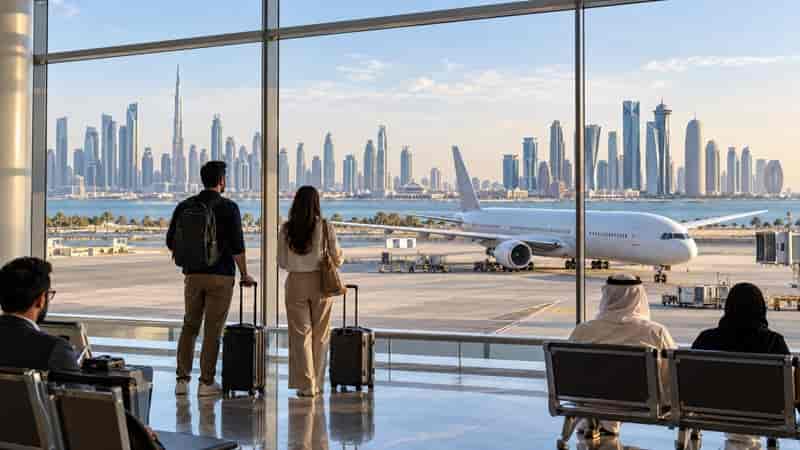
Australia turns down the travel-warning dial for the UAE and Qatar, but the Gulf’s seatbelt sign is still on.
Australia has eased its travel warnings for two Gulf countries at the heart of international aviation. The catch? That familiar airline instruction to keep your seatbelt fastened still feels rather appropriate.
The Australian Government’s Smartraveller service lowered its overall travel advice for the United Arab Emirates (UAE) and Qatar on 8 October 2026, moving both from Level 3, “Reconsider your need to travel”, to Level 2, “Exercise a high degree of caution”.
For Australian travellers heading to Dubai, Abu Dhabi or Doha, or simply changing aircraft on their way to Europe, Africa and beyond, that is a welcome shift. After months of uncertainty, the official travel-warning dial has moved in a more reassuring direction.
It has not, however, clicked all the way to green.
A little less alarm, not an all-clear
The change marks another step in a difficult year for Gulf travel. Australia had placed both countries at Level 4, “Do not travel”, during the escalation of regional conflict in March. Their advice was lowered to Level 3 on 17 June, before the latest move to Level 2.
That progression matters to airlines, travel advisers and passengers. Dubai, Abu Dhabi and Doha are pivotal links in international aviation, connecting Australian travellers with destinations across several continents. A change to government travel advice is therefore more than a diplomatic footnote.
But an advisory level measures risk, not a promise that nothing will go wrong.
Smartraveller continues to warn that the security situation in the Middle East is unpredictable. Military strikes and reprisal attacks have occurred across the region, and further escalation remains possible. Attacks could affect military facilities, energy installations and civilian infrastructure.
Terrorism also remains a threat in both the UAE and Qatar. Australians are urged to stay alert, avoid potential targets where possible and follow instructions from local authorities. If local officials warn of an imminent attack, seek shelter as advised.
The message is straightforward: enjoy the prospect of travelling, but do not mistake a reduced warning for an invitation to abandon caution at the departure gate.
Airspace does not follow the departure board
For passengers connecting through the Gulf, the practical issue is whether their journey will be reliable.
Smartraveller warns that UAE airspace can open or close at short notice, affecting flights through Dubai and Abu Dhabi. Qatar’s airspace could also close suddenly, affecting services at Doha’s Hamad International Airport.
Such disruption can mean delays, cancellations or diversions, even for passengers whose final destination is well beyond the Middle East. Airlines may also adjust services as wider conflict affects operations and fuel supplies.
It is worth checking flight status directly with the airline before leaving for the airport, monitoring connections and allowing some flexibility in the itinerary. Travellers should follow official local alerts and know what to do if security conditions deteriorate.
In other words, the Gulf remains a remarkable crossroads of world travel. It is just not the place to assume every connection will run like clockwork.
Insurance: the small print with a big role
One essential task comes before packing the passport: read the travel insurance policy.
The Australian Government advises travellers to check whether their cover includes flight delays, cancellations, disruption and changes to official travel advice. Policies vary, and conflict-related exclusions may apply. A downgrade to Level 2 does not automatically guarantee a claim will be covered.
Travellers should also check cover for stopovers, medical expenses and emergency assistance, and ask the insurer about anything unclear before departure.
Another important distinction is geographical. Australia has lowered its advice for the UAE and Qatar, not for the whole Gulf or the wider Middle East. Bahrain, Kuwait, Oman and Saudi Arabia remain at Level 3, alongside Israel and Jordan. Iran, Iraq, Lebanon, Palestine, Syria and Yemen remain at Level 4.
That makes checking every destination and transit point especially important.
Good news, with the caution light still glowing
For the Australian travel industry, the latest update offers a more positive starting point for discussions about Gulf itineraries and connections. It may help restore confidence, although the advice change alone does not establish that bookings have rebounded or that disruption is over.
Travellers can consult Smartraveller’s separate advice for the UAE and Qatar, subscribe to updates and check with their airline or travel adviser immediately before departure. Security conditions and official warnings can change quickly.
So yes, a little more sunshine is breaking through the geopolitical clouds. Dubai, Abu Dhabi and Doha remain firmly in the travel conversation.
Just remember: the Gulf’s travel light has edged towards green, but the caution sign is still illuminated.
By: John Alwyn-Jones – © 2026.
Read Time: 4 minutes.
Author Bio:
 John Alwyn-Jones is one of those rare figures who can make the business of travel sound positively adventurous.
A lifelong communicator with the polish of a broadcaster and the curiosity of a journalist, he’s spent decades shaping stories and strategies across tourism, aviation, and the cruise world. He’s led from the front as CEO, director, mentor, and advisor, and still brings warmth and wit to every boardroom and microphone.
Known for his sharp insight into global cruise lines and destinations, John has an old-school belief in professionalism, tempered with the sparkle of someone who’s genuinely seen the world. He’s not just in the travel business; he’s made it an art form.











