

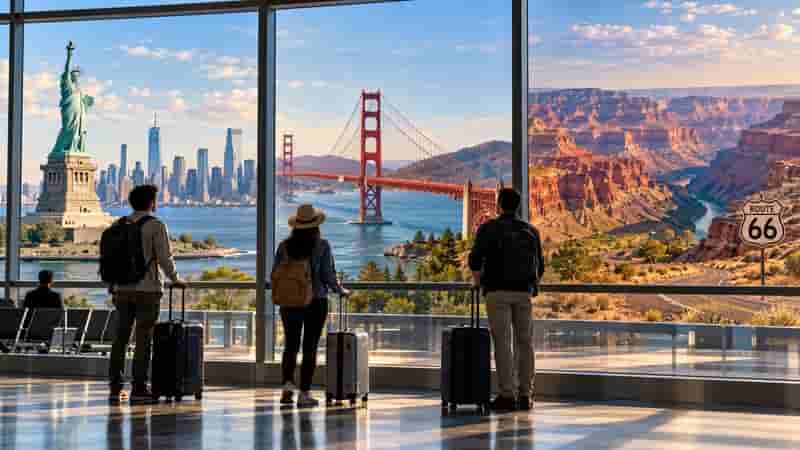
With overseas arrivals falling and billions in potential spending on the line, America’s tourism industry faces an awkward question: can the world’s best-known holiday destination persuade international visitors to come back?
Once upon a time, selling a holiday to the United States seemed wonderfully straightforward. Show a traveller the Grand Canyon, a Broadway theatre and a photograph of the Golden Gate Bridge, then point them towards the nearest travel agency.
The holiday practically sold itself. The credit card, admittedly, occasionally required counselling afterwards.
But America’s tourism industry has entered a far less comfortable chapter. Overseas arrivals are slipping, some of its most loyal source markets are retreating, and its biggest sporting spectacle in decades has not been enough to reverse the wider trend.
The latest warning is particularly expensive.
Tourism Economics estimates the United States will forgo US$39.6 billion in international visitor expenditure across 2025 and 2026, compared with what it might have earned had it retained its 2024 share of global international travel spending.
That is a modelled measure of missed opportunity, not an audited loss or a forecast of an absolute fall in revenue. Even with that distinction, it is a formidable signal that America is surrendering ground in an increasingly competitive global market.
The difficulty isn’t that America has suddenly run out of places worth visiting. Quite the opposite.
Overseas arrivals tell a troubling story
The U.S. Travel Association’s October industry dashboard reports that overseas arrivals declined 11.8 per cent in August 2026, leaving the year-to-date total 5.8 per cent below the corresponding period in 2025.
An important statistical distinction applies here. These overseas arrivals figures exclude visitors from Canada and Mexico. They should not be mistaken for a decline of the same size in total international visitation.
Indeed, the wider picture is uneven. Tourism Economics reports that Mexican arrivals grew 14.6 per cent through June, while arrivals from South America increased 3.8 per cent through August. By contrast, Western European arrivals were 8.8 per cent lower through August.
In other words, the international market is not simply disappearing. It is changing shape, and American destinations are experiencing those changes very differently.
Falling arrival numbers are not synonymous with an industry-wide financial collapse. Travel spending in the United States reached US$116.6 billion in August, up 2.5 per cent from the same month last year. Hotel room demand edged up 0.8 per cent, and revenue per available room rose 2 per cent.
Yet total air passenger traffic fell 4.4 per cent in August.
So the tills are still ringing, even as some visitor counts weaken. Higher rates and prices can flatter revenues without delivering corresponding growth in the number of travellers. As any hotelier will tell you, a splendid room rate is less splendid if too many rooms remain empty.
America’s enormous domestic safety net
America has an advantage few other destinations can match: Americans themselves.
The U.S. Travel Association’s spring forecast projected US$1.37 trillion in total travel spending for 2026, expressed in inflation-adjusted 2025 US dollars. Domestic travel accounted for approximately 87 per cent of that total.
That is a formidable cushion. But domestic demand cannot replace every role previously filled by international visitors, particularly in gateway cities, cross-border communities, and businesses geared toward long-haul guests.
The same spring forecast anticipated 70.6 million international visits in 2026. By July, an updated Tourism Economics projection reported by Travel Weekly had lowered that figure to approximately 69.9 million, representing expected annual growth of 2.4 per cent rather than 3.4 per cent.
Those numbers project total international visitation, including Canada and Mexico. They are not interchangeable with the separate overseas-arrivals series.
And with later data showing continued weakness in several markets, even a revised forecast should be read as an estimate rather than a result already delivered.
The World Cup filled stadiums, not every gap
Surely, 2026 should have been the year America could do no wrong in tourism.
The United States co-hosted the FIFA World Cup with Canada and Mexico, celebrated the 250th anniversary of American independence, and marked 100 years of Route 66. If any country ever had the promotional equivalent of a royal flush, this was it.
The football delivered real business. Tourism Economics’ September review found the tournament drew 6.8 million attendees across North America. In American host markets, hotel room revenue climbed 36.3 per cent year-on-year on match dates.
The researcher estimates that the tournament generated approximately US$634 million in additional hotel room revenue in US host markets on and around match dates. That figure is a hotel-specific estimate, not the event’s total economic contribution.
Then came the less triumphant part of the scorecard.
Across June and July, overseas arrivals from participating countries declined 1.1 per cent compared with the previous year. Arrivals from non-participating countries fell 8.9 per cent.
Football clearly helped certain markets. It did not solve the broader problem.
A World Cup can produce a magnificent six-week party. A sustainable tourism recovery requires visitors to return long after someone has packed away the corner flags.
Canada pulls back, while Mexico moves ahead
The retreat in Canadian visitation is especially painful because Canada’s relationship with American tourism has been built over generations.
Canadians have long headed south for winter sunshine, shopping, family holidays and sporting weekends. Florida, Arizona, and border-state businesses have grown accustomed to this custom.
Tourism Economics says Canadian visits to US states fell 21.8 per cent in 2025, with particularly sharp declines in northern border states.
Statistics Canada offers another measure of the retreat. Canadian residents took 5.5 million trips to the United States in the first quarter of 2026, down 10.6 per cent from a year earlier. Expenditure on those visits fell 13.6 per cent.
Crucially, those 5.5 million trips included same-day visits; not all were overnight leisure holidays. Statistics Canada says 37.5 per cent were same-day visits.
Politics, economic pressures, and changing travel preferences may all influence holiday decisions, but no single explanation should account for every missing visitor.
Mexico, meanwhile, has been a relative bright spot. That contrast is instructive: a single national advertising campaign cannot fix the very different challenges facing every US source market.
Why Australians still matter
For Australian travel advisors, the American story is considerably more promising than the bleakest headlines suggest.
In February, Brand USA forecast Australian visitation would rise 5 per cent in 2026 to more than one million. The figure was a projection, not a final count, and subsequent international travel trends make the year-end result worth watching.
Brand USA reinforced the market with trade and media events in Australia and New Zealand. Its Sydney business-to-business programme brought together American tourism suppliers and local buyers, underlining the commercial importance of knowledgeable distribution partners.
Australians are well suited to America’s great strength: the varied, longer itinerary. A traveller might combine San Francisco with California’s wine regions, or New York with New England’s villages and coastlines. Others may prefer a national parks circuit, the music of Nashville and New Orleans, or a slower drive along the remnants of Route 66.
It is the sort of holiday on which an experienced advisor can earn their keep several times over.
Why sell a client just three nights in Las Vegas when the wider American West offers mountains, desert towns, historic railways and landscapes that make even the most enthusiastic smartphone photographer fall silent?
That last achievement may be America’s greatest tourism miracle.
A warm welcome must also be a clear one
Attraction alone does not close a booking. International travellers need clear information on entry rules, fees, safety, and the practicalities of getting through an airport without unpleasant surprises.
In May, Brand USA introduced its Get Facts. Get Going. initiative to direct travellers and industry partners towards reliable information on visas, entry policies and charges. In June, it released a toolkit for tour operators, agents, airlines and destination marketers.
Brand USA’s leadership is also changing. As of 9 October, Fred Dixon remains President and CEO. Caroline Beteta is due to become interim President and CEO on 9 November, while Dixon is scheduled to depart on 13 November.
For Australians, the Visa Waiver Program generally permits eligible passport holders to visit for tourism or specified business purposes for up to 90 days, provided they obtain approved Electronic System for Travel Authorisation (ESTA) before travelling.
There are important exceptions. Travellers who have been to Cuba on or after 12 January 2021, or to specified other countries on or after 1 March 2011, may be ineligible for the Visa Waiver Program and require a visa instead, subject to limited exceptions. Certain dual nationalities and other individual circumstances can also affect eligibility.
The official fee for an approved ESTA is US$40.27 as at 9 October 2026, increasing to US$40.62 from 16 October 2026, according to a US Federal Register notice. A denied application incurs a lower processing fee.
Agents should send clients to the official ESTA website and Australia’s Smartraveller United States advice. An approved ESTA permits travel to seek admission; it does not guarantee entry.
That may be less romantic than recommending a sunset cruise beneath the Golden Gate Bridge, but sound travel advice has always included getting the paperwork right.
The regional America waiting to be discovered
Another compelling reason for cautious optimism. Repeat international visitors still undervalue much of America’s tourism product.
Beyond the familiar gateways are Louisiana’s food and music, the scenic roads of the Appalachian Mountains, Utah’s sandstone country, the Great Lakes, the Pacific Northwest and an extraordinary network of small towns with their own stories to tell.
These experiences aren’t interchangeable, and that is precisely their selling point.
For destination marketers, the task is to help overseas visitors discover more than the usual landmarks. For airlines and tour operators, it means connecting those experiences with realistic transport options, sensible itineraries, and prices that make sense.
For advisors, it means doing what the best of the profession have always done: listening first, matching the destination to the customer and making travel feel like a discovery rather than a transaction.
A memorable week in a lesser-known region can create a repeat customer far more effectively than a glossy slogan.
Business travel offers a late-year lift
Not every sign points downwards.
The U.S. Travel Association’s October dashboard reports that, as of mid-September, corporate hotel bookings for October were 5.2 per cent ahead of the comparable year-earlier booking position. Forward bookings were 7.7 per cent higher for November and 11.2 per cent higher for December.
Group room nights booked for the October-to-December quarter were 4.2 per cent ahead of the corresponding position a year earlier.
They are advance-booking indicators, not proof of final occupied room nights. Even so, they offer a welcome measure of confidence for hotels, conference venues, airlines and the businesses serving corporate travellers.
Looking ahead, the 2028 Olympic and Paralympic Games in Los Angeles will put America back in front of an enormous international audience.
The temptation will be to celebrate another surge of arrivals and room rates. The smarter objective is to turn that attention into lasting relationships with travellers who have more countries to choose from than ever.
America has the product; now it must win the booking
No one needs to write an obituary for American tourism. Its natural wonders, cultural landmarks, hospitality businesses and extraordinary variety remain formidable assets.
But no one should dismiss the latest warning figures as a passing inconvenience.
The US$39.6 billion estimate from Tourism Economics compares against a hypothetical global market-share benchmark. It is not a measured cash shortfall. Its power lies in what it exposes: global tourism demand can grow while individual destinations capture less than their former share.
America’s challenge is therefore not merely to advertise more loudly. It must give international visitors persuasive reasons to choose the United States, help them navigate the practicalities and deliver an experience worth recommending when they return home.
For Australian travel advisors, this is an invitation to sell the country’s depth rather than simply its best-known postcards.
The American dream still offers an impressive range of itinerary destinations. But in the fiercely contested business of international tourism, even the most famous name on the map has to earn the next booking.
Preferably before the customer discovers a tempting offer somewhere else.
By: Jason Smith – © 2026.
Read Time: 11 minutes.
Author Bio:
 Jason Smith didn’t learn travel from textbooks. He learned it in airports, taxis and hotel lobbies, watching the business unfold long before he played his own part. Half American, half Asian, he grew up around the quiet workings of tourism, where people come and go, and stories rarely stand still.
Bangkok came first, then formal study, then a career that carried him through Singapore, Malaysia and Vietnam. Each place left something behind. In the end, Thailand felt like home, along with a senior role in hotel sales.
Then everything stopped. Borders shut, planes grounded, and Jason found himself back in America with time to reflect.
Now, at Stephen’s EGT Media, he writes travel as it really is, not polished or perfect, but human, and all the better for it.











