

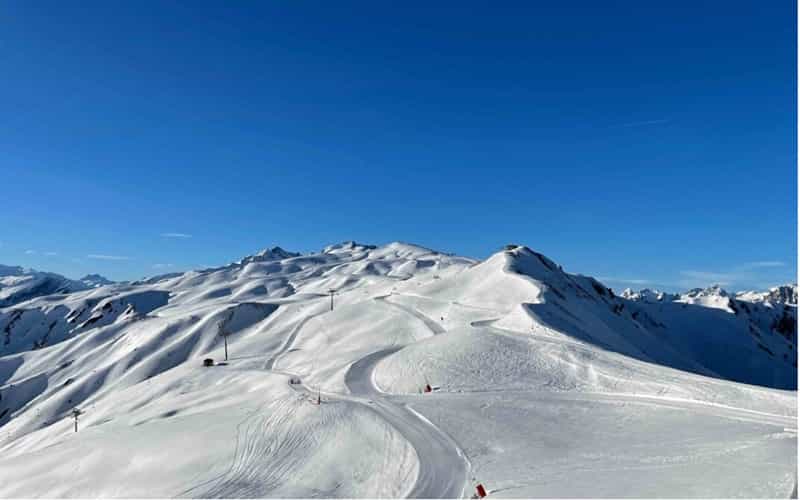
France has skied its way back to the top of the world and, after more than a decade of waiting in the lift queue, done so in considerable style.
French ski resorts recorded 56.1 million skier days during the 2025/2026 winter, putting France ahead of Austria and the United States and restoring its position as the world’s leading ski destination for the first time since the 2014/2015 season.
According to Domaines Skiables de France (DSF), skier visits increased 2.4 per cent year on year and finished 6 per cent above the average of the previous four seasons. Austria recorded 53.7 million skier days, while the United States recorded 52.6 million in DSF’s international comparison.
For the French industry, this was not simply another respectable winter.
It was the country’s third-best ski season on record, surpassed only by 2008/2009, when France clocked up 58.6 million skier days, and 2012/2013, with 57.6 million.
That is a sizeable result for an industry whose most influential business partner remains famously temperamental: the weather.
Alps and Pyrenees lead France back to the summit
The strongest performances came from the French Alps and Pyrenees, where favourable snow conditions helped lift the national result.
The Massif Central, Jura Mountains and Vosges faced more variable snow cover at times, demonstrating something ski operators know all too well: a national average can look splendid while conditions on individual mountains remain considerably less cooperative.
The season began promisingly.
Early snowfall from late November allowed many French ski areas to open in good conditions, providing operators with an encouraging run-up to the commercially important Christmas holiday period.
Christmas delivered a broadly solid national performance. The Alps and Pyrenees capitalised on established snow cover, while lower- and mid-altitude mountain areas dealt with a temporary spell of milder weather.
Then January arrived with precisely what every ski resort operator wants to see outside the office window: colder temperatures and fresh snow.
DSF reported an exceptionally strong January inter-holiday period, with national visitation 3 per cent higher than the previous winter and 9 per cent above the average of the preceding four seasons.
By 6 February, cumulative national visitor numbers were running 9 per cent above that four-year benchmark.
March makes a welcome comeback
The main winter holiday period subsequently held broadly steady, close to both the previous season and the recent average, with the Southern Alps and Jura among the stronger performers.
March then produced another encouraging development.
The inter-holiday period recorded a remarkable 20 per cent year-on-year increase nationally, bringing visitation back towards the four-year average.
For resorts seeking to stretch the commercially productive part of the season beyond the major school holidays, the news was particularly welcome.
So, too, was the performance at the other end of winter.
Spring holiday visitation increased 3 per cent year on year, helped by a strong Easter weekend. DSF says the result reinforces April’s importance to resorts and the economies of surrounding mountain valleys.
April skiing is easy to think of as an end-of-season bonus. For hotels, restaurants, ski schools, retailers, transport operators and thousands of seasonal workers, it can be substantially more important than that.
Every additional operating week counts.
The bigger story may actually be summer
France returning to number one in global skiing is unquestionably the headline.
The more intriguing commercial development, however, may be what happens after the skis disappear into the garage.
French mountain resorts are steadily becoming two-season and increasingly year-round destinations.
During the peak summer period from 4 July to 22 August 2026, French mountain accommodation occupancy reached 65.8 per cent, up 2.5 percentage points compared with summer 2025. Occupancy peaked at an impressive 80.7 per cent during the week of 8 August.
Across the extended summer period from 13 June to 11 September, industry figures in the seasonal review put average occupancy at 52.7 per cent, up one percentage point from 2025.
And suddenly the mountains are no longer waiting for the first snowfall before turning on the lights.
The attractions are increasingly diverse: hiking, cycling, mountain biking, gastronomy, wellness, family activities, festivals and major sporting events such as the Tour de France.
Then there is the latest piece of travel vocabulary to join “bleisure” and “revenge travel” at the industry cocktail party: the coolcation.
The theory is simple enough.
When European cities are baking in increasingly intense summer temperatures, holidaymakers head uphill.
No consultancy presentation required.
The French mountain resort association says demand for cooler temperatures, more diverse resort activities and major events has helped strengthen mountain tourism during summer.
Why Australian travel advisors should take notice
For Australian travel advisors, the implications extend well beyond selling a week on the slopes.
France’s mountain tourism product is increasingly becoming a 12-month proposition, spanning skiing, walking, cycling, wellness, gastronomy, family holidays, festivals and nature-based touring.
That creates an opportunity to sell essentially the same geographical regions to quite different customers at different times of year.
A client who would never willingly strap two planks of fibreglass to their feet may still happily spend July walking through Alpine villages, cycling mountain roads, enjoying regional cuisine or watching the Tour de France thunder past.
France also benefits from an unusually broad ski proposition.
Enormous internationally recognised resorts, traditional villages, high-altitude terrain, family-friendly areas, and smaller regional domains are spread across the Alps, Pyrenees, Jura, Vosges, and Massif Central.
Add France’s railway network, airports, established accommodation sector and formidable culinary credentials, and advisors have considerably more to work with than snow depth alone.
And, importantly for agents selling long-haul holidays from Australia, there is plenty of scope to package mountain stays with Paris, Lyon, Geneva gateways, regional touring, or wider European itineraries.
Skiing remains serious economic business
The scale of the French mountain economy explains why this season’s figures matter far beyond the lift-ticket window.
Domaines Skiables de France currently represents 380 members, comprising 230 active ski-lift or ski-area operators and around 150 corresponding members including suppliers, manufacturers, training organisations and project specialists.
DSF estimates that around 10 million tourists visit the French mountains in winter, approximately seven million of whom participate in snowsports.
More than 120,000 jobs in French mountain areas depend on ski areas opening each winter, the organisation says. Recent DSF figures also show French ski areas invested €3.96 billion between 2016 and 2025 to maintain and develop mountain infrastructure.
That investment extends far beyond glamorous new gondolas.
It encompasses maintenance, safety systems, snowmaking infrastructure, energy efficiency, slope management, guest facilities and the constant modernisation required to keep major mountain destinations internationally competitive.
Climate remains the mountain in the room
However, France’s celebratory numbers come with an important qualification.
Snow conditions remain variable, and climate change presents a long-term structural challenge, particularly for smaller and lower-altitude resorts.
DSF itself has acknowledged the difficulties faced by ski areas that cannot readily finance continued investment and adaptation. The organisation has previously highlighted greater variability in snowfall and other consequences of a changing mountain climate.
The fact that some French ranges encountered less reliable conditions during an otherwise exceptional 2025/2026 national season illustrates the issue neatly.
One brilliant winter does not abolish long-term risk.
It does, however, make the continuing development of summer tourism considerably more important.
If French mountain communities can complement skiing with hiking, cycling, events, gastronomy and cooler-climate summer holidays, their future becomes less dependent on one season and one rather unpredictable substance falling from the sky.
France has its ski crown back
For travel advisors, France’s 56.1 million skier days provide something valuable in an increasingly competitive international market: hard evidence that consumer appetite for mountain holidays remains strong.
The figures do not mean every French resort experienced identical conditions, nor do they guarantee another record-breaking winter in 2026/2027.
What they do demonstrate is the extraordinary resilience of skiing as a tourism product.
France has the infrastructure, resorts, transport, accommodation and global recognition to capitalise on that appetite. Increasingly, it also has something else: a mountain tourism proposition that can survive beyond the final chairlift of spring.
After eleven winters away from the top spot, France has climbed back onto the highest step of the global ski podium.
And judging by the rapidly growing summer numbers, the French mountains no longer intend to spend half the year admiring the view.
For further information, visit: https://www.domaines-skiables.fr/.
By: Bridget Gomez – © 2026.
Read Time: 6 minutes.
Author Bio:
 Bridget has never been built for stillness. Of Portuguese heritage, she began as a nurse, tending veterans at the Repatriation Hospital, listening to stories as colourful as the life she was yet to live. It was worthy, steady work, but wanderlust, as always, proved louder than routine.
So, she traded starch for a backpack and disappeared for a year, chasing trains, sunsets and the occasional regrettable glass of wine. She wrote everything down: the dust, the laughter, the missteps, the magic. Those notebooks became a travel blog, then a habit, then a calling.
Eventually she found Stephen’s EGT Media, or perhaps it found her.
Today Bridget writes with heart, humour and a dash of mischief, still travelling, just now with words.











