

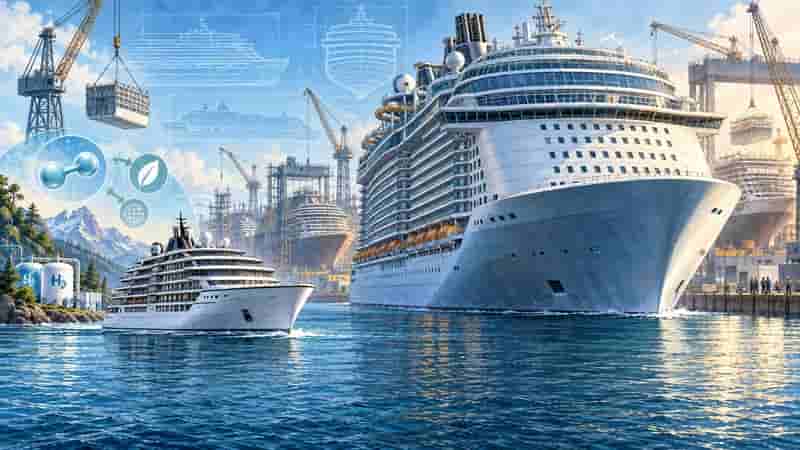
A recent Travel Life Vibes post put a startling number on cruising’s next great construction boom: six major cruise brands collectively have 47 ships in their future pipelines.
That figure is guaranteed to make even the most hardened shipspotter reach for the binoculars.
But there is an important footnote before anybody starts counting funnels.
The 47 is best regarded as a broad pipeline figure, rather than 47 identical, unconditional firm orders. Some vessels are fully contracted and financed; others remain subject to financing or final contractual conditions. MSC Cruises’ four proposed New Frontier ships, for example, were still in advanced contract negotiations with Meyer Werft in the latest official joint update.
Even with that qualification, the investment scale is extraordinary.
Here is the current broad picture:
Viking – 13
MSC Cruises – 10
Royal Caribbean – 7
Norwegian Cruise Line – 7
Carnival Cruise Line – 5
Disney Cruise Line – 5
Total: 47 vessels across firm orders, conditional contracts and advanced newbuild plans.
And Viking sitting at the top of that list may surprise plenty of people. However, there is a catch, and it changes the picture considerably.
Not all cruise ships are remotely the same size.
Viking’s newest ocean ships are classified as small ships, at approximately 54,300 GT, with 499 staterooms accommodating up to 998 guests. Royal Caribbean’s Icon-class giants, by contrast, occupy the quarter-million-GT neighbourhood, with forthcoming vessels planned for about 5,600 lower berths.
In other words, one Icon-class ship can accommodate more guests than five 998-guest Viking ocean ships combined.
So Viking may lead this six-brand comparison in hull numbers, while Royal Caribbean represents vastly greater berth capacity per vessel.
Both observations can be correct. They measure very different things.
What each cruise line is actually building
Viking – 13 in the broad pipeline
Viking’s published programme currently includes 11 future ocean ships, including the two vessels for 2032, whose options were exercised after 30 June 2026.
It also has contracts for two expedition newbuilds, scheduled for 2030 and 2031. Viking’s most recent regulatory filing says those expedition contracts remain subject to certain financing and other conditions through 30 September 2026.
That distinction is important. They belong in Viking’s broader future development programme, but the conditions should be disclosed rather than swept conveniently beneath the gangway.
Viking’s river programme is larger again. At 30 June 2026, the company reported 14 river vessels on order and options for another 16, although subsequent deliveries mean those numbers should not be presented as a live September tally. Viking took delivery of Viking Dagur in July, for example.
Viking is therefore making a very different bet from the mega-ship operators: more vessels, relatively modest passenger numbers and a product centred heavily on destinations rather than floating-resort scale.
MSC Cruises – 10 in the wider programme
MSC Cruises has six future World Class ships in its programme: MSC World Asia, due in late 2026; MSC World Atlantic in 2027; and four further World Class vessels scheduled to follow through 2031.
Then comes something entirely new: the New Frontier platform.
MSC and Meyer Werft announced plans covering four approximately 180,000-GT New Frontier ships, plus two options, with annual deliveries intended from 2030.
But precise wording matters.
In their latest official joint statement, dated 24 June 2026, MSC Cruises and Meyer Werft said detailed design planning and negotiations had reached an advanced stage, but they had not yet concluded the final contractual package. The ships are expected to accommodate up to approximately 5,400 passengers each.
So “10 ships in MSC’s wider pipeline” is reasonable.
“Ten unequivocal firm orders” is, at present, too absolute.
Royal Caribbean – 7
Royal Caribbean’s pipeline is somewhat easier to count and considerably harder to miss when one of these giants pulls alongside.
It includes Hero of the Seas for 2027, Icon 5 in 2028, Icon 6 in 2029, Icon 7 in 2030, a seventh Oasis-class ship in 2028, plus two Discovery-class vessels scheduled for 2029 and 2032.
Royal Caribbean Group confirmed orders for Icon 6 and Icon 7 in April 2026. Icon 7 was initially subject to customary conditions, including financing, with the company’s subsequent regulatory filing recording that its agreement became effective in July 2026.
The two Discovery-class ships are particularly interesting because Royal Caribbean says the class will place greater emphasis on destinations, exploration and global deployment. Each is currently listed at approximately 4,300 berths.
That gives Royal Caribbean something of a two-handed strategy: keep building some of the largest holiday resorts ever put to sea while simultaneously creating ships designed to broaden where the brand can go.
Not exactly putting all the deckchairs in one basket.
Norwegian Cruise Line – 7
This figure deserves a firm correction from the original version.
For Norwegian Cruise Line itself, the figure is seven, not six to eight.
Norwegian Cruise Line Holdings’ latest filing lists two approximately 170,000-GT Prima-class ships, scheduled for delivery in 2027 and 2028, plus five vessels of a much larger new class, currently scheduled between 2030 and 2037.
Those five future ships are expected to measure approximately 227,000 GT, with about 5,000 berths apiece.
That will take Norwegian Cruise Line comfortably beyond the 200,000-GT threshold for the first time.
The message is hardly subtle. NCL wants scale, but it is spreading that growth across more than a decade.
Carnival Cruise Line – 5
Carnival has five major newbuilds ahead.
Carnival Festivale is scheduled for 2027, followed by Carnival Tropicale in 2028.
Then comes Project Ace: three ships of approximately 230,000 GT each, scheduled for delivery in 2029, 2031 and 2033.
Carnival says each Project Ace ship will have more than 3,000 guest staterooms and capacity for almost 8,000 guests at maximum occupancy, making them the largest vessels in Carnival Cruise Line history.
If the name “Project Ace” sounds modest, the ships most certainly will not be.
Disney Cruise Line – 5
Disney has also confirmed that five additional ships are coming following Disney Adventure.
Disney Believe, the fourth Wish-class ship, is scheduled to sail in 2027.
Disney is also developing three vessels in an entirely new, smaller class, beginning in 2029, while another Disney-branded ship is being developed for the Japanese market with Oriental Land Company.
Disney says its new class will sit between its classic vessels and its latest, larger ships in size. The new design is intended to open up additional destinations and deployment possibilities.
In other words, Disney appears less interested in joining a maritime contest over who can build the biggest floating postcode and more interested in broadening where its ships can operate.
Viking Libra: perhaps the most fascinating ship of the lot
Buried among all those orders and eye-watering tonnage figures is arguably the most technically intriguing vessel in the entire pipeline: Viking Libra.
Due for delivery in late 2026, Viking Libra is described by Viking and builder Fincantieri as the world’s first cruise ship powered by hydrogen stored onboard for propulsion and onboard electricity generation.
The ship’s hybrid propulsion system is based partly on liquefied hydrogen and fuel cells and is designed to generate up to six megawatts of power.
Viking says the technology will enable the vessel to operate with zero emissions in certain circumstances, potentially allowing it to navigate environmentally sensitive areas.
And Viking Libra will not be alone for long.
Viking Astrea, scheduled for delivery in May 2027, will use the same hydrogen technology and was floated out at Fincantieri’s Ancona shipyard in September 2026.
One correction is important, however.
No official confirmation currently exists that Viking Lyra, due in 2028, will use the hydrogen system. Viking’s own documentation specifically identifies Viking Libra and Viking Astrea as the hydrogen-powered vessels.
So Lyra should not yet be placed automatically in the same hydrogen-powered category.
While the industry debates waterslides, rollercoasters, restaurants and increasingly inventive methods of separating passengers from terra firma, Viking is testing technology that could have rather more enduring consequences for ship design.
Two very different bets on cruising’s future
Carnival, Royal Caribbean, MSC and Norwegian are investing heavily in scale.
Their future fleets feature enormous passenger capacity, multiple entertainment districts, water attractions, restaurants and increasingly elaborate onboard experiences.
Viking and, to some extent, Disney’s new smaller class are pursuing a different proposition: fewer guests per vessel, greater deployment flexibility and the potential to reach destinations unsuited to the industry’s biggest ships.
Neither strategy is inherently superior.
They target different travellers, different itineraries, and very different economics.
What is difficult to ignore is the confidence behind the spending.
Some of the ships in these programmes will not carry their first paying passenger until well into the 2030s. Norwegian’s present schedule stretches all the way to 2037.
That is an extraordinarily long-range wager on cruising’s continuing appeal, particularly for an industry that only five years ago was still rebuilding after pandemic shutdowns.
The question for travellers and travel advisors is no longer whether the major cruise companies believe demand will continue.
Their shipyards have already answered that.
The more interesting question is what sort of ship passengers will choose.
Would you rather sail aboard a 998-guest Viking vessel, designed heavily around destination immersion, or an Icon-class giant carrying roughly 5,600 guests at double occupancy, where an entire resort holiday awaits before the gangway has even dropped?
Cruising’s next decade, it seems, has room for both.
By: John Alwyn-Jones – © 2026.
Read Time: 6 minutes.
Author Bio:
 John Alwyn-Jones is one of those rare figures who can make the business of travel sound positively adventurous.
A lifelong communicator with the polish of a broadcaster and the curiosity of a journalist, he’s spent decades shaping stories and strategies across tourism, aviation, and the cruise world. He’s led from the front as CEO, director, mentor, and advisor, and still brings warmth and wit to every boardroom and microphone.
Known for his sharp insight into global cruise lines and destinations, John has an old-school belief in professionalism, tempered with the sparkle of someone who’s genuinely seen the world. He’s not just in the travel business; he’s made it an art form.











