

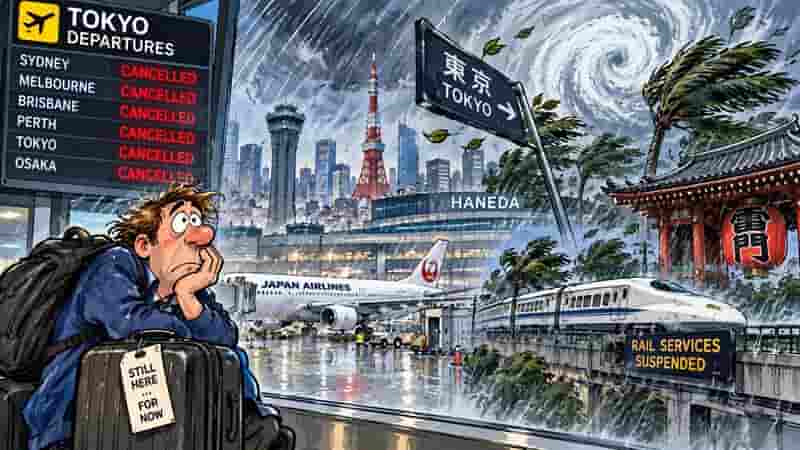
Typhoon Dujuan has battered Tokyo and surrounding eastern Japan with torrential rain and powerful winds, leaving two people dead, cancelling hundreds of flights and disrupting rail services as one of the world’s busiest travel regions counts the cost of the storm.
The weather gods have given Japan’s busy Silver Week holiday a thoroughly unwelcome itinerary change.
Typhoon Dujuan swept past the Tokyo region on Monday, 21 September, bringing flooding, landslides, transport cancellations and widespread warnings before moving away from Japan’s Pacific coast early Tuesday.
For travellers, the effects have been considerable.
Japan Airlines cancelled 135 flights, while All Nippon Airways cancelled 140, according to updated reports, leaving thousands of passengers scrambling for alternatives.
At Tokyo’s Haneda Airport, stranded passengers were photographed waiting as cancellations and delays mounted.
Railways were also affected, with operators suspending services on some lines across Tokyo and neighbouring prefectures as authorities warned passengers against unnecessary travel.
The human consequences have been considerably more serious than missed flights and disrupted holidays.
Two people have been confirmed dead following landslides in Chiba and Kanagawa prefectures, according to local authorities cited by Japanese media.
Japan’s Fire and Disaster Management Agency urged more than 1.6 million residents in and around the Japanese capital to evacuate on Monday. The evacuation advisories were not mandatory.
More than 9,000 households near Tokyo were also reported without electricity as Dujuan brought winds of about 144km/h while passing around 130 kilometres south of Katsuura in Chiba Prefecture.
By early Tuesday, the typhoon had moved away from Japan’s eastern coast and was tracking northeast over the Pacific, with its winds weakening.
Record rain turns dangerous
While “Tokyo typhoon” inevitably captures international attention, some of the most extreme conditions occurred outside central Tokyo.
The Izu Islands, south of the capital, endured extraordinary rainfall.
The Japan Meteorological Agency issued its highest-level, Level 5 landslide special warning for Oshima in the northern Izu Islands on Monday, warning that a disaster may already be underway and that residents faced an immediate threat to life.
The warning was anything but routine bureaucratic weather-speak.
The JMA told people in affected areas to take immediate action to protect themselves, including moving away from cliffs and streams where travelling to an evacuation centre might itself be dangerous.
Izu Oshima recorded a remarkable 672.5 millimetres of rain in the 24 hours to 4.40 pm on Monday, according to JMA figures reported by The Japan Times.
In Chiba Prefecture, the Sakahata area of Kimitsu recorded 324mm over the same period.
Those figures help explain why the effects of Dujuan extended well beyond Tokyo’s particularly wet day.
Flooding was reported in several locations, including Ichikawa in Chiba Prefecture and around Kamakura, the historic tourist destination southwest of Tokyo.
Kamakura Mayor Takashi Matsuo warned that flooding had occurred in various parts of the city and that driving was dangerous.
Airlines take Dujuan off the schedule
For the travel industry, the most immediate consequence has been disruption to Japan’s enormous domestic aviation network.
Combined Japan Airlines and ANA figures total at least 275 cancelled flights.
Japan Airlines’ cancellations included domestic and international services, while ANA’s reported cancellations were concentrated on domestic operations.
Earlier warnings had also identified services involving Haneda, Narita, Shizuoka and Hachijojima airports as potentially vulnerable to disruption.
The figures are particularly significant because Tokyo’s airports are not merely gateways to the Japanese capital. Haneda and Narita form one of Asia’s most important aviation hubs, handling enormous volumes of domestic, regional and long-haul international traffic.
A cancellation in Tokyo can therefore have a rather longer tail than the aircraft sitting at the gate.
Australian travellers connecting through Tokyo to regional Japanese destinations should continue checking their flights directly with their airlines, even as the typhoon moves away.
Passengers should also confirm onward rail connections and airport transfers rather than assuming that a departing flight means the rest of the journey will proceed normally.
Trains feel the force
Japan’s famously dependable railway network was not immune.
East Japan Railway announced partial and full-day suspensions on some routes in Chiba and Ibaraki prefectures and western Tokyo as conditions deteriorated.
That matters particularly during Silver Week, when domestic travel demand in Japan traditionally rises sharply.
The storm’s arrival during the holiday period added another layer of difficulty for hotels, airlines, railways, attractions and travellers already dealing with increased passenger volumes.
It was, to put it mildly, not the sort of additional excitement anyone had ordered with their holiday.
Travellers should keep checking the latest information from their individual railway operators because conditions can vary considerably between lines, and services can resume, operate to modified timetables, or remain suspended as inspections are completed.
Tokyo Game Show loses its finale
Dujuan also upset one of Tokyo’s biggest events.
Organisers of Tokyo Game Show 2026 cancelled Monday’s program, cutting what had been planned as a five-day event down to four days.
They made the decision ahead of the worst conditions rather than waiting for the typhoon to decide for them, generally a considerably wiser approach when tropical cyclones are involved.
Other events were affected, including a major outdoor music festival and a baseball match scheduled in Chiba.
The Asian Games also felt Dujuan’s reach, with the equestrian eventing competition in Aichi Prefecture postponed.
What Australian travellers should do
For Australians currently visiting Japan or scheduled to travel there soon, the key message is that Tokyo has not closed.
It hasn’t.
Instead, travellers should expect residual disruption even after Dujuan moves further away.
Flights and rail services can take time to return to normal schedules, aircraft and crews may be displaced, and local transport in areas affected by flooding or landslides can remain interrupted after the weather improves.
Passengers should check directly with their airline before travelling to Haneda or Narita and confirm train services before beginning longer journeys.
Australian travel advisors should similarly monitor clients with itineraries involving Tokyo, Chiba, Kanagawa, the Izu Islands and other affected areas of eastern Japan.
Where travel has been disrupted, clients should keep receipts and documentation for cancellations, additional accommodation, replacement transport, and other unexpected expenses for any subsequent travel-insurance claim.
Travellers should also follow instructions issued by Japanese authorities rather than relying solely on airline notifications or social media.
The Japan Meteorological Agency remains the authoritative source for Japanese weather warnings and disaster-risk information.
Australians should also consult the Australian Government’s Smartraveller advice for Japan and follow local authorities’ instructions.
Dujuan moves away, but disruption remains
By early Tuesday, Dujuan was heading northeast away from Japan’s eastern coast and into the Pacific, with somewhat weaker winds.
That is encouraging news, but it does not instantly remove the danger.
The JMA continued to warn that rain could persist in affected areas as the system moved north, with saturated ground increasing the potential for further landslides.
For Japan’s tourism industry, Dujuan is another reminder of the operational challenges presented by the country’s late-summer and early-autumn typhoon season.
For travellers, the advice is simpler: check before leaving the hotel, allow more time than usual, and don’t assume Japan’s normally clockwork transport system can outsmart a typhoon.
Even Japan’s trains occasionally have to concede that Mother Nature hasn’t read the timetable.
Useful traveller information:
Japan Meteorological Agency
Smartraveller – Japan
Japan Airlines
ANA
By: Sandra Jones – © 2026.
Read Time: 5 minutes.
Author Bio:
 Sandra has spent a working lifetime quietly rescuing journeys, one itinerary, one anxious caller, one impossible connection at a time. Years in Australia’s finest travel agencies taught her the art of calm, how to find a flight in a fog of cancellations, how to soothe a traveller when luggage wanders, how to turn nine frantic days in Europe into something resembling sense. Qualified, seasoned, endlessly patient, she learned that good travel advice is part logistics, part listening.
But the storyteller in her was always waiting its turn. Writing offered a new map, a way to turn experience into reflection, detail into delight. At Global Travel Media, Sandra now writes the truths only insiders know: the mishaps, the laughter, the grace found between gates and goodbyes. She reminds us that travel, for all its fuss, is still one of life’s better ideas.











