

Årdal, Hjelmeland (Ryfylke), Western Norway
Karen Kyllesø was fourteen when she watched a Norwegian comedian haul a sled across the Greenland ice cap alongside polar explorer Cecilie Skog, and something in her simply decided. At twenty-one, after six years of planning, saving and training, she skied 1,130 kilometres through -40°C, alone and completely unsupported, to the geographic South Pole — the youngest person, male or female, ever to do it. Norway’s prime minister praised her from Oslo. Her home village in Ryfylke welcomed her back in a way she never saw coming.
But ask Karen where the story actually begins, she takes you to a forest outside Årdal, in Hjelmeland, where she once spent her first night alone under the trees as a child — and where, today, a small statue of her stands among the trolls and fairytale figures, waiting for the next generation of kids to find it.
You grew up in Årdal, in Hjelmeland, in a family where holidays meant hunting and fishing trips, and you were carried into the mountains before you could even walk. What was that childhood actually like?
Karen’s outdoor life began before she could walk. As a baby she was carried on her father’s back in a child carrier, small ear protectors clamped over her ears against the crack of his shotgun, on the grouse-hunting trips that were simply part of family life in Årdal. Hunting and fishing weren’t a special occasion in the Kyllesø household; they were the rhythm of ordinary time together, and her parents encouraged her to roam and explore independently from very early on. Her mother, a calm math teacher, and her father, a hunter with a wide range of talents who later built a career advising companies and organisations on process and method, remain her two biggest role models. Alongside it all, Karen competed in cross-country skiing through her youth, racing in the youth classes until she was eighteen — the discipline and physical base that would later prove essential, even though at the time it had nothing to do with polar expeditions. She simply loved being outside.
So where did the polar dream actually come from?
It started with a television screen, when Karen was fourteen. In early 2015, Norwegian broadcaster TV2 aired a series following comedian Truls “Tjukken” Svendsen and polar explorer Cecilie Skog — “Lillemor” — as they skied across Greenland together, hauling their own sleds. Karen was captivated by Cecilie above all: a woman taking on something enormous and physically brutal, in a field dominated by men, entirely on her own terms. It planted an idea that never really left — the same kind of idea, she notes, that she would go on to plant in young girls in her own village years later, without ever meaning to.
A documentary is one thing. Actually getting yourself to Greenland at fourteen or fifteen is another. How did that happen?
Slowly, and largely through her own effort. Karen wanted to join a crossing of the Greenland ice sheet with Ousland Explorers, the polar expedition company founded by Børge Ousland — but they set one condition first: she had to prove, on her own, that she could handle herself in the wild before they would take her on a real expedition. That proof came when she was invited on a crossing of Finnmarksvidda, the vast Arctic plateau in Northern Norway: her first ever winter expedition, with temperatures as low as -35°C, and one she loved from start to finish. It was enough — she had proven herself, and the invitation to join the Greenland crossing followed.
What remained was the budget, built from nothing: odd jobs, cold-emails to local companies sent from her school desk, every krone she earned saved, and the rest borrowed from her parents. It took about a year of training, planning and fundraising before she finally stood on the ice sheet — not yet fifteen — and skied roughly 600 kilometres across Greenland, becoming the youngest girl ever to cross it on skis. A decade later, in a full-circle turn she still finds slightly surreal, Karen now leads Greenland crossings for Ousland Explorers herself: the student has become the guide.
After Greenland, what came next?
A far bigger quest: the South Pole. Skiing solo and unsupported to the Pole isn’t something you simply decide to do — it requires official approval, a proven level of experience, and years of preparation. From her first serious idea to the start line at Hercules Inlet took six years, during which getting to Antarctica was effectively her full-time occupation: training her body, testing equipment down to the smallest detail, and building the sponsorships that would fund the expedition. Her father, whose career had become helping organisations optimise their methods, worked alongside her almost like a project partner, going through every item on her gear list and every part of her plan, looking for what could be tightened. Just as important was risk planning: working through everything that could conceivably go wrong and deciding in advance how she would respond to each scenario. That groundwork is what let her stand at the start line and feel calm — and what let her parents send her off and trust it.
Take us onto the ice. What was it actually like out there?
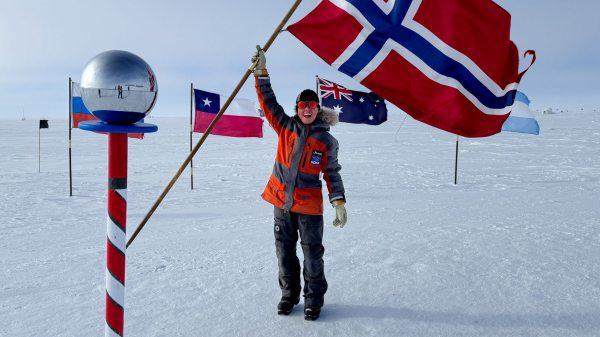
Karen departed Hercules Inlet on 21 November 2024, hauling a sled that weighed close to 114 kilograms — well over double her own bodyweight; she is 152cm and 48kg — through temperatures that dropped to -40°C, entirely alone. The middle stretch was hardest: days seven through twenty brought deep, heavy snow that slowed her well behind schedule, to the point where the maths for finishing in time grew tight. She recalculated, adjusted, and kept moving, trusting the preparation and equipment she had spent six years building. Fifty-three days after setting out, on 13 January 2025, she reached the geographic South Pole, becoming the youngest person ever, male or female, to ski there solo and unsupported — breaking the previous record by six years, a feat confirmed by Guinness World Records and publicly praised by Norway’s prime minister, Jonas Gahr Støre.
What was it like re-entering the world after fifty-three days completely alone?
Almost disorienting — not because the silence ended, but because of what had happened to her story while she wasn’t looking. Out on the ice she had no idea how far the expedition had travelled online or how much attention it had drawn; coming home, she found that everyone had already followed it on their screens, which made it feel, oddly, as if it no longer belonged to her alone. Nothing prepared her, though, for what was waiting in Hjelmeland: the whole village turned out, and at the local elementary school, young girls cheered for her the way she once watched Cecilie Skog on TV. It was, she says, the moment it really hit her — that a girl somewhere might now be looking at her exactly the way she once looked at Cecilie.
That same realisation is part of why she co-founded Polarjenter with three other women, to bring more women into a field that has historically been very male and very solitary.
Ryfylke — home. What does this place actually mean to you today, beyond where you grew up?
It’s still where Karen feels most like herself. She points first to Eventyrskogen, the “fairytale forest” outside Årdal dotted with troll carvings and storybook figures, where local children go to play and lose themselves in stories — and where Karen herself spent her very first night ever camping completely alone. Today, a small statue of her stands in that same forest, discovered by the young visitors who pass through. Her favourite spot in the whole region is Lyngsheia, for the view: on a clear day you can see across the entire area, all the way to Lysefjord. She lives in Stavanger now, guiding tours, running outdoor workshops and giving keynotes for companies, but spends as much time as she can back home, hiking and swimming through the landscape in every season — her private paradise, whatever the time of year.











