

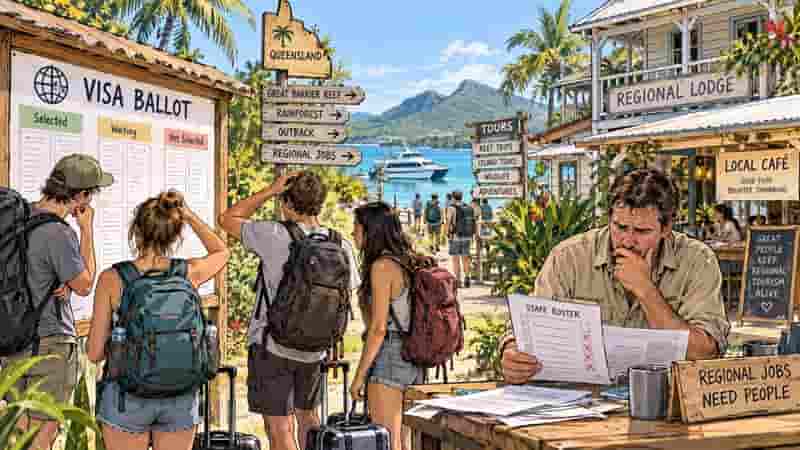
Australia’s Working Holiday Maker program is heading for its biggest shake-up in years, with new limits and ballots for second and third-year visas prompting an immediate warning from Queensland’s tourism industry that regional operators could lose thousands of backpacker workers and the visitor spending that travels with them.
Home Affairs Minister Tony Burke unveiled the broader migration overhaul at the National Press Club in Canberra on Thursday, 17 September, as the Federal Government moves to bring net overseas migration down towards 225,000 by 2028.
For tourism operators, however, the headline is not buried in Canberra’s migration arithmetic. It is much closer to the front desk, kitchen, tour bus, farm gate and housekeeping roster.
The government will introduce a ballot system governing access to second and third Working Holiday Maker visas. The second-year program will be limited to 45,000 places, compared with about 57,000 people who qualified this year. Third-year places will be restricted much more sharply, to a ballot of 5,000, compared with about 31,000 people in the group this year. Arrangements applying to UK passport holders are affected differently because of Australia’s free trade agreement with Britain.
That distinction matters. For many Working Holiday Makers, specified work has traditionally provided a reasonably clear road towards another year in Australia. Complete the required work, satisfy the other visa conditions and the traveller could apply for the next visa.
Under the announced system, specified work would instead qualify an eligible traveller to enter a ballot. Completing the work would therefore no longer necessarily result in another visa.
And that has Queensland Tourism Industry Council chief executive Natassia Wheeler sounding the alarm.
“The Australian Government, following today’s announcement, has not simply cut Working Holiday Maker visas. It has dismantled the incentive that sends thousands of young travellers into regional Australia.”
Her argument goes directly to one of the long-standing mechanics of the backpacker economy: young travellers go where the work is partly because doing so can help them remain in Australia longer.
For eligible Working Holiday Makers, a second visa has involved completing three months of specified work, while a third visa can require six months of specified work. Home Affairs continues to describe specified work as an eligibility requirement for further Working Holiday Maker visas, although UK passport holders enjoy exemptions from those requirements under the Australia–UK arrangements.
Wheeler said replacing that relatively direct incentive with a ballot could change behaviour well before a traveller actually applies for another visa.
“Under the current system, a Working Holiday Maker who completes the required specified work earns access to another year in Australia. Under the new system, they can do everything asked of them and still lose their place in a ballot.”
She added: “Why would a young traveller leave the city and complete three months of regional work when there is no longer certainty of receiving a second visa? The workforce impact will begin during their first year, long before the ballot is held.”
Northern Australia particularly exposed
For tourism businesses across Tropical North Queensland and other parts of northern Australia, the third-year setting may be the bigger change.
Tourism and hospitality work in eligible northern locations has long been part of the specified-work pathway used by Working Holiday Makers extending their stay.
“The third-year pathway is even more concerning,” Wheeler said.
“Working Holiday Makers currently undertake six months of specified work during their second visa to qualify, including tourism and hospitality work across northern Australia. Reducing third-year availability to just 5,000 places undermines that incentive at the source.”
She said destinations that have built seasonal workforce models around these travellers could be especially exposed.
“This is why Tropical North Queensland and other northern destinations are so exposed. Tourism and hospitality work across the north has long been an attractive pathway to a third year. That workforce now has very little certainty that six months of specified work will lead anywhere.”
The government’s figures underline the scale of the adjustment. About 31,000 people were in the third-year qualification group this year, while the announced ballot will provide 5,000 places, subject to the UK-related arrangements.
QTIC forecasts 10,300 fewer backpackers in Queensland
QTIC estimates the changes could ultimately mean approximately 10,300 fewer regional backpackers in Queensland, while its national modelling points to a reduction of around 38,000 regional backpackers.
Those figures are QTIC estimates and should not be confused with a government forecast.
Wheeler argues the effect would extend beyond labour supply.

QTIC CEO Natassia Wheeler responds to today’s news on working holiday makers
“These are not abstract migration numbers. They are the people staffing tourism experiences, accommodation, hospitality venues, farms and regional businesses across Queensland,” she said.
“Working Holiday Makers are also visitors. When we lose that workforce, we also lose the money they would have spent on accommodation, transport, hospitality, tours and experiences.”
Solid historical evidence supports the broader economic point that Working Holiday Makers are unusually valuable travellers.
Tourism Australia says Working Holiday Makers tend to stay longer, spend more and disperse more widely than many other visitor segments. Its data showed they contributed about $3.2 billion to Australia’s visitor economy in 2019, while more recent Tourism Research Australia analysis found working holidaymakers spent $2.5 billion in 2024, averaging $10,714 per trip. They contributed more than half the increase in international holiday expenditure in regional Australia that year.
That is an important wrinkle in the debate. A backpacker working behind a bar in Cairns or picking produce outside Bundaberg is simultaneously part of the labour market and part of the visitor economy.
In tourism terms, they arrive with two hats and preferably a backpack sturdy enough to carry both.
Processing resumes, but industry wants certainty
Businesses concerned about the recent slowdown in Working Holiday Maker processing felt some relief.
Burke said changes to Ministerial Direction 119 would add agriculture, construction, fisheries and teaching to priority sectors and allow the department to restore normal processing speeds for primary Working Holiday Maker applications.
Applications had previously been paused across numerous capped subclass 462 countries. Home Affairs says such pauses can occur when allocations are nearing their caps, to spread applications throughout the program year, or to support broader migration settings.
QTIC, however, argues that faster processing does not compensate for uncertainty around access to subsequent visas.
“Lifting the processing pause does not represent a win for industry when it is accompanied by deep cuts, a ballot and processing times of up to three months,” Wheeler said.
“The pause has simply been replaced by permanent restriction and uncertainty.”
The government’s broader argument is that migration needs to be managed more precisely rather than reduced without regard to labour demand.
Burke said the visa-priority changes were intended to direct workers towards sectors Australia needs, while the wider policy is designed to reduce net overseas migration without creating larger economic disruptions. Government data released in June showed annual net overseas migration had already fallen to 301,000 in the year to December 2025, down more than 45 per cent from the post-pandemic peak.
The dispute, therefore, is less about whether migration should be managed than about where the reductions fall and what incentives remain for travellers to work outside the capitals.
QTIC says regional Australia risks carrying a disproportionate share of the consequences.
“We recognise that the government must manage migration responsibly. But this policy achieves a headline reduction at the expense of the regional communities least able to absorb the loss,” Wheeler said.
Tourism industry pushes for rethink
QTIC is now calling on Canberra to reconsider the ballot arrangements, protect people already completing specified work and maintain viable pathways into second and third-year Working Holiday Maker visas.
“QTIC is calling for the ballot decision to be reconsidered, for existing applicants and people already completing specified work to be protected, and for viable second and third-year pathways to be retained,” Wheeler said.
“Queensland tourism will keep making this case, loudly and clearly, on behalf of the regional businesses that will carry the consequences of this decision. Our operators need certainty, not a lottery.”
For regional tourism employers, the next critical stage will be the fine print: when the ballots begin, how transitional applicants are treated, how places are distributed and exactly how the UK exemption interacts with the overall limits.
Those details will determine whether the new system simply changes the paperwork or fundamentally alters one of regional tourism’s most enduring sources of mobile labour.
What is already clear is that Working Holiday Makers are not merely an immigration statistic.
They pour beers, make beds, guide tours, pick crops, serve meals and spend much of what they earn while travelling through Australia.
And for regional tourism businesses trying to fill the next roster, the distinction between a visa number and an available pair of hands can be considerable.
Additional information: Australian Department of Home Affairs, Working Holiday Maker Program; Working Holiday Maker Program – Home Affairs | Tourism Australia; Youth and Working Holiday Maker research; Tourism Australia – Youth Sector.
By: Jason Smith – © 2026.
Read Time: 6 minutes.
Author Bio:
 Jason Smith didn’t learn travel from textbooks. He learned it in airports, taxis and hotel lobbies, watching the business unfold long before he played his own part. Half American, half Asian, he grew up around the quiet workings of tourism, where people come and go, and stories rarely stand still.
Bangkok came first, then formal study, then a career that carried him through Singapore, Malaysia and Vietnam. Each place left something behind. In the end, Thailand felt like home, along with a senior role in hotel sales.
Then everything stopped. Borders shut, planes grounded, and Jason found himself back in America with time to reflect.
Now at Global Travel Media, he writes travel as it really is, not polished, not perfect, but human, and all the better for it.











