

Emirates is heading into the northern winter with something every airline likes to see before the temperature drops: a booking curve pointing firmly in the right direction.
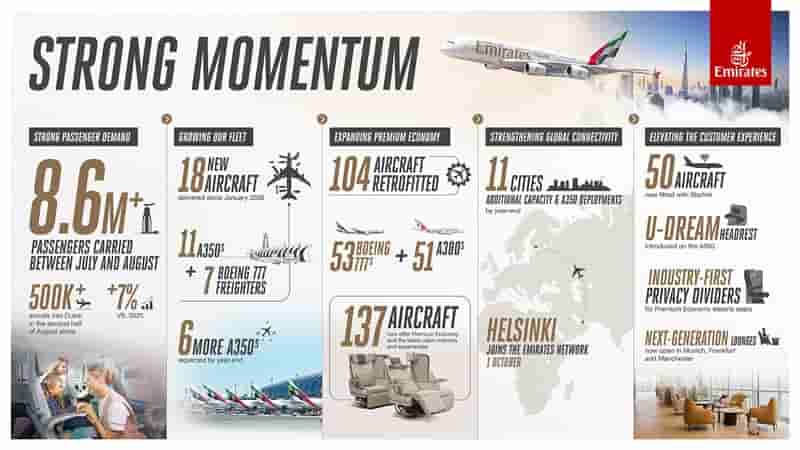
The Dubai carrier says it carried more than 8.6 million passengers during July and August, finishing the summer ahead of expectations and entering the late-October winter season with solid booking momentum.
Seat load factors remained healthy across the network, while Emirates says it is now operating at about 93% of its pre-disruption capacity. The figures form part of the airline’s latest trading and network update, released on 14 September.
That matters because 2026 has hardly been a year in which international aviation could put its feet up and order another coffee.
Regional airspace disruption has tested schedules, capacity and passenger confidence, particularly through the Middle East. Yet Emirates’ latest figures suggest demand is responding quickly wherever capacity returns.
Dubai International Airport provides some useful perspective. DXB handled 31.5 million passengers during the first six months of 2026, with Dubai Airports reporting steadily improving traffic through the second quarter as airline capacity returned.
For Emirates, that recovery feeds directly into the economics of the Dubai hub.
Winter Demand Spreads Across Key Markets
Emirates says winter bookings are tracking ahead of last year across a surprisingly broad range of markets, including South Africa, Brazil, India, Portugal, Egypt, Ghana, Colombia, Saudi Arabia and Pakistan. Nepal is also performing strongly through the airline’s partnership with flydubai.
That geographical spread is important. It means Emirates is not depending upon one or two booming markets to do the heavy lifting.
The UAE remains a strong outbound market, while demand for premium travel continues to rise.
Premium Economy, in particular, is becoming an increasingly important part of the Emirates proposition, with the Americas recording the strongest growth in demand for the cabin during the northern summer.
Across West Asia, Europe, the Middle East, the Americas and Africa, Emirates reported summer seat load factors comfortably above 75%, with particularly strong performance on services involving Indonesia, Côte d’Ivoire and the United Kingdom.
Dubai itself remains central to the story.
In the second half of August alone, more than half a million Emirates passengers arrived in Dubai, up 7% from the same period in 2025.
Those travellers included residents returning before the new school year, people relocating to Dubai to live and work, and visitors choosing the city for a late-summer break.
In airline terms, it is a useful cocktail: tourists, residents, business travellers and connecting passengers all moving through the same hub.
Fleet Investment Moves From Promise to Product
The other half of Emirates’ winter story is metal and plenty of it.
Since January, the airline says it has taken delivery of 18 aircraft: 11 Airbus A350s and seven Boeing 777 freighters. Another six A350s are scheduled to arrive before the end of December.
The A350 is becoming increasingly important to Emirates’ network and product strategy.
Helsinki joins the Emirates network on 1 October 2026, with a daily A350 service between Dubai and the Finnish capital. Emirates says the route will create the only year-round direct connection between Finland and the UAE.
The A350 currently serves 30 destinations from Dubai, with that figure expected to increase to 36 by the end of the year.
Meanwhile, Emirates says 104 aircraft have completed its formal retrofit programme, comprising 53 Boeing 777s and 51 Airbus A380s.
The number of aircraft offering Premium Economy and Emirates’ latest cabin products has reached 137, with the airline forecasting 155 by the end of December.
Premium Economy is now available on services to 90 destinations, with another six destinations scheduled to receive the product before the end of 2026.
For passengers, this is where a multibillion-dollar fleet program stops being an engineering story and becomes something they can actually sit in.
Emirates’ wider retrofit initiative represents a US$5 billion investment covering 219 aircraft. In July, the airline marked the completion of the 100th aircraft under the formal retrofit program.
Privacy, Headrests and Wi-Fi at 40,000 Feet
There is also a noticeable push to make cabin investment more visible to travellers.
This year, Emirates introduced its U-Dream headrest for Economy Class, an adjustable system designed to provide greater neck and head support during long flights.
It is hardly the stuff of aviation folklore, perhaps, but anyone who has spent 14 hours attempting to sleep upright may regard a decent headrest as considerably more useful than another glossy launch video.
Emirates says the U-Dream system will ultimately feature across its A350 fleet and most of its A380s and Boeing 777s.
The airline has also unveiled a new electrically powered Premium Economy seat on the A350 featuring a full-height adjustable privacy divider, which Emirates describes as an industry first for the cabin category.
The seat is arranged in a 2-3-2 configuration on the A350, with a width of 20 inches and pitch of up to 39 inches.
Connectivity is moving almost as quickly.
Emirates says close to 50 aircraft are now equipped with Starlink, with installations continuing alongside its broader fleet modernisation program.
The objective is straightforward: streaming, messaging, browsing and working at 40,000 feet should increasingly feel like an expected utility rather than an aviation party trick.
More Flights Build Dubai’s Global Web
Network expansion will continue through the winter season.
Emirates plans second daily services to Accra, Tokyo Narita, Ho Chi Minh City and Hanoi, while one daily Delhi flight will be upgraded to the A380.
The A350 is scheduled for deployment to Larnaca, Malta, Nairobi and Hamburg from late October, followed by Mauritius in November.
Meanwhile, retrofitted Boeing 777s will be introduced on Stockholm services in October and Frankfurt in November.
But Emirates is not relying entirely upon aircraft wearing its own colours.
The airline says its 168 codeshare, interline and intermodal partnerships give customers access to an additional 1,750 cities. On an average day, more than 13,000 Emirates customers continue their journeys aboard partner airlines.
The flydubai relationship remains particularly significant.
Emirates says the two carriers now provide access to more than 214 unique destinations in over 100 countries, producing more than 4,600 potential connection opportunities through Dubai.
Since the partnership began in 2017, the carriers have transported more than 28 million passengers across their integrated networks.
That gives Emirates something relatively few long-haul airlines can easily reproduce: a huge widebody operation feeding into an extensive short and medium-haul regional network from the same home hub.
Strong Finances Give Emirates Room to Move
Crucially, Emirates enters this expansion phase with considerable financial strength.
For the financial year ended 31 March 2026, Emirates reported record revenue of AED130.9 billion (US$35.7 billion) and profit before tax of AED22.8 billion (US$6.2 billion).
The airline carried 53.2 million passengers during the year and ended March with cash assets of AED54.9 billion.
Those numbers give Emirates considerable financial firepower for aircraft, cabin upgrades, lounges, technology and network growth.
Passengers, of course, tend to judge airlines using simpler measures: whether the aircraft leaves on time, whether the seat is comfortable, whether the Wi-Fi works, whether the suitcase arrives, and what happens when the carefully constructed itinerary falls to pieces.
Emirates has therefore also been adding flexibility.
Its current customer measures include free date-change options and Comprehensive Travel Cover, introduced in June, incorporating insurance and airline-managed assistance across a range of disruption scenarios, including certain conflict-related events and airspace closures.
Emirates Keeps the Throttle Open
For the travel trade, the broader message is clear.
Emirates is no longer simply restoring capacity lost during disruption. It is using the recovery to expand its network, refresh older aircraft, introduce the A350 more widely, push Premium Economy deeper into the system and strengthen the partnerships that make Dubai function as one of global aviation’s great connecting hubs.
There are still plenty of variables capable of upsetting aviation’s best-laid plans. Geopolitics remains unpredictable, travellers are increasingly booking closer to departure, and operational resilience will continue to be tested.
But Emirates is entering the approaching winter with passengers returning, aircraft arriving and bookings building.
With Helsinki joining the map, more A350s on the way and premium cabins spreading across more routes, the airline appears determined to keep the throttle open.
For travel advisers, that translates into more capacity to sell, more connections to explain and, increasingly, more Emirates cabin configurations to remember.
Nobody said progress came without homework.
By: Sandra Jones – © 2026.
Read Time: 5 minutes.
Author Bio:
 Sandra has spent a working lifetime quietly rescuing journeys, one itinerary, one anxious caller, one impossible connection at a time. Years in Australia’s finest travel agencies taught her the art of calm, how to find a flight in a fog of cancellations, how to soothe a traveller when luggage wanders, how to turn nine frantic days in Europe into something resembling sense. Qualified, seasoned, endlessly patient, she learned that good travel advice is part logistics, part listening.
But the storyteller in her was always waiting its turn. Writing offered a new map, a way to turn experience into reflection, detail into delight. At Global Travel Media, Sandra now writes the truths only insiders know: the mishaps, the laughter, the grace found between gates and goodbyes. She reminds us that travel, for all its fuss, is still one of life’s better ideas.











