

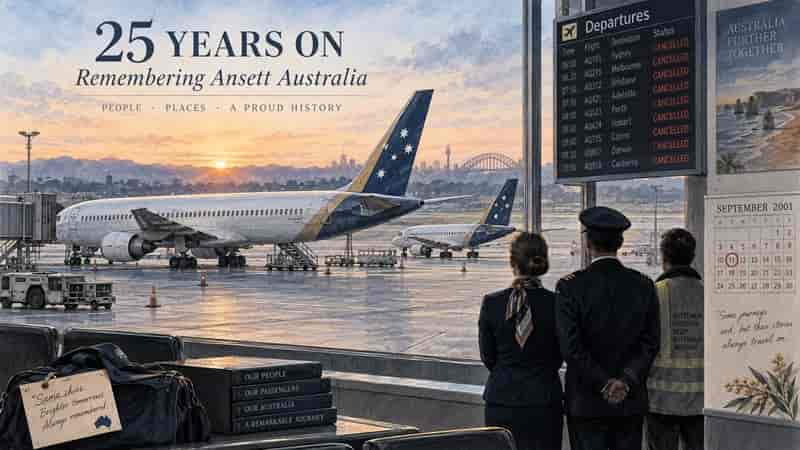
For a generation of Australian travellers and travel-industry people, the name Ansett Australia still carries an emotional weight few vanished airlines can match.
This week marks 25 years since the collapse of Ansett Australia, an airline that had been part of the national aviation landscape for 65 years and, for me, was once my favourite Australian carrier.
The anniversary deserves to be remembered accurately, because Ansett did not disappear in a single moment.
On 12 September 2001, the Air New Zealand-owned Ansett Group began entering voluntary administration as its financial position became untenable. Two days later, on 14 September, administrators grounded the airline’s main fleet and the majority of employees were stood down.
About 15,000 people faced retrenchment. For employees, their families, travel agents, suppliers and communities around Australia, the consequences were immediate and deeply personal. Australian National Audit Office records confirm that the Ansett Group began external administration on 12 September and that approximately 15,000 employees faced possible retrenchment.
The timing could scarcely have been worse.
The collapse unfolded in the immediate aftermath of the September 11 terrorist attacks in the United States, when the global aviation industry was entering one of the most uncertain periods in its history.
Ansett had already been fighting serious problems of its own. Shortly before its collapse, parent company Air New Zealand confirmed the Australian carrier was losing approximately $1.3 million a day.
It had also endured damaging operational problems involving its Boeing 767 fleet.
The Australian Transport Safety Bureau later identified deficiencies in Ansett’s engineering and maintenance organisation, including organisational structure and change management, work processes, resource allocation, and workload.
Importantly, however, the ATSB found no evidence that Ansett had deliberately breached airworthiness regulations.
Ansett refuses to disappear quietly
The September grounding was not quite the final curtain.
Administrators Mark Mentha and Mark Korda worked to restart a dramatically smaller operation. Limited services returned later in September 2001, followed by the reduced operation that became widely known as Ansett Mark II.
The Federal Government also agreed to provide a limited guarantee to support ticket sales as part of efforts to get some aircraft back into the air.
For a time, there was genuine hope that a buyer might give Ansett another life.
A proposed sale to the Fox-Lew Tesna consortium ultimately failed, however, and the resurrected mainline operation could not continue.
All Ansett mainline flights were suspended from midnight on 4 March 2002.
It was the final ending for an airline that, before administration, had carried more than 14 million passengers a year, employed more than 15,000 people and operated a fleet of 133 aircraft.
For employees, the ordeal lasted another decade
For thousands of former Ansett employees, however, the airline’s story continued long after its aircraft disappeared from Australia’s departure boards.
The Federal Government established the Special Employee Entitlements Scheme for Ansett Group Employees, or SEESA, providing a safety net for eligible employee entitlements.
A special passenger-ticket levy was introduced to help fund the scheme, while administrators continued selling Ansett’s assets and distributing the proceeds.
It was a long process.
In September 2011, a full decade after the collapse, the administrators announced the 14th and final employee dividend.
Former employees shared $727.5 million through the administration, receiving an average of about 96 cents for every dollar of their entitlements.
That was a considerably better result than many had initially feared.
But a decade remains an extraordinarily long time for people to wait for final closure after losing careers, incomes and, in many cases, a workplace that had become an enormous part of their lives.
Could Ansett have been saved?
That question can still start a lively argument among Australian aviation veterans.
The Howard Government rejected a direct taxpayer-funded bailout before Ansett collapsed. Prime Minister John Howard argued against committing taxpayers to the enormous financial burden required to keep the struggling carrier operating.
The government nevertheless intervened in important ways, including supporting employee entitlements and providing a limited guarantee that helped the reduced Ansett operation return to the skies.
It would therefore be too simplistic to declare as fact that government intervention would certainly have prevented Ansett’s demise.
Whether earlier, different or substantially greater intervention might have produced another outcome remains a legitimate subject for historical and economic debate.
An Australian aviation tragedy still remembered
The scale of the loss is not in doubt.
Ansett Australia was more than aircraft, terminals and timetables.
It was cabin crew, pilots, engineers, ground staff, sales representatives and thousands of other employees who helped build one of Australia’s best-known aviation brands.
Twenty-five years later, many people throughout Australia’s travel industry still remember Ansett with extraordinary affection.
For me, that is Ansett’s enduring sadness.
Airlines can vanish remarkably quickly from airport departure boards, but the people, friendships and memories they leave behind take considerably longer to disappear.
Ansett’s aircraft may have fallen silent a quarter of a century ago, but in Australian aviation history, the airline has never entirely left the departure lounge.
By: John Alwyn-Jones – © 2026.
Read Time: 3 minutes.
Author Bio:
 John Alwyn-Jones is one of those rare figures who can make the business of travel sound positively adventurous.
A lifelong communicator with the polish of a broadcaster and the curiosity of a journalist, he’s spent decades shaping stories and strategies across tourism, aviation, and the cruise world. He’s led from the front as CEO, director, mentor, and advisor, and still brings warmth and wit to every boardroom and microphone.
Known for his sharp insight into global cruise lines and destinations, John has an old-school belief in professionalism, tempered with the sparkle of someone who’s genuinely seen the world. He’s not just in the business of travel; he’s made it an art form.











