

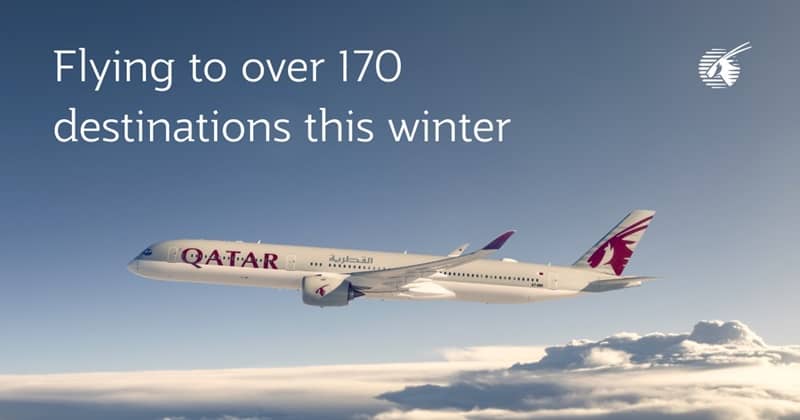
Qatar Airways is putting serious muscle behind its 2026–27 winter timetable. Its network will grow to more than 170 destinations across Africa, Asia Pacific, Europe, the Americas and the Middle East.
For Australian travel sellers, however, the headline act is much closer to home. Canberra returns to the map from 9 December 2026, linked daily to Doha via Melbourne.
The expansion is more than a route-map flourish. Qatar Airways says it is preparing nearly 1,800 weekly frequencies during December 2026. That gives its Doha hub an even larger role in moving travellers between continents.
Schedule depth can be just as valuable as another pin on the map. The strategy is simple: offer more departure choices, strengthen onward connections and make Doha considerably harder to bypass.
For travel advisors, that matters.
A broader network is useful. A broader network with higher frequencies is much more useful.
Clients miss connections, change plans and extend holidays. Some simply refuse to rise at an ungodly hour, a perfectly understandable objection at any stage of life.
Frequency therefore becomes one of the quiet luxuries of long-haul travel.
Australia moves up the Qatar Airways agenda
Australia is one of the key parts of this winter push.
From 9 December, Qatar Airways will resume daily Canberra services via Melbourne. That reconnects the national capital with the carrier’s global network through Hamad International Airport.
The airline will also lift its Melbourne schedule from seven to 14 weekly Qatar Airways flights. In practical terms, Qatar Airways is doubling its own frequency on the route.
The Australian picture becomes still more substantial when Virgin Australia is added.
From 7 December 2026, Virgin Australia says it will operate two daily Sydney–Doha services. Qatar Airways aircraft will fly them under Virgin Australia flight numbers.
Brisbane–Doha returns with three weekly flights in December, while Perth–Doha comes back with four.
Together, those services give agents more inventory and considerably more routing flexibility for clients heading towards Europe, Africa and the Middle East.
Canberra’s return is particularly noteworthy.
Australia’s capital has long had an odd aviation problem. It has plenty of diplomats, public servants, politicians and corporate travellers, but relatively few long-haul international options.
The daily Canberra–Melbourne–Doha service gives the ACT and surrounding region a one-stop pathway into Qatar Airways’ wider system. It also removes the need for travellers to construct a separate domestic booking through Sydney.
Zanzibar returns as Africa gets more capacity
Beyond Australia, the winter schedule sweeps through high-demand leisure and business markets.
Zanzibar returns to daily Qatar Airways service from 25 October 2026.
The Seychelles rises from four to seven weekly flights from 1 March 2027, while Johannesburg increases from 14 to 18 weekly services from 2 December 2026.
North America also receives a useful lift.
Montréal moves from five to seven weekly services from 25 October. Qatar Airways says that represents a 40 per cent increase in seat capacity.
The extra flying is aimed in part at demand between Canada, the Indian Subcontinent and the Middle East.
Those multi-market traffic flows are exactly what have turned Gulf hubs into such powerful connecting machines.
Asia Pacific lands some of the biggest increases
Asia Pacific receives some of the largest frequency gains.
Phuket climbs from 14 to 21 weekly flights from 25 October.
Malé, gateway to the Maldives, jumps from 12 to 21 weekly services.
Ho Chi Minh City increases from seven to 11 weekly services from 7 November. Four direct Doha–Ho Chi Minh City flights will return, alongside the existing operation via Phnom Penh.
Kuala Lumpur will be served by 18 Qatar Airways flights each week from 25 October.
Malaysia Airlines will complement them with another 14 weekly Kuala Lumpur–Doha services.
The practical effect is more choice across departure times and connecting banks.
Not glamorous language, perhaps, but exactly the sort of detail that can rescue an itinerary from becoming an endurance event involving three airport coffees, two security queues and a very unhappy client.
London reaches eight Qatar Airways flights a day
Europe is receiving similar treatment.
London Heathrow will rise from 49 to 56 Qatar Airways services a week from 25 October, effectively eight flights a day.
British Airways also operates a daily Doha service as Qatar Airways’ codeshare partner.
Frankfurt increases from 18 to 21 weekly flights from 7 December.
The Middle East network is also widening.
Qatar Airways will resume Qassim on 25 October and Taif on 31 October.
Yanbu follows on 2 January 2027, then Tabuk on 3 January.
Each route will operate twice weekly. That takes the airline’s Saudi Arabian network to 12 destinations and more than 155 weekly flights.
Starlink becomes part of the product
The other major story is happening above the clouds, not on the route map.
Qatar Airways says more than 150 widebody aircraft are now equipped with Starlink, with as many as 340 Starlink-enabled flights operating daily under its latest winter announcement.
An August airline update confirmed that 150 widebody aircraft had already been fitted.
It also said Qatar Airways remained on track to complete the Starlink rollout across its Boeing 787 fleet by the end of 2026.
That connectivity proposition matters to premium and corporate travellers.
Fast gate-to-gate internet can turn a long-haul sector from enforced downtime into usable work time.
Leisure travellers can message, stream and keep family updated.
Either way, “airborne and unavailable” is becoming a rather less convincing excuse.
An airline arriving with considerable silverware
Qatar Airways also enters this expansion with substantial brand recognition.
The latest completed Skytrax World Airline Awards, held in 2025, named Qatar Airways the World’s Best Airline and World’s Best Business Class.
Awards don’t guarantee every journey will be flawless. Aviation has never been so obliging.
Even so, they give travel advisors useful third-party context when comparing premium long-haul products for clients.
Why travel advisors should care
For the travel trade, the commercial message is straightforward.
More frequencies mean more combinations.
More combinations mean more viable itineraries.
That improves an advisor’s chance of matching a client’s preferred dates, budget and tolerance for connections.
Qatar Airways’ winter expansion is therefore not simply about adding scale.
It is about making that scale saleable.
The restored Canberra service may be the most visible Australian development.
The larger story is the density being built around Doha.
Sydney, Melbourne, Perth, Brisbane, Adelaide and Canberra all feed into Qatar Airways and partner services, creating deeper pathways for Australian travellers into Europe, Africa, the Middle East and beyond.
Bookings for the expanded winter schedule are available through the airline’s official website and mobile app.
Qatar Airways official website and bookings
Travel advisors should, naturally, recheck operating days, timings and aircraft details when making future bookings. Airline schedules can and do change.
For Qatar Airways, however, the direction of travel is unmistakable.
Winter 2026–27 is not shaping up as a quiet seasonal adjustment.
It is a network offensive: more cities, more frequencies and more Australian capacity.
And if Starlink behaves itself at 35,000 feet, there will be considerably fewer excuses for ignoring the inbox.
By: Michelle Warner – © 2026.
Read Time: 5 minutes.
Author Bio:
 Michelle Warner has always carried stories the way others carry passports lightly, faithfully, and with purpose. She learned her craft in newsrooms, shaping sentences with care, before swapping deadlines for departures as a flight attendant with some of the world’s great airlines. Years aloft sharpened her eye for character and deepened her fondness for the small, dignified rituals of travel, the quiet kindness of strangers, the poetry of arrival, the patience learned between time zones.
Now grounded by choice, Michelle has come home to writing with the same calm authority she once brought to turbulent cabins. Her prose blends an editor’s discipline with a traveller’s wonder, tinged with humour and reverence for the golden age of travel. Each piece feels like a handwritten boarding pass, gracious, observant, and unmistakably alive.











