

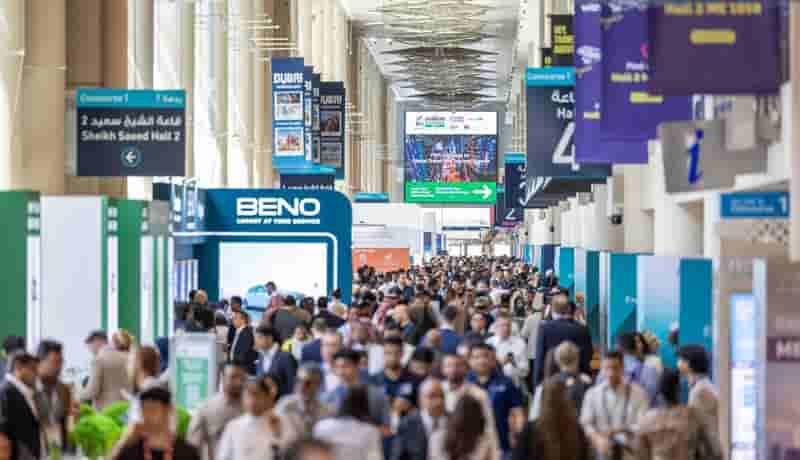
Arabian Travel Market 2026 opened yesterday at Dubai World Trade Centre, throwing open the doors on four days of serious deal-making, technology, tourism debate and the sort of networking for which comfortable shoes remain travel’s most underrated accessory.
The 33rd edition of Arabian Travel Market (ATM) is running from 14–17 September, bringing airlines, tourism boards, hotels, travel sellers, buyers, technology companies and industry leaders from around the world to Dubai.
And Global Travel Media is there, with May attending ATM 2026 on the ground in Dubai, giving our readers a first-hand view of one of the Middle East’s most important travel trade gatherings.
The official event website is available through Arabian Travel Market.
ATM arrives at a significant moment for international travel.
The industry has endured another period in which geopolitical uncertainty, airline disruption, shifting consumer sentiment, and relentless cost pressures have reminded everyone that tourism can be remarkably resilient but never entirely bulletproof.
That makes this year’s theme, “Travel 2040: Driving New Frontiers Through Innovation and Technology”, particularly relevant.
It sounds futuristic. In reality, much of it concerns problems travel businesses are dealing with this morning.
Artificial intelligence, digital distribution, changing traveller expectations, smart mobility, sustainability, data ownership and destination resilience are no longer distant concepts being discussed over coffee at conferences.
They are reshaping the business now.
Technology moves centre stage
One of ATM 2026’s biggest developments is the debut of ATM Travel Tech as a dedicated co-located show.
Organisers say more than 180 exhibitors from 30 countries are participating across two dedicated halls, creating a major new platform for technology businesses, innovators and travel companies looking for commercial solutions.
At its centre is the 850-square-metre Tech & Innovation Hub, focusing on artificial intelligence, virtual and augmented reality, robotics, fintech and green technologies.
It is an impressive shopping list.
The more important question, of course, is which technologies will actually make travel businesses more efficient, improve the customer experience and make money on that rather unfashionable but crucial concept.
The accompanying Future Stage is tackling those questions through sessions covering artificial intelligence and automation, data and digital transformation, immersive technology, fintech, robotics and next-generation travel platforms.
Dr Marwan Alzarouni, CEO, AI at the Dubai Department of Economy and Tourism, is among those examining how artificial intelligence is reshaping travel.
Senior representatives from Sabre, Trip.com, Tripadvisor, Wego, MakeMyTrip, RateGain and Visa are also involved in discussions covering agentic AI, digital discovery, investment, online travel agencies and the rapidly evolving travel supply chain.
For travel advisors, these conversations matter.
AI can build an itinerary in seconds. What it cannot automatically answer is who owns the customer, who controls the booking relationship and who ultimately keeps the margin.
Those may prove to be some of travel’s defining commercial questions over the next decade.
Confidence joins innovation on the agenda
Technology, however, is only one part of ATM 2026.
The conference program extends across the Global Stage, Future Stage and Experience Hub, combining government, tourism, aviation and private-sector expertise.
Details are available through the official ATM Conference Programme.
A major opening discussion is the Ministerial Debate: Building A Resilient Industry Through Collaboration.
Participants include H.E. Abdulla bin Touq Al Marri, UAE Minister of Economy and Tourism; H.E. Shaikha Nasser Al Nuwais, Secretary-General of UN Tourism; Bahrain Tourism Minister Fatima Jaafar Al Sairafi; and Apostolos Tzitzikostas, European Commissioner for Sustainable Transport and Tourism.
The timing could hardly be better.
The Gulf has invested extraordinary sums in airlines, airports, resorts, attractions and hospitality infrastructure.
Yet infrastructure alone does not guarantee traveller confidence.
Confidence is also built through reliable air access, effective crisis management, clear communication, sensible travel advice and the ability of governments and tourism organisations to respond quickly when circumstances change.
ATM is providing an important forum for precisely those conversations.
Tourism still has plenty of runway
Danielle Curtis, Regional Portfolio Director – UAE at RX Global, summed up the commercial outlook ahead of the event when she said:

Danielle Curtis, Regional Portfolio Director, UAE, RX
“The opportunity ahead for travel and tourism remains significant.”
It is a deceptively simple observation.
Global appetite for travel has repeatedly demonstrated its resilience. Yet strong demand does not mean every tourism business automatically prospers.
Airlines still need sustainable routes. Hotels need profitable occupancy. Destinations need visitors who spend, not just arrive. Travel advisors need products worth selling, while technology companies must prove their latest invention is more than a very clever answer to a question nobody asked.
That is why research will also play an important part in ATM 2026.
Organisations including Tourism Economics, Euromonitor International, STR and Dragon Trail International are contributing market intelligence designed to help tourism companies assess consumer demand, emerging markets and future opportunities.
For decision-makers, those numbers may ultimately prove every bit as valuable as the dazzling technology being demonstrated next door.
ATM grows beyond the exhibition floor
Another noticeable change for 2026 is ATM’s refreshed brand identity.
It reflects the organisers’ ambition to develop Arabian Travel Market beyond the traditional four-day exhibition into a broader, year-round platform connecting tourism businesses, ideas and commercial opportunities.
The physical event remains substantial in scale.
ATM attracts more than 55,000 attendees, around 2,800 exhibitors and approximately 6,600 buyers, with representation from more than 160 countries.
Few travel trade gatherings can match that reach.
Dubai is also a particularly fitting host.
Sitting between Europe, Asia, Africa and the wider Middle East, the emirate has grown from being primarily an aviation crossroads into one of the world’s most influential tourism, hospitality and investment centres.
For Australian travel professionals, developments here should not be dismissed as distant Gulf business.
Middle Eastern airlines carry enormous numbers of Australians internationally. Gulf hotel groups and investors increasingly influence the global hospitality sector, while the region itself has become a major tourism destination rather than simply somewhere passengers change aircraft.
And increasingly, Dubai is becoming a laboratory for how the next generation of travel may be sold, managed and experienced.
The questions that matter
ATM 2026 is looking towards 2040, but many of the most important questions confronting delegates are considerably more immediate.
How will AI change the travel advisor’s role?
Who will own the traveller relationship?
How will destinations maintain confidence when disruption occurs?
Which technologies will improve productivity rather than merely add another subscription to the monthly accounts?
And where will the next wave of profitable tourism growth come from?
Four days in Dubai will not answer all of them.
But Arabian Travel Market has once again assembled much of the global travel industry under one roof to have the conversation.
Global Travel Media will follow developments from ATM 2026 in Dubai, with May attending the event and bringing readers further news, interviews, and industry insights as they emerge.
By: May Marclay – © 2026, on location at ATM Dubai.
Read Time: 5 minutes.
Author Bio:
 May Marclay’s career hasn’t followed a straight line, and she’s better for it. She began in real estate, then moved into hospitality, finding her rhythm with Centara in the Maldives. There, she worked the Asian markets the old-fashioned way: building trust, closing deals, and turning conversations into lasting business.
The UAE sharpened its focus. At IHG, supporting an Area General Manager, she saw the machinery of a major travel hub from the inside, no gloss, just how things actually get done.
Now, with her sights set on healthcare, May brings a broader lens than most. She speaks three languages, reads widely, travels with intent, and writes with the calm assurance of someone who understands both the detail and the bigger picture without needing to say so too loudly.











