

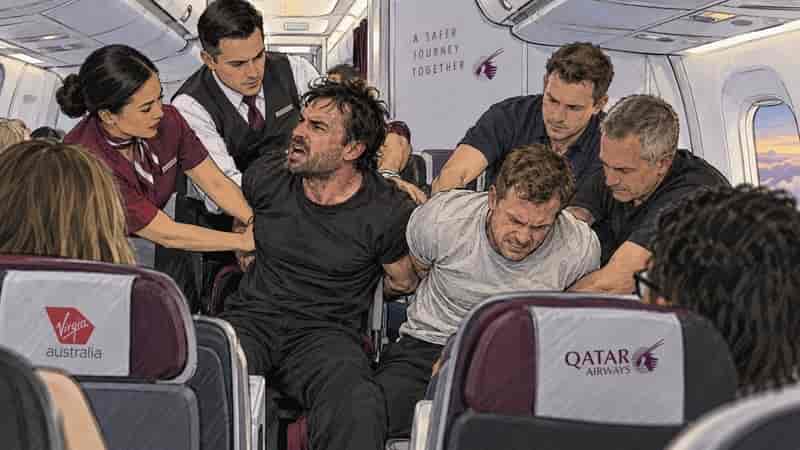
Two men have been restrained aboard a Qatar Airways-operated Virgin Australia flight from Melbourne to Doha after an extraordinary mid-air disturbance involving alleged threats about a gun and reported assaults on cabin crew, turning a routine long-haul journey into a confronting test of aviation security, crew training and passenger safety.
Virgin Australia flight VA7, operated by Qatar Airways, departed Melbourne on Friday, 11 September 2026, bound for Doha when two male passengers became involved in what Qatar Airways has officially described as a “physical altercation”.
What followed, according to passenger accounts reported by Australian media, was considerably more serious.
Witnesses alleged the men became increasingly agitated, repeatedly moved around the cabin and later made violent threats, including claims that they had a gun. Passengers also alleged that cabin crew were headbutted and spat at as the confrontation escalated.
Fellow travellers reportedly joined crew members in restraining the two men.
It was the sort of drama no passenger expects after fastening a seatbelt for the long haul from Melbourne to the Gulf.
And at cruising altitude, there is nowhere to walk away to.
Passengers and crew forced to act
Accounts from passengers aboard the aircraft paint a disturbing picture of an incident that escalated before crew brought the two men under control.
Australian reports said the pair had been behaving erratically and repeatedly leaving their seats before the disturbance intensified. Witnesses said crew members tried to manage the situation before other passengers helped restrain the men.
Cable ties were reportedly used, while passenger accounts suggested several people were needed to subdue each man.
The most alarming allegation was that the men claimed they had a firearm.
There has, importantly, been no public confirmation that a gun or other firearm was actually found aboard the aircraft.
That distinction matters.
An alleged claim that someone possesses a firearm aboard an international passenger aircraft is serious enough without turning an unverified threat into an established fact.
Qatar Airways subsequently confirmed that two passengers had been restrained.
“We can confirm that two male passengers were involved in a physical altercation on board flight VA7 from Melbourne to Doha, operated by Qatar Airways,” the airline said.
It added: “Both passengers were restrained and, upon arrival in Doha, were handed over to local authorities.”
Qatar Airways also said: “The safety and wellbeing of our crew and passengers remain our highest priority.”
A particularly uncomfortable date
Another element inevitably sharpened the anxiety surrounding the incident.
The flight departed Melbourne on 11 September 2026 — exactly 25 years after the terrorist attacks of 11 September 2001 in the United States.
There is no publicly available evidence linking the Melbourne–Doha incident to terrorism, and it would be irresponsible to suggest otherwise.
Nevertheless, for passengers hearing alleged threats involving a gun aboard an international flight on that particular date, the historical coincidence would hardly have made the situation more comfortable.
The distinction is critical.
This was a serious onboard disturbance involving alleged violent behaviour and threats. It has not been established as a terrorist incident.
Crew professionalism deserves the spotlight
Beyond the dramatic headlines, the incident highlights something the travelling public can too easily take for granted: cabin crew are safety professionals first.
The drinks trolley, meal service and welcoming smile may be the most visible parts of the job, but cabin crew are trained to manage emergencies, evacuations, fires, medical incidents, decompression and disruptive passengers.
On VA7, that responsibility appears to have been tested in unusually difficult circumstances.
Passengers who reportedly assisted the crew also found themselves doing something nobody reasonably expects when booking a flight to Doha — helping contain an allegedly violent confrontation thousands of metres above the ground.
The aircraft continued to Doha rather than diverting.
Flight-tracking data identifies the aircraft as Qatar Airways Boeing 777-300ER A7-BEH. The service was scheduled to depart Melbourne at 4.10 pm AEST and arrive in Doha at 11.15 pm local time.
Media reports said authorities boarded the aircraft after it reached Doha and took the two men into custody. Video from the flight showed officials entering the cabin, with passengers applauding as the incident ended.
Virgin Australia flight, Qatar Airways operation
The branding of this service requires some explanation.
VA7 is marketed as a Virgin Australia Melbourne–Doha flight but is operated by Qatar Airways under the strategic partnership between the two carriers. Qatar Airways lists the corresponding codeshare flight as QR8402.
According to Qatar Airways’ published partnership schedule, the Melbourne–Doha VA7 service commenced on 1 December 2025.
That distinction matters when reporting an incident such as this.
Calling VA7 simply a “Qatar Airways flight” does not fully explain the commercial arrangement, while describing it as a Virgin Australia-operated aircraft would also be incorrect.
The most precise description is straightforward:
A Virgin Australia flight operated by Qatar Airways.
The arrangement gives Virgin Australia customers access through Doha to Qatar Airways’ extensive international network across Europe, Africa, the Middle East and beyond.
Virgin Australia says its Qatar Airways-operated Doha program will return to 28 services a week from early December 2026 through late March 2027, including a daily Melbourne–Doha service.
The bigger aviation question
The Melbourne incident also puts the difficult subject of disruptive passengers firmly back on the aviation agenda.
Airlines can build sophisticated aircraft, install increasingly advanced security systems and train crews for an extraordinary range of emergencies.
Human behaviour remains rather less predictable.
For cabin crew, an aggressive passenger is not merely an inconvenience.
Inside a pressurised aircraft travelling at high altitude, violent or threatening behaviour can quickly become a safety issue for everybody aboard.
That is why airlines maintain procedures for dealing with disruptive passengers and why cabin crews undergo training to manage situations most travellers will fortunately never encounter.
It is also why considerable care must be taken before drawing conclusions about the individuals involved.
At the time of publication, the men’s identities, nationalities and the circumstances that led to the disturbance had not been publicly established through authoritative sources reviewed by Global Travel Media.
Nor has there been public confirmation that an actual firearm was discovered.
Those remain important unanswered questions.
A flight passengers will remember
For those aboard VA7, however, this was no theoretical aviation-security exercise.
A long flight from Melbourne to Doha became an extraordinary confrontation in which cabin crew were reportedly assaulted, passengers reportedly helped restrain two men, an alleged gun threat reverberated through the cabin and authorities were waiting when the aircraft finally reached Qatar.
There will undoubtedly be questions about precisely what happened, what triggered the confrontation and what action authorities may take.
Those questions should be answered through evidence rather than speculation.
The incident does demonstrate the responsibility placed on cabin crew when an otherwise routine flight suddenly becomes anything but.
Cabin crew are sometimes judged by how quickly dinner arrives, whether the coffee is hot or whether another glass of wine appears.
VA7 delivered a rather more sobering reminder of what the job can entail.
At 35,000 feet, when circumstances deteriorate, cabin crew are not simply there to serve passengers.
They are there to help keep them safe.
By: Jason Smith – © 2026.
Read Time: 5 minutes.
Author Bio:
 Jason Smith didn’t learn travel from textbooks. He learned it in airports, taxis and hotel lobbies, watching the business unfold long before he played his own part. Half American, half Asian, he grew up around the quiet workings of tourism, where people come and go, and stories rarely stand still.
Bangkok came first, then formal study, then a career that carried him through Singapore, Malaysia and Vietnam. Each place left something behind. In the end, Thailand felt like home, along with a senior role in hotel sales.
Then everything stopped. Borders shut, planes grounded, and Jason found himself back in America with time to reflect.
Now at Global Travel Media, he writes travel as it really is, not polished, not perfect, but human, and all the better for it.











