

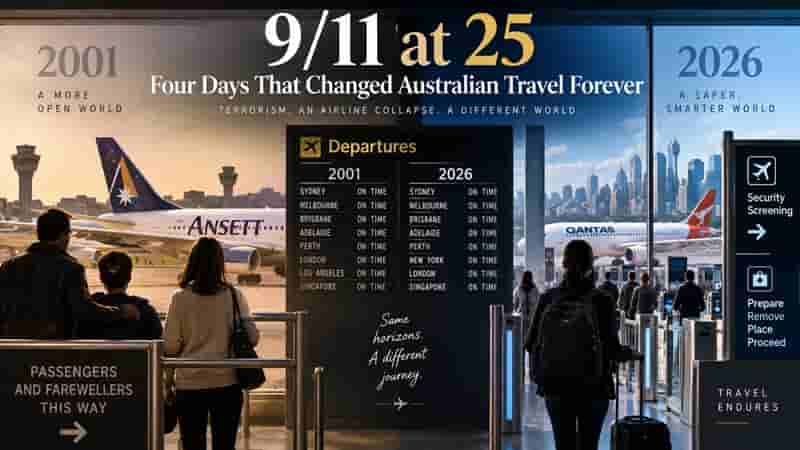
Twenty-five years ago, terrorism transformed global aviation. Three days later, Ansett collapsed. In four extraordinary days, the way Australians travelled and thought about travel changed forever.
Some moments in history don’t knock politely. It kicks the door down.
For aviation and the travel industry, 11 September 2001 was one of those moments.
Twenty-five years ago today, 19 al-Qaeda terrorists hijacked four commercial aircraft in the United States. Two were deliberately flown into the World Trade Centre towers in New York, a third struck the Pentagon outside Washington, while passengers and crew aboard United Airlines Flight 93 fought back before the aircraft crashed in Pennsylvania.
The attacks killed 2,977 people from 90 nations. Ten Australians were among them.
Nothing about international aviation would ever be quite the same.
The human consequences of September 11 dwarf everything else associated with that day and should never be reduced to a story about longer airport queues and confiscated toiletries.
Yet for the travel industry, 9/11 unquestionably created a dividing line.
There was aviation before September 11.
And there was aviation after it.
For Australia, however, September 2001 delivered an extraordinary second aviation shock.
Just three days later, on 14 September 2001, Ansett Australia entered voluntary administration, and its operations ceased.
The two events were fundamentally different.
September 11 was an act of terrorism and an immense human tragedy. Ansett was a commercial airline whose financial and operational difficulties had developed well before the attacks.
9/11 did not cause Ansett to collapse.
That distinction matters.
Nevertheless, their near-simultaneous arrival meant Australia experienced two profound aviation crises within four days, and Australian tourism felt the consequences of both.
When airports were different places
For younger travellers, explaining the pre-9/11 airport can sound rather like describing black-and-white television.
Yes, it really was different.
Airport security existed, as did metal detectors, baggage controls and restrictions on certain items. Aviation had already endured hijackings and terrorist attacks, including the bombing of Pan Am Flight 103 over Lockerbie in 1988.
But the underlying assumptions surrounding hijacking were markedly different.
Before September 11, the prevailing assumption among US aviation authorities was that hijackers would seek leverage, make demands or negotiate, not deliberately turn fully fuelled passenger aircraft into weapons.
September 11 destroyed that assumption.
Suddenly, the aircraft itself was potentially part of the weapon.
Access to airport gates tightened. Passenger screening intensified. Items previously regarded as comparatively innocuous disappeared from cabins. Cockpit security was transformed.
In the United States, President George W. Bush signed the Aviation and Transportation Security Act on 19 November 2001, formally creating the Transportation Security Administration, or TSA.
Security was no longer simply one element of the passenger experience.
It became a defining feature.
The security revolution
The modern airport security regime was not created in a single afternoon.
It accumulated.
September 11 led to sweeping changes, including much tighter access to airport gate areas, federalised passenger screening in the United States, restrictions on carry-on items, screening of checked baggage and reinforced cockpit doors.
Then subsequent attempted terrorist attacks added further layers.
The attempted shoe bombing in December 2001 brought greater scrutiny of footwear. The 2006 transatlantic liquid explosives plot produced restrictions on liquids. Later threats accelerated the development of advanced imaging, explosives detection and increasingly sophisticated passenger screening.
Today’s passenger consequently experiences a security environment built from more than two decades of responses to evolving threats.
Technology has also transformed the process.
Computed tomography scanners, credential authentication systems, biometrics and advanced imaging equipment increasingly sit beside the metal detectors and baggage belts familiar to earlier generations.
The objective remains remarkably simple despite all that technology: determine who and what can safely board an aircraft without grinding global aviation to a halt.
Not always an elegant dance, perhaps, but an essential one.
Australia was watching from very close range
September 11 was never simply an American story.
Ten Australians lost their lives.
Then-prime minister John Howard was in Washington when the attacks occurred, witnessing the immediate fear and disruption in the US capital.
Three days later, on 14 September, the Australian Government decided, in consultation with Washington, that Article IV of the ANZUS Treaty applied to the terrorist attacks.
It was the first and remains the only time the ANZUS Treaty has been formally invoked since it came into force.
The consequences ultimately extended far beyond airport terminals.
Australia’s military involvement in Afghanistan lasted almost 20 years. More than 39,000 Australian Defence Force personnel deployed there, 41 Australian service personnel lost their lives, and more than 260 were wounded or injured as a result of operations.
At home, meanwhile, aviation security was being substantially reinforced.
Australia expanded its regulatory security regime, implemented airport security programs based on individual risk assessments, strengthened air-freight regulation and required hardened cockpit doors on regular passenger and charter aircraft with more than 30 seats.
Those measures helped establish the security environment Australians now regard as routine.
Routine, however, is what extraordinary measures eventually become when they remain around for long enough.
Then Ansett stopped flying
Australians had barely begun comprehending what they had watched unfold in New York and Washington when another extraordinary aviation story erupted at home.
On 14 September 2001, Ansett Australia entered voluntary administration, and all group operations ceased.
Again, it is essential not to rewrite history.
Ansett’s problems pre-dated 9/11.
The airline had serious financial and operational difficulties, and its troubles had been building well before those four aircraft were hijacked in America.
September 11 did not bring Ansett down.
But the timing could hardly have been worse for Australian tourism.
Ansett was not simply another airline.
For generations of Australians, the name had been woven into the country’s transport system and tourism industry.
Founded by Reginald Ansett in the 1930s, it developed into one of Australia’s great corporate names. In October 1964, Ansett introduced the Boeing 727, the first jet airliner in Australian service, and by 1969 it had become Australia’s largest domestic airline.
At 30 June 2001, Ansett’s main fleet comprised 67 aircraft, while regional airlines within the Ansett group operated another 53 aircraft.
Then, only weeks later, they stopped.
The consequences spread well beyond airport terminals.
When an airline disappears, tourism notices
Airlines are not simply transport companies.
They are economic infrastructure.
Remove enough seats from a route overnight, and the consequences travel remarkably quickly.
Hotels notice.
Tour operators notice.
Conference organisers notice.
Car-hire companies notice.
Travel agents certainly notice.
Regional communities can notice most of all.
Ansett had served both major cities and regional destinations, meaning its disappearance created a particularly serious challenge for parts of Australia’s domestic tourism system.
The Australian Bureau of Statistics later examined the consequences of September 11 and Ansett’s collapse together.
Its conclusion was striking.
Both events immediately affected tourism. The terrorist attacks shocked the international tourism market, while Ansett’s collapse was particularly significant to domestic and regional tourism because of the airline’s substantial share of those markets.
Australia had experienced two very different shocks almost simultaneously.
Tourism sat squarely in the blast radius of both.
Travellers paid for the fallout
The effects were remarkably tangible.
Passengers holding Ansett bookings suddenly found themselves with tickets for flights that no longer existed. They had to find alternative seats, sometimes at different prices and under very different circumstances.
The collapse also produced one of Australia’s more unusual aviation legacies.
The Commonwealth introduced a $10 Air Passenger Ticket Levy to help fund employee entitlements associated with Ansett’s failure.
For ordinary Australian passengers, the collapse had quite literally appeared on the ticket.
Ansett’s disappearance also accelerated the transformation of the domestic aviation market.
Virgin Blue had commenced Australian domestic services only in August 2000, operating nine Boeing 737 aircraft by 30 June 2001.
Barely a year after its arrival, Australian aviation suddenly looked completely different.
Ansett was gone.
Qantas remained.
Virgin Blue was expanding.
The old domestic aviation establishment had fractured.
The market that followed would ultimately become the foundation of the competitive structure Australians recognise today.
Tourism takes the hit
The economic effects went beyond aviation.
Australian tourism GDP declined in 2001–02, the first annual decline recorded since the ABS Tourism Satellite Account series began in 1997–98.
The ABS said there was “little doubt” that the destruction of the World Trade Centre and the demise of Ansett were major factors contributing to the fall.
That is worth remembering because it demonstrates the remarkable vulnerability of tourism.
A hotel can be beautifully managed.
A destination can have excellent attractions.
A travel company can run a sound business.
And yet events occurring thousands of kilometres away can suddenly change everything.
September 2001 became a brutal lesson in how interconnected modern travel had become.
The industry would learn that lesson again and again over the next quarter-century.
Terrorism.
Wars.
Financial crises.
Volcanic eruptions.
Airline collapses.
Natural disasters.
Pandemics.
Closed borders.
Through each came the same uncomfortable reminder: tourism sells movement, and anything that prevents people from moving can rapidly become everybody’s problem.
The airport farewell disappeared
One of the less dramatic but socially significant changes following September 11 was the disappearance of the traditional airport gate farewell in the United States.
Before 9/11, non-passengers could commonly accompany family and friends much farther into American airports.
Afterwards, access to secure areas became substantially more restrictive.
It became one of those losses that travellers gradually stopped discussing because an entire generation grew up assuming airports had always worked that way.
Which makes a development occurring this very week particularly interesting.
Just ahead of the 25th anniversary, the TSA has launched Gateside by TSA PreCheck, allowing eligible TSA PreCheck members without airline tickets to apply for access to gate areas at participating US airports.
The scheme initially operates at 13 airports. Approved participants still require identification and security screening, but they can once again accompany someone to a gate or meet a traveller arriving from a flight.
After 25 years, one small part of the pre-9/11 airport is returning.
With forms.
With identity verification.
With security screening.
Progress, apparently, occasionally involves recreating yesterday with considerably more paperwork.
Flying in 2001 versus flying in 2026
Put the two eras side by side, and the transformation becomes extraordinary.
In 2001, paper tickets were still familiar, smartphones did not exist, biometric boarding belonged largely to the future, and many of today’s digital travel habits were barely imaginable.
In 2026, a passenger can research a destination, book the fare, choose a seat, check in, carry the boarding pass, receive disruption alerts and increasingly verify identity using a single device.
At the same time, aviation security is both more extensive and, in many respects, more technologically sophisticated.
The traveller sees the checkpoint.
Behind it sits an enormous architecture of intelligence, regulation, risk assessment, identification systems, baggage screening, airport security, aircraft security and international cooperation.
Twenty-five years have transformed aviation security from a checkpoint into an ecosystem.
What September 2001 taught Australian travel
Perhaps one lesson connects September 11 and Ansett, despite the enormous difference between the events.
Travel depends upon confidence.
Passengers must believe an aircraft is safe.
They must believe an airline will still exist when the departure date arrives.
They must believe borders will remain open, destinations will be accessible, and the journey can actually be completed.
When confidence disappears, demand can disappear astonishingly quickly.
September 11 damaged confidence in the safety of international aviation.
Ansett’s collapse damaged confidence in the stability of Australia’s domestic aviation system.
One confronted the world with the possibility that a passenger aircraft could become a weapon.
The other confronted Australians with the possibility that a household-name airline could simply stop.
Neither lesson was easily forgotten.
Yet travel came back
And perhaps that is the most important point 25 years later.
Travel came back.
Aircraft kept flying.
Airports reopened.
Tourists returned.
New airlines grew.
Destinations recovered.
Australian domestic aviation rebuilt its capacity after Ansett.
The travel industry adapted to security requirements that would have seemed extraordinary only months earlier.
There is always a temptation when looking backwards to conclude that everything was better in the old days.
Some things undoubtedly seemed simpler.
Airport terminals were more accessible. Farewells could last longer. Security was less intrusive.
Nobody ever booked a holiday because they were looking forward to surrendering a bottle at airport screening.
But aviation also learned immensely difficult lessons.
Aircraft became harder to seize.
Cockpit security improved.
Screening became more sophisticated.
Governments developed better intelligence-led systems.
Airports invested heavily in technology.
And aviation continued carrying billions of people around the world.
Four days that changed Australian travel
The dates still seem almost impossibly close.
11 September 2001: 19 terrorists hijacked four passenger aircraft in the United States. The attacks killed 2,977 people from 90 nations, including 10 Australians.
14 September 2001: Ansett Australia entered voluntary administration and ceased operations.
One event did not cause the other.
Their significance was different.
Their human consequences were incomparable.
But for Australian aviation and tourism, they collided within the same extraordinary week.
Within four days, Australians witnessed both the vulnerability of international aviation and the fragility of their own domestic airline system.
Twenty-five years later, the airports are different.
The aircraft are different.
The technology is different.
Ansett belongs to history.
And an entire generation of passengers has grown up knowing no other aviation environment than one characterised by screening, restricted areas, hardened cockpits and heightened security.
Yet something more fundamental survived.
People still want to travel.
They still board aircraft to see family, do business, discover countries, meet people and experience places they have spent years dreaming about.
They still gather at departure gates.
They still watch aircraft disappear into the distance.
And they still complain about airport coffee.
Perhaps that is the most fitting travel-industry reflection on September 11, a quarter-century later.
The world changed. Travel changed with it. But travel endured.
By: Jason Smith – © 2026.
Read Time: 9 minutes.
Author Bio:
 Stephen Peters has spent much of his career proving that the straight-and-narrow path is considerably overrated. Armed with a Bachelor’s degree in Technology from the University of Queensland and a Master’s in Management, he first ventured into hospitality, working in and helping open several five-star hotels across Sydney and Asia.
After deciding he had experienced quite enough of five-star hospitality from the operational side of the desk, Stephen returned to technology, working with major US tech companies while based between Australia and Asia.
Then came the ultimate change of scenery. Stephen built his own yacht and, with his family aboard, sailed from Florida through the United States and its Great Lakes before crossing the Pacific to Asia. Several memorable years followed, exploring Indonesian waters before the Peters family eventually returned to Australia with considerably more sea miles, stories and perspective than when they left.











