

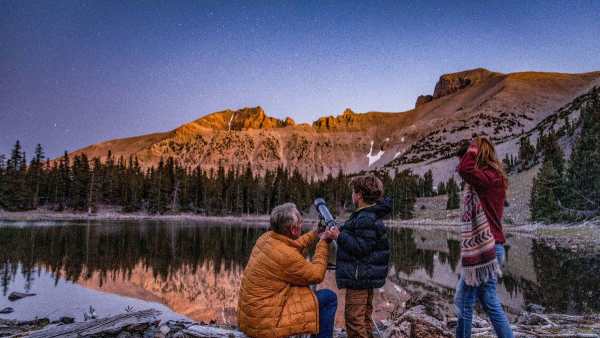
Travel Nevada is putting a new spin on the classic American road trip, inviting travellers to venture beyond the bright lights of Las Vegas and discover the spectacular, bright skies of the Silver State.
With vast stretches of the state free from light pollution, Nevada offers exceptional conditions for naked-eye stargazing, including some of the darkest skies in the United States.
Despite its scenic attributes, Great Basin National Park is one of the least visited national parks, yet offers so many experiences for the astro-enthusiast. A designated International Dark Sky Park, it’s home to an annual astronomy festival, and a research-grade observatory that hosts open nights for fascinating astronomy talks and viewing sessions. By day, explore the park’s limestone Lehman Caves and seek out the ancient Bristlecone Pine – the world’s oldest trees. Complete the experience with a stay at the Stargazer Inn nestled by this beautiful national park.
Located in north-western Nevada, Massacre Rim is recognised as a Dark Sky Sanctuary and is regarded as one of the darkest places in the United States. Its remote setting and virtually non-existent light pollution create exceptional conditions for viewing the Milky Way and stars.
All aboard the Star Train – an unforgettable rail journey into the cosmos
Experience Nevada’s blanket of stars aboard the dedicated Star Train, operated by the Nevada Northern Railway in Ely. Departing just before sunset, the train travels along the Valley Vista route, climbing above Steptoe Valley. As darkness falls, passengers arrive at remote Star Flat, where telescopes await for an unforgettable evening of stargazing with guidance from knowledgeable astronomers. The train operates most Friday evenings from mid-May through mid-October.
Black Rock Desert – stars across an endless landscape
Offering off-grid solitude amid striking landscapes, the vast Black Rock Desert delivers both in abundance. Its expansive playa is home to Burning Man, while the wider area encompasses 800,000 acres of national conservation and wilderness areas, making it one of the largest expanses of publicly managed land in the United States. By night, the remote setting creates an exceptional backdrop for stargazing, with expansive views of the stars stretching across the desert sky.
Tonopah Stargazing Park – a front-row seat to Nevada’s night sky
The town of Tonopah offers travellers an accessible base for exploring Nevada’s dark skies. Tonopah Stargazing Park provides a dedicated space to enjoy the stars and is particularly suited to road-trippers looking to combine stargazing with a stopover in Nevada’s rural heartland. Keep an eye out for monthly Star Parties from June to October.
Lamoille Canyon and the Ruby Mountains – alpine skies and stars
Known as the “Swiss Alps of Nevada,” Lamoille Canyon and Ruby Mountains offer a different perspective on the state’s landscapes, with its alpine scenery providing the backdrop for dark-sky experiences. In summer, travellers can hike, fish and explore alpine lakes and towering peaks, while winter brings famously dry, fluffy snow for snowshoeing, snowmobiling and backcountry skiing.
An extension of the Ruby Mountains, Angel Lake combines high-elevation scenery with exceptional stargazing away from urban light pollution. Perched at 8,500 feet and surrounded by dramatic glacial cirques, the lake offers travellers an immersive backcountry experience.
Cathedral Gorge State Park – otherworldly landscapes by day, stars by night
The dramatic clay formations of Cathedral Gorge create an otherworldly landscape of slot canyons, spires and hoodoos, making it a photographer’s dream and a hiker’s playground. Explore the park on trails such as the Miller Point Trail, which descends into its striking formations and then soak up the natural light show by night.
Travellers based in Las Vegas don’t have to venture deep into the Nevada wilderness to experience the night sky. Just outside the bright lights of the city, Red Rock Canyon National Conservation Area, the state’s first National Conservation Area, showcases the unique beauty of the Mojave Desert with its striking red-banded canyons, towering sandstone peaks and ancient petroglyphs. They provide a striking contrast at nightfall, to the dark, expansive horizons and crisp mountain air with a clear window straight into the Milky Way.
The Nevada stargazing season is particularly strong from May to September, when the Milky Way’s galactic centre is most visible in the Northern Hemisphere. For more on Nevada’s awe-inspiring stargazing experiences, visit travelnevada.com/stargazing











