


For travellers who love a road trip with a difference, Oklahoma delivers the unexpected. Across its highways and back roads, more than 100 roadside oddities turn the journey into the destination, with giant sculptures, retro diners, neon signs, quirky museums and larger-than-life landmarks creating unforgettable, share-worthy photo opportunities.
From the iconic Blue Whale and 76-foot-tall Golden Driller to a giant soda bottle and the World’s Largest Concrete Totem Pole, these wonderfully kitschy attractions capture a uniquely American mix of nostalgia, pop culture, history and pure eccentricity.
It’s a chance to see a side of Oklahoma that sits beyond the standard itinerary — colourful, curious and larger than life — and build a road trip where the next unexpected photo opportunity is always just around the corner.
Explore Oklahoma on a photogenic roadtrip:
Blue Whale – Catoosa
Few roadside attractions are more instantly recognisable than the giant Blue Whale of Catoosa. Built in the early 1970s by zoologist Hugh Davis as a surprise for his wife, the concrete whale stretches approximately 24 metres long and six metres high. Today, it is one of Oklahoma’s most beloved Route 66 photo stops. Travellers can walk inside the whale and photograph it beside the surrounding pond.
Totem Pole Park – Chelsea
Ed Galloway’s Totem Pole Park is the oldest and largest example of a folk art environment in Oklahoma, containing the original, highly decorated creations of Galloway – one of Oklahoma’s premier folk artists and significant in the “visionary art” movement. The striking monument celebrates Oklahoma’s American Indian culture and has become one of the state’s classic roadside photo opportunities.
Golden Driller – Tulsa
Bring a wide-angle lens for one of Oklahoma’s biggest photo opportunities. The 76-foot Golden Driller stands outside Tulsa Expo Square, one hand resting on an oil derrick. Weighing almost 44,000 pounds, the statue represents Tulsa’s long association with the petroleum industry and has been a permanent fixture since 1966.
Meadow Gold District – Tulsa
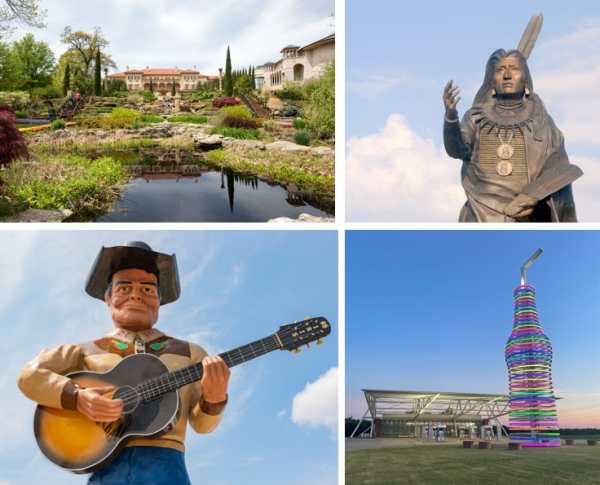
For travellers chasing neon, vintage Americana and oversized characters, Tulsa’s Meadow Gold District delivers. The restored Meadow Gold neon sign provides a classic backdrop, and the area is in a constant state of artistic development with outdoor murals, wall art and larger-than-life figures including Space Cowboy Buck Atom, Cosmic Cowgirl Stella Atom, and Mack the Friendly Lumberjack offering a playful series of photo opportunities.
The Round Barn – Arcadia
One of the most distinctive buildings on Route 66, Arcadia’s bright red Round Barn is listed on the National Register of Historic Places and is more than a century old. It is the only round barn on Route 66 and hosts many live music events, while providing a striking backdrop for a photo opportunity year-round.
Pops – Arcadia
Also in Arcadia, look for the giant illuminated soda bottle. Rising dramatically beside Route 66, the enormous neon-lit bottle outside Pops has become one of Oklahoma’s most recognisable roadside images – particularly after dark. The soda ranch is a handy service station for re-filling the vehicle on a road-trip, and for a meal from their diner. There is also a huge collection of soft drinks, with more than 600 wild and fantastical flavours to choose from.
Lucille’s Service Station – Hydro
Step back into the golden age of American motoring at Lucille’s Service Station, one of the historic service stations that once served motorists travelling Oklahoma’s highways in the 1920s and 1930s. Owner Lucille Hamons became known as the “Mother of the Mother Road” for her hospitality to travellers. No longer in use, the restored station makes an atmospheric stop for photographs, particularly for fans of vintage Americana.
Standing Bear – Ponca City
Standing Bear may have been a chief of the Ponca tribe, but the towering bronze statue erected in his honor at Standing Bear Park stands as a tribute to every Native American. Famous for his landmark speech in 1879 stating that all American Indians regardless of tribe deserved the same recognition and protection under the law as white men, he paved the way for native rights in this country and is considered America’s first Native American civil rights leader.
Birdhouse Cottages – Medicine Park
Take the roadtrip theme to new heights with a stay at the colourful Birdhouse Cottages with four whimsical creekside cabins named Cardinal, Bluebird, Hummingbird and Painted Bunting. Designed for couples, these eye-catching cottages offer photogenic appeal and are located in a pretty, peaceful location right in the heart of Medicine Park along the creek.
The Grave of Mister Ed – Tahlequah
The grave of America’s favorite talking horse, Mister Ed, is just north of Tahlequah on a farm in a peaceful field. The show ran from 1961 to 1966 on CBS and was beloved for many years afterwards. Mister Ed ended up in Oklahoma after the show ended and his Hollywood career was over. He lived on the farm he is buried on for the rest of his days until he passed away in 1979.
Showmen’s Rest rodeo and circus cemetery – Hugo
Mount Olivet Cemetery in Hugo is the final resting place for rodeo greats Freckles Brown, Lane Frost and many others. Because Hugo was the wintering home for several circuses, it also features a special area called ‘Showmen’s Rest’ featuring unique headstones and gravesites for circus performers and owners.
Waylan’s Ku-Ku Burger – Miami
One of the most fun food stops on the road trip, Waylan’s Ku-Ku Burger not only makes incredible hamburgers, it is housed in a building designed to resemble a giant cuckoo clock with a giant yellow fibreglass bird and features a distinctive 1960s-style neon sign. It is the only remaining restaurant from the original Ku-Ku Burger chain, making it a particularly photogenic slice of roadside Americana.
Philbrook Museum of Art – Tulsa
Swap the roadside kitsch for unexpected Italian-inspired glamour at Philbrook Museum of Art’s 25-acre gardens, described by House Beautiful as “the most beautiful place in Oklahoma.” Set around the historic Villa Philbrook, the gardens feature formal terraces, a reflecting pool, grottoes, a tempietto, sculpture walks and lush woodland paths to create a series of elegant, highly photogenic backdrops that feel more Tuscany than Tulsa.











