

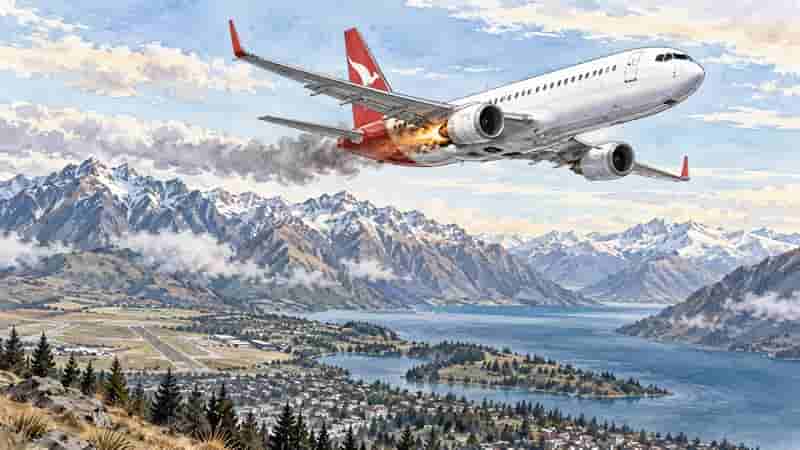
A Sydney-bound Qantas flight gave passengers a frightening start to their trans-Tasman journey on Saturday, 5 September, when bursts of flame appeared near the aircraft’s left engine soon after take-off from Queenstown.
Flight QF122 was operating from Queenstown to Sydney when Qantas said it developed a “suspected engine issue”. The Boeing 737-800 diverted to Christchurch and landed safely, with emergency crews waiting on the ground.
The pictures were dramatic. The facts need a calmer reading.
Qantas told ABC News that both engines remained operating throughout the incident. The airline said there was no engine shutdown and no engine failure. The aircraft was also cleared for a priority landing at Christchurch.
“Our pilots are highly trained to manage situations like this and the aircraft landed safely,” a Qantas spokesperson said.
That detail matters. Flames from an airliner will always draw attention. Social media can send the pictures around the world in seconds. Engineering findings take longer.
Witness Liam Aspinall told ABC News the noise “sounded like gunshots”. Video supplied to the broadcaster showed flashes appearing to come from the left engine as the aircraft climbed away from Queenstown.
For passengers, the difference between an engine issue and an engine failure may have meant little at the time. For an accurate aviation report, it is vital.
Cause of QF122 incident remains unconfirmed
Early reports linked the incident to a bird strike. That should no longer be reported as confirmed.
RNZ later reported that New Zealand’s Civil Aviation Authority had changed its first statement, which had blamed a bird strike. The authority said it could not confirm the cause at that stage. Qantas continued to describe the event as a “suspected engine issue”.
That correction matters.
In air safety reporting, there is a clear difference between what witnesses see, what they may first suspect, and what an inquiry later proves.
A burst of flame shows that something unusual happened. It does not prove why.
Online discussion has included theories about a bird strike and an engine compressor stall. Neither should be presented as fact unless Qantas, the CAA or another responsible safety body confirms it.
For now, the known facts are simple. QF122 had a suspected engine issue after leaving Queenstown. Bursts of flame were seen near the left engine. The crew diverted to Christchurch. Both engines kept running, and the aircraft landed safely.
A familiar Boeing 737 on a major regional route
QF122 was operated by a Boeing 737-800. Qantas describes the Boeing 737 as the “backbone” of its fleet and uses the type across Australia, New Zealand and the Pacific.
The aircraft is a familiar sight on regional and trans-Tasman routes.
That does not make an incident like this routine for passengers. It does show why crews train for engine warnings, diversions and priority landings. Airline safety depends on being ready for events that everyone hopes will never happen.
The diversion also shows the value of having a suitable alternate airport within reach. The crew turned towards Christchurch rather than continue across the Tasman Sea.
1News footage showed emergency crews waiting on the tarmac as the aircraft arrived. Qantas later said it was offering affected customers accommodation and help with alternative flights.
The result was inconvenient and clearly distressing. It was also a safe landing. In aviation, that is the part of the story that deserves the largest headline.
Bird strikes remain a real aviation risk
A bird strike has not been confirmed as the cause of the QF122 incident. Even so, wildlife strikes remain a real issue for airlines and airports.
The Australian Transport Safety Bureau says wildlife strikes, especially bird strikes, are the most common aviation occurrence reported to the bureau.
ATSB data show 17,060 reported bird strikes across all aircraft types in Australia between 2014 and 2024.
The bureau also says most wildlife strikes do not cause injury. Even so, they remain a safety risk and can be costly for airports and aircraft operators.
Those figures are useful background. They do not prove what happened to QF122.
That point is worth making. Dramatic events can gather certainty as they move around the internet. A theory becomes a claim, the claim becomes a “fact”, and before long the aircraft has apparently survived three disasters before dinner.
Good aviation reporting should resist that temptation.
Queenstown remains a major tourism gateway
Queenstown is one of New Zealand’s best-known holiday destinations and is especially popular with Australian travellers.
Destination Queenstown’s visitor research has shown strong satisfaction among Australian visitors, while winter remains one of the region’s key travel periods. Recent Destination Queenstown research recorded Australian visitors among the destination’s most satisfied international guests.
Direct air links with Australia are an important part of the local visitor economy. They bring travellers for skiing, adventure, food, wine and scenery.
An incident involving a Qantas service on a high-profile trans-Tasman route will therefore draw wide attention from travellers, travel agents and the tourism industry.
For travel advisers, the practical response is simple. Use confirmed information from the airline, airport and aviation authorities. Treat social-media claims as leads, not findings.
A diversion can cause missed connections, extra hotel nights, changed transfers and travel-insurance questions. Clear advice matters most when passengers are already dealing with disruption.
Calm crew response is the real story
The most important part of the QF122 story is not the flame footage. It is what happened next.
The crew diverted to Christchurch. The aircraft received priority handling. Emergency crews were ready. The Boeing landed safely. Qantas said both engines kept running.
That is why airline training, checklists and standard procedures matter.
Passengers buy a ticket expecting to travel from A to B. They do not usually expect C to become Christchurch. Yet when a problem occurs, a safe response matters far more than keeping the original timetable.
The incident also serves as a reminder for airline communications teams.
Video can go global before an airline has finished its first internal call. That puts pressure on companies to speak quickly. It also makes careful wording more important.
Qantas described the event as a “suspected engine issue” rather than announcing a cause before one had been proved. Its later statement that both engines remained operating was just as important.
Without that detail, the images could easily suggest a complete engine failure.
Qantas says no such failure occurred.
What we know about Qantas QF122
As of 6 September 2026, the confirmed picture is clear.
QF122 departed Queenstown for Sydney on Saturday, 5 September. Soon after take-off, witnesses saw bursts of flame near the aircraft’s left engine and heard loud bangs.
Qantas said the aircraft had a suspected engine issue and diverted to Christchurch.
Both engines remained operating, with no engine shutdown or engine failure, according to the airline. The aircraft landed safely. Passengers were offered support, accommodation and help with alternative travel.
The cause remains unconfirmed.
That final point should stay prominent until Qantas, the CAA or another responsible safety authority releases further findings.
The video supplied the spectacle. The crew supplied the outcome that mattered.
In aviation, the safest ending is often the least exciting one. Nobody complains about that once the wheels are on the ground.
By: Michelle Warner – © 2026.
Read Time: 6 minutes.
Author Bio:
 Michelle Warner has always carried stories the way others carry passports lightly, faithfully, and with purpose. She learned her craft in newsrooms, shaping sentences with care, before swapping deadlines for departures as a flight attendant with some of the world’s great airlines. Years aloft sharpened her eye for character and deepened her fondness for the small, dignified rituals of travel, the quiet kindness of strangers, the poetry of arrival, the patience learned between time zones.
Now grounded by choice, Michelle has come home to writing with the same calm authority she once brought to turbulent cabins. Her prose blends an editor’s discipline with a traveller’s wonder, tinged with humour and reverence for the golden age of travel. Each piece feels like a handwritten boarding pass, gracious, observant, and unmistakably alive.













