

Thailand’s northeast is preparing to light the Mekong again.
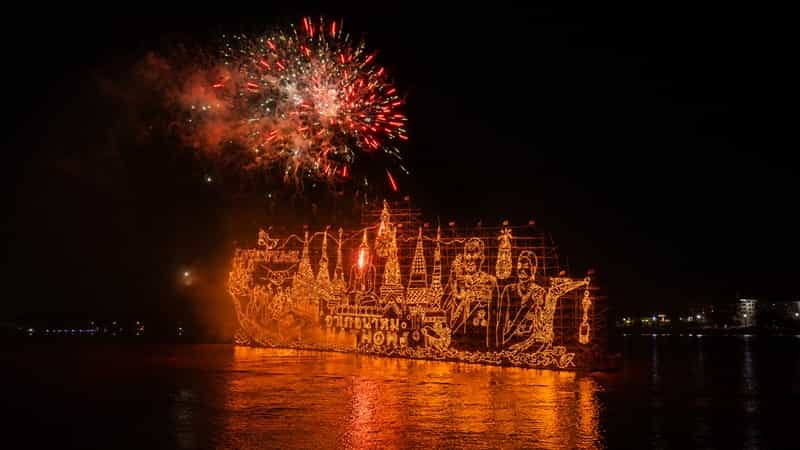
Nakhon Phanom’s famous Illuminated Boat Procession, or Lai Reua Fai, will return from 16 to 27 October 2026, with the main illuminated boat procession taking place on 26 October.
That night coincides with Ok Phansa, the end of Buddhist Lent. It is the moment when faith, folklore and local craftsmanship meet on one of Asia’s great rivers. The result is not some carefully manufactured tourist spectacle. It is a living tradition that still belongs to the communities that create it.
And that difference matters.
The Tourism Authority of Thailand is now giving the celebration greater international weight. Nakhon Phanom’s Illuminated Boat Procession is one of three home-grown traditions being elevated as “Signature Thailand Events”, alongside Ubon Ratchathani’s Candle Procession and Sakon Nakhon’s Christmas Star Parade.
For the travel trade, that makes Nakhon Phanom one to watch.
For travellers, it offers something considerably better than a marketing slogan: a very good reason to stay longer in Isan.
Faith Floats Down the Mekong
Lai Reua Fai is held around Wan Ok Phansa, marking the end of the monks’ three-month rainy-season retreat.
Its roots are spiritual.
Communities along the Mekong have long made offerings in honour of the Buddha while also showing respect to the Naga, the mythical serpent deeply woven into beliefs on both the Thai and Lao sides of the river.
Traditional illuminated boats and rafts carried flowers, food, incense, candles and lanterns. The ceremony also expressed respect for the river and the hope that sadness, troubles and misfortune could be carried away with the current.
Over time, the boats have become grander.
Today, communities representing Nakhon Phanom’s 12 districts create enormous illuminated works for the festival. Designs draw on Buddhist imagery, temples, Naga forms and local cultural symbols.
Provincial plans for 2026 include illuminated boats from all 12 districts, traditional fire boats, display vessels, lantern installations, local cultural performances, contemporary mor lam, pong lang music and ceremonies connected with Phra That Phanom.
Then comes the moment everybody has been waiting for.
The lights begin moving across the dark Mekong. Families crowd the riverfront. Music drifts through town. Across the water, the mountains of Laos become a dark silhouette behind a river suddenly alive with colour.
It is grand without being gaudy. Spiritual without becoming stiff.
Very Isan, in other words.
More Than One Night of Light
The procession may win the headlines, but Nakhon Phanom deserves more than a quick festival visit.
The provincial capital occupies a particularly handsome stretch of the Mekong. Its riverside promenade invites walking, cycling and that increasingly neglected holiday activity — simply sitting down and watching the world go by.
Across the river lies Thakhek in Laos, framed by rugged mountains that give Nakhon Phanom one of the most distinctive horizons of any provincial Thai city.
TAT describes Nakhon Phanom as a cultural meeting point shaped by Lao and other ethnic influences, reflected in its language, customs, dance and food.
That cultural layering is precisely what gives the province its charm.
For Buddhist travellers, Wat Phra That Phanom Woramahawihan is the essential pilgrimage.
The revered stupa in That Phanom district is traditionally believed to contain relics of the Buddha and has long been one of northeastern Thailand’s most important Buddhist sites.
One point deserves careful wording.
The belief that Phra That Phanom contains the Buddha’s breastbone comes from religious tradition and local legend. Academic research treats that tradition separately from archaeological evidence, so it should not simply be presented as established historical fact.
Back in Nakhon Phanom city, Phaya Si Sattanakharat, the seven-headed Naga monument on the Mekong waterfront, has become another provincial emblem.
Worshippers come to pray, while visitors gather along the riverfront as daylight softens.
No theme-park soundtrack required.
A Vietnamese Chapter in Thai History
Nakhon Phanom also holds an important place in modern Vietnamese history.
At Ban Na Chok, visitors can explore the Ho Chi Minh memorial house and the Thai-Vietnamese Friendship Village, linked to the period when the future Vietnamese leader lived and worked among Vietnamese communities in northeastern Siam during the late 1920s.
The story is fascinating, but accuracy matters.
The memorial house visitors see today is a reconstruction based on where Ho Chi Minh stayed, not an untouched original residence. Historical scholarship generally places his period in Siam around 1928–29, although some local accounts have traditionally used broader dates.
That distinction hardly diminishes the story.
Quite the opposite.
It illustrates how an otherwise quiet village beside the Mekong became part of a much larger tale involving migration, anti-colonial politics and the emergence of modern Vietnam.
The Mekong on a Plate
Nakhon Phanom’s food provides another excellent excuse to linger.
Isan favourites remain firmly in charge. Expect sticky rice, grilled meats, chilli, herbs, sour soups and spicy salads.
Yet the province also carries a strong Vietnamese culinary influence.
TAT’s own food mapping highlights Vietnamese-style dumplings, spring rolls and other dishes that have found a comfortable home in the local repertoire. Freshwater fish also features prominently in the province’s cooking.
Travellers can find cooked river fish, duck larb, fermented-rice noodles, grilled chicken, and Vietnamese-influenced snacks in markets and family-run restaurants.
This is food that rarely feels the need to explain itself.
A good bowl generally makes the argument rather better.
Gateway to Laos and Beyond
Nakhon Phanom also possesses genuine value as a cross-border tourism hub.
The Third Thai-Lao Friendship Bridge connects Nakhon Phanom with Thakhek in Laos’ Khammouane Province. It is also part of Asian Highway 15, creating an important road corridor linking Thailand, Laos and Vietnam.
For international visitors holding the correct passport, visa and border documents, Nakhon Phanom can therefore become the starting point for a broader Mekong itinerary.
Khammouane is particularly noted for its limestone and karst landscapes, while longer journeys can continue deeper into Laos or east towards Vietnam.
That is a more useful way of viewing Nakhon Phanom than treating it as some remote northeastern endpoint.
It is a crossroads.
Why Nakhon Phanom Matters in 2026
The 2026 Illuminated Boat Procession comes at an opportune moment for Thailand’s visitor economy.
Travellers are increasingly interested in moving beyond well-worn resort circuits and finding destinations with cultural depth, strong local character and experiences that have not been invented merely to satisfy a content calendar.
Nakhon Phanom does not need to manufacture that product.
It already has it.
The Mekong, Buddhist faith, Thai-Lao traditions, Vietnamese heritage, regional cuisine, and cross-border history give the province substance year-round.
Lai Reua Fai simply brings those threads together on one extraordinary night.
Come for the river of fire.
Stay for the dawn rides beside the Mekong, the temple bells, the market breakfasts, the borderland history and that unmistakable Isan hospitality.
And when the final illuminated boat disappears downstream on 26 October, do not be terribly surprised if Nakhon Phanom has already found its way onto the return-trip list.
By: Kanda Limw – © 2026.
Read Time: 5 minutes.
Author Bio:
 Kanda Limw is one of those rare people every office quietly depends on. She doesn’t fuss or fanfare her way through the day; she simply notices what needs doing and gets on with it, often before anyone else has drawn breath.
Years behind the scenes have taught her that good administration isn’t about control; it’s about care. Diaries align, tensions soften, loose ends disappear. When the day threatens to tilt, Kanda steadies it without drama.
There’s something reassuringly old-fashioned about her reliability. She listens properly, remembers the small things, and does what she says she will.
Kanda has no appetite for the spotlight. Yet ask anyone who works alongside her, and they’ll tell you that when she’s there, everything runs just a little smoother.











