

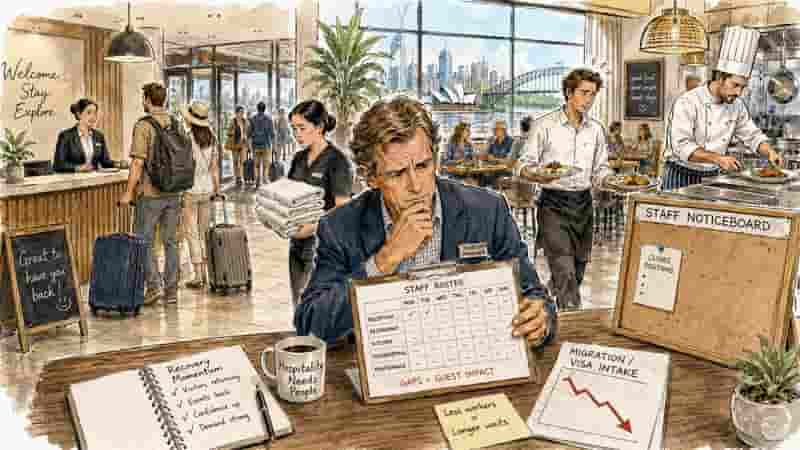
Australia’s hospitality recovery is finally looking like a recovery. Hotels are busy again. Restaurant tables are filling. Airlines are adding seats. International visitors are returning in greater numbers and spending heavily once they arrive.
Tourism Research Australia says international visitors spent $40.9 billion in Australia in the year to March 2026, up 20 per cent on the previous year. The Australian Bureau of Statistics counted 726,800 tourism jobs in the March quarter, 4.2 per cent more than a year earlier.
After the wreckage of border closures, lost staff and shuttered venues, those numbers should be cause for a decent bottle of something cold.
Instead, Australian hospitality is staring at another workforce question: can the recovery keep its momentum if migration falls too quickly and the labour pipelines used by hotels, restaurants and regional tourism businesses become harder to navigate?
It is a fair question, and not an argument for migration without limits.
Australia has legitimate pressures around housing, infrastructure, population growth and the integrity of its visa system. But labour policy has consequences. In tourism, those consequences can arrive at reception at 7 am, in the kitchen at dinner service and in housekeeping when every room is booked.
Politics, as ever, eventually finds its way onto the roster.
A recovery still hungry for workers
Net overseas migration is already falling sharply. Home Affairs Minister Tony Burke said in June that annual net overseas migration had dropped to 301,000 in the year to December 2025, more than 45 per cent below the post-COVID peak in 2023.
The 2026–27 Federal Budget forecasts net overseas migration of 245,000 this financial year, then 225,000 from 2027–28.
That does not mean Canberra has simply set a 225,000 migration quota. Net overseas migration is the outcome of people arriving and departing across many visa categories. But the policy direction is clear: migration is being brought down, and several settings are being tightened along the way.
For Australian hospitality, timing is everything.
Jobs and Skills Australia says Accommodation and Food Services employed 967,200 people in February 2026, representing 6.5 per cent of the national workforce. It is also a notably flexible industry: 61 per cent of employees work part-time and the median age is just 26.
Tourism employment is similarly substantial. Of the 726,800 tourism jobs recorded in the March quarter, 137,300 were in accommodation, an increase of 17.3 per cent over the year. Cafés, restaurants and takeaway food services accounted for another 210,200 jobs.
That is growth worth celebrating.
It is also a warning against assuming labour will simply appear when demand does.
Home Affairs data shows the Accommodation and Food Services industry lodged 16,910 primary temporary skilled visa applications in 2024–25, up 111.5 per cent from the previous year. The industry received 10,770 primary temporary skilled visa grants during the same period, up 125.2 per cent.
Chefs were particularly prominent. Home Affairs recorded 6,360 primary skilled visa grants for chefs in 2024–25, making chefs the largest single nominated occupation in that program.
Nobody should read those figures as proof that hospitality has given up on Australian workers. They show that employers are relying heavily on skilled migration where suitable people are hard to find.
A hotel can invest in apprenticeships. A restaurant can build a career pathway. A resort can improve staff accommodation and conditions.
What none of them can do is train tomorrow’s executive chef before tonight’s dinner service.
Regional Australia feels the squeeze first
The problem becomes sharper outside the capital cities.
A staffing shortage in central Sydney is troublesome. A staffing shortage in a remote lodge, island resort or regional tourism town can determine whether rooms are sold, tables are opened, or tours operate at all.
Hospitality has a geographic reality that migration debates sometimes miss.
A resort cannot move its kitchen to Parramatta because that is where the available chef happens to live. Nor can a regional hotel ask guests to make their own beds in the national interest.
Some guests have enough difficulty with the coffee machine.
Queensland tourism industry consultation undertaken for Jobs and Skills Australia has identified persistent workforce gaps across senior chefs, catering managers, hospitality managers, tourism managers and accommodation service managers. The challenge is especially relevant to regional businesses, where smaller labour pools make recruitment and retention harder.
Working Holiday Makers matter
Then there is the Working Holiday Maker program.
It began in 1975 as a cultural exchange program, but over five decades it has also become woven into the labour fabric of Australian tourism, hospitality, agriculture and regional communities.
The latest Home Affairs immigration administration paper reports 225,751 Working Holiday Maker visa holders in Australia at 31 December 2025. That was 9.5 per cent higher than a year earlier.
That is a significant correction to the earlier figure of 206,187, which was accurate for a previous reporting date but is no longer the most recent official count.
For hospitality operators, these visitors are not a replacement for a permanent workforce. They are part of a broader labour mix that includes Australians, students, skilled migrants, school leavers and career hospitality professionals.
The Work and Holiday subclass 462 stream, however, has become less predictable.
As at 2 September 2026, Home Affairs lists 22 partner-country application caps as paused. San Marino, Thailand and Türkiye are open, while China, India, Indonesia and Vietnam are managed through ballot arrangements.
A pause is not a permanent closure.
Home Affairs says paused caps can reopen later in the same program year. The department says pauses can spread applications through the year, monitor caps, and support government migration settings while keeping the program sustainable.
That is an important distinction.
But to an employer planning the summer season, “may reopen” is not quite the same thing as knowing when a worker can arrive.
Hospitality slips down the processing queue
Another change arrived on 25 July 2026, when Ministerial Direction 119 introduced new priorities for certain skilled visa applications.
Law enforcement and defence occupations receive the highest priority, followed by construction, healthcare and teaching. Applicants already in Australia also receive priority over applicants outside Australia.
Those priorities have a perfectly rational public-policy case. Australia needs nurses, teachers, builders and people supporting national security.
Yet hospitality has learned the hard way what happens when it falls too far down the labour queue.
Tourism Research Australia has previously identified the absence of temporary and permanent migrant workers as one factor behind the visitor economy’s post-pandemic workforce shortages.
Anyone who travelled around Australia during the early recovery period will remember the consequences: reduced restaurant hours, rooms taken out of inventory and businesses operating below capacity despite strong demand.
Industry concern has therefore sharpened.
Accor Pacific chief operating officer Adrian Williams warned this week that hospitality could not afford a repeat of the severe labour shortages experienced during the COVID recovery. Current industry concerns centre on maintaining a workable labour mix that includes Australians, Working Holiday Makers, students and skilled migrants.
The concern is not theoretical.
International visitation reached 8.5 million trips in the year to March 2026, up 10 per cent, while international visitor spending reached $40.9 billion.
Tourism Research Australia’s 2025 benchmark also recorded 27.9 million international aviation seats, up 7.5 per cent, and 340,662 accommodation rooms in establishments with 10 rooms or more.
Australia is rebuilding visitor capacity.
The workforce has to rebuild with it.
Migration needs balance, not a blunt instrument
The answer is not to abandon migration reform.
Australia needs strong visa integrity. Migrant workers must be protected from exploitation. Housing and infrastructure pressures are real. Employers must also do more to recruit, train and retain Australians.
Better apprenticeships matter. Reliable rosters matter. Fair wages matter. Regional staff accommodation matters.
So does showing young Australians that hospitality can be a profession, not merely the job they do until something else turns up.
A visa should never replace good workforce policy.
But migration should support workforce policy where genuine shortages remain.
That requires predictable skilled pathways for occupations employers demonstrably struggle to fill, sensible settings for the Working Holiday Maker visa and enough certainty for regional tourism businesses to plan ahead.
Burke described the government’s approach in June as “sensible, measured”, saying it was intended to bring migration down while still providing Australia with required skills and addressing exploitation. That wording is taken directly from his official Home Affairs statement.
That is a reasonable test.
The hospitality industry’s response should be equally measured: judge migration policy not only by the headline number, but by what happens where the economy actually meets the customer.
Technology will help.
A kiosk can check in a guest. Software can build a roster. Artificial intelligence can answer straightforward questions.
But hospitality remains, gloriously and sometimes inconveniently, a people business.
A machine is less useful when a family arrives after midnight, a wedding changes its seating plan at the last moment, a guest has lost a passport or 150 breakfasts need to leave the kitchen before 8 am.
Australia has fought hard to rebuild its visitor economy.
It would be an expensive irony if, just as tourists return through the front door, a poorly calibrated labour policy leaves nobody available to greet them.
By: Michelle Warner – © 2026.
Read Time: 7 minutes.
Author Bio:
 Michelle Warner has always carried stories the way others carry passports lightly, faithfully, and with purpose. She learned her craft in newsrooms, shaping sentences with care, before swapping deadlines for departures as a flight attendant with some of the world’s great airlines. Years aloft sharpened her eye for character and deepened her fondness for the small, dignified rituals of travel, the quiet kindness of strangers, the poetry of arrival, the patience learned between time zones.
Now grounded by choice, Michelle has come home to writing with the same calm authority she once brought to turbulent cabins. Her prose blends an editor’s discipline with a traveller’s wonder, tinged with humour and reverence for the golden age of travel. Each piece feels like a handwritten boarding pass, gracious, observant, and unmistakably alive.











