

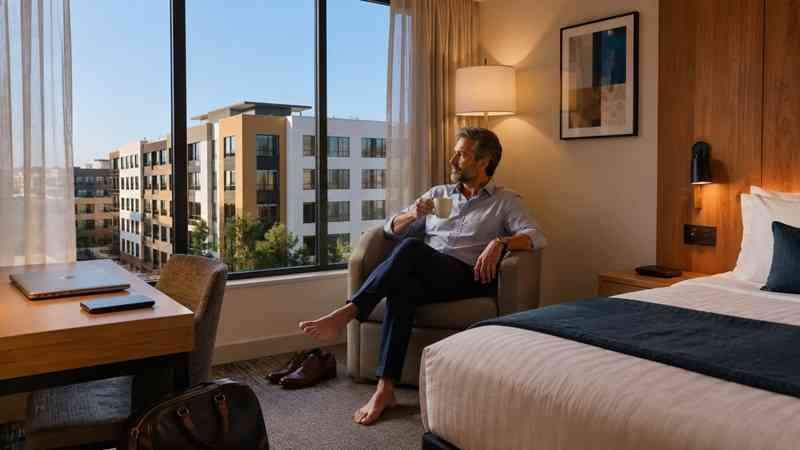
A Hyatt-commissioned study finds US road warriors are guarding their hotel rooms as rare pockets of peace, while beds, Wi-Fi, and loyalty rewards increasingly shape booking decisions.
There comes a moment on almost every business trip when the lanyard comes off, the laptop lid closes, and even the most determined networker has had quite enough of “circling back”. According to new Hyatt research, that moment now has a preferred address: the hotel room.
The study found 90 per cent of surveyed US business travellers regarded their room as the only place where they truly felt off the clock during a work trip. Nearly half, or 47 per cent, would rather spend spare time relaxing alone there than attend an optional networking event.
Some are defending that solitude with more invention than dignity. Respondents admitted to scheduling fake meetings or making excuses to dodge optional functions. These ranged from family video calls to caring for a pet anaconda. The snake may be fictitious, but the desire to escape another round of name badges and warm chardonnay appears very real.
A revealing snapshot, with an important limit
Hyatt commissioned Talker Research to question 2,000 US business travellers between 29 May and 11 June 2026. The sample was divided evenly between extended-stay and transient business travellers.
That methodology gives the figures useful weight, but it also sets a firm boundary. This was a company-commissioned US survey, not a global census of corporate travel. Its findings should therefore be read as a revealing market snapshot rather than a universal verdict.
Even with that caveat, the message is hard to miss. Business travellers are not simply buying a bed for the night. They are buying a door that closes, a space that works and, if fortune smiles, a few hours in which nobody asks for “just one quick chat”.
“Business travel has evolved and so have travelers’ expectations,” said Jason Ballard, Hyatt’s Senior Vice President and Global Brand Leader, Essentials.
Ballard pointed to a well-designed guestroom, a comfortable bed, dependable Wi-Fi and breakfast before an early meeting as the small details that can determine whether a traveller starts the day refreshed or already running on fumes.
The humble essentials regain their crown
The survey found 46 per cent of respondents saw consistency between stays as one of the clearest signs of hotel quality. More strikingly, 79 per cent believed a high-quality hotel directly improved their work performance.
Their preferred amenities were hardly outlandish: comfortable beds, reliable in-room Wi-Fi, round-the-clock food options, complimentary breakfast and early check-in. No one clamoured for gold taps or a pillow menu running to three volumes. Travellers wanted the basics done properly, which is often the most demanding brief in hospitality.
Nearly three-quarters said they usually worked in their room after the formal workday had ended. That puts the guestroom under unusual pressure. It must serve as an office, dining room and refuge, sometimes within the same hour.
For hotel owners and travel managers, the commercial lesson is plain. A good business-travel room needs a comfortable workspace without surrendering its sense of calm. Fast Wi-Fi, practical lighting, accessible power, quiet surroundings and a reliable bed are no longer background details. Together, they form the product.
Hyatt is using the findings to support its Essentials Portfolio, which includes Hyatt Place, Hyatt House, Hyatt Studios, Hyatt Select, Caption by Hyatt, Unscripted by Hyatt and UrCove. The company says rooms across the portfolio are designed to move between work and rest, with dedicated work areas and, at participating properties, breakfast and 24-hour food and beverage options.
Loyalty still has a seat at the table
Downtime may be precious, but points remain persuasive. Eighty per cent of respondents said hotel loyalty programs influenced where they stayed for work. That figure shows why rewards have become part of the corporate-travel contest rather than a pleasant extra tucked behind reception.
Through World of Hyatt, members earn points on qualifying stays and can progress towards status benefits, milestone rewards and free-night awards. Early check-in and late checkout may also be available, although those benefits depend on property availability and applicable program rules.
Two current promotions add some sparkle, but travellers should read the map as carefully as the headline. Members who register can earn 3,000 bonus points for each qualifying stay of at least three consecutive nights at participating Hyatt Place and Hyatt Select hotels, up to 30,000 points. The offer covers participating properties in the United States, Canada, the Caribbean and Latin America, and eligible stays must be completed by 30 September 2026.
A separate extended-stay offer awards 5,000 bonus points for each qualifying stay of five or more consecutive nights at participating Hyatt House and Hyatt Studios hotels worldwide, up to 50,000 points. Registration is required, and eligible stays must be completed by 31 December 2026. Again, the small print deserves a proper look before booking.
A growing portfolio follows changing work habits
Hyatt reported more than 700 Essentials hotels across seven brands worldwide as at 31 August 2026. It also said the portfolio added almost 70 hotels in the first half of the year.
The announced expansion includes Hyatt Place Asheville Airport, expected in September, followed by Hyatt Place JFK Airport, Hyatt Select Wooster and Hyatt Studios Tallahassee/I-10, each expected in December 2026. Earlier additions cited by Hyatt include properties in Vancouver, Galveston, Jacksonville, Chesapeake, Texarkana, Ontario and Portland.
Openings can move, of course, and travellers should confirm dates directly before making plans. Yet the direction is clear. Hotel groups see value in brands that promise predictability, useful amenities and fewer complications for guests who already have quite enough in their diaries.
For Australian travel buyers, the US-only scope means the percentages cannot simply be pasted onto the local market. The questions behind them, however, travel rather well. Does the preferred hotel help an employee work without turning the entire stay into work? Can the traveller eat, sleep and connect without wrestling with avoidable friction? Does the loyalty value justify the rate and suit company policy?
The best business hotels have long understood an old hospitality truth: comfort is not frippery. It is part of performance. Hyatt’s research puts fresh numbers around that principle and gives the industry a timely reminder that a closed hotel-room door can be more than privacy. For a weary traveller, it may be the final, blessed meeting cancellation of the day.
By: Soo James – © 2026.
Read Time: 5 minutes.
Author Bio:
 There’s nothing rehearsed about Soo James, and that’s precisely the point. Malaysian by heritage, Sydney by schooling, she arrived at UNSW to study Arts, then took a left turn into IT, not out of ambition, but curiosity. Somewhere among systems and schedules, she worked out what really held her attention: people, language, and the quiet spaces between them.
Writing followed naturally. Travel and lifestyle gave her room to observe, to listen, to notice the details others rush past. Soo writes like good travellers do: watching the room before admiring the view, catching the gesture before chasing the headline.
At Global Travel Media, her stories don’t shout or sell. They linger. They slow you down, open a door, and gently suggest there’s more to see if you’re willing to look.











