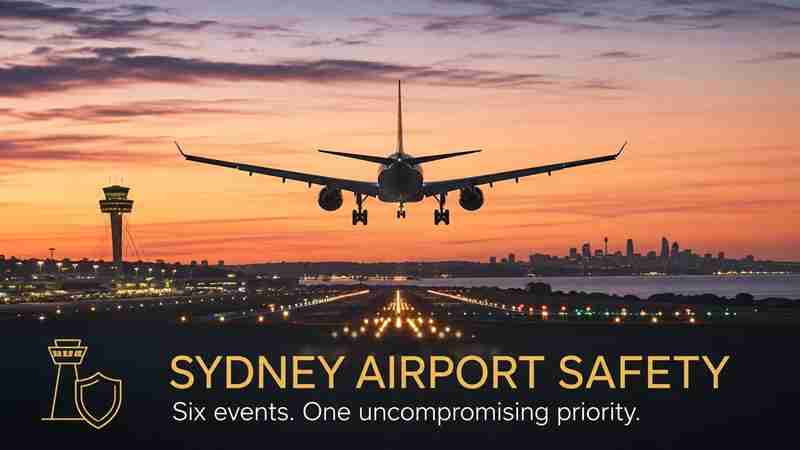
Sydney Airport’s intricate web of runways and taxiways is under intense scrutiny after six separate safety occurrences prompted investigations in barely a month.
The cluster, recorded between 27 July and 25 August 2026, involved aircraft operated by Qantas, QantasLink, Virgin Australia, Jetstar and Qatar Airways. Nobody was killed, and no passengers were injured, although one Jetstar cabin crew member suffered a serious injury during the 9 August taxiway occurrence.
The Australian Transport Safety Bureau’s formal classifications matter. The six comprise one accident, one serious incident and four incidents. Only the Jetstar–Qatar Airways event was categorised as a taxiing collision or near collision. They should not all be presented as six near misses.
That may seem like aviation splitting hairs at 30,000 feet, but precise language is vital. Safety reporting demands cool heads, dependable evidence and a healthy resistance to booking a seat aboard the panic express.
Even so, six investigations at Australia’s busiest airport in such a short period cannot be waved away like an unwanted boarding pass. The ATSB is examining each occurrence separately while its investigation teams coordinate their work and look for any common contributing factors or underlying safety issues.
27 July: runway conflict becomes serious incident
The first occurrence happened at 8.14 am on 27 July. QantasLink flight QLK424D, a Bombardier Dash 8 arriving from Canberra, was completing its landing roll on runway 34 Left. At the same time, air traffic control cleared Qantas flight QF124, a Boeing 737 arriving from Queenstown, to cross the same runway from runway 25.
Air traffic control detected the conflict and advised both crews. The Boeing stopped after passing the holding point. No one was injured, and neither aircraft was damaged, but the ATSB classified the occurrence as a serious incident involving a breakdown in coordination, procedural error, and a runway incursion.
The distinction is worth noting: this was not merely a delay or an awkward exchange over the radio. The ATSB classified it as a serious incident, and the investigation remains active.
9 August: two events within three hours
The second occurrence unfolded at about 7.20 am on 9 August. Jetstar flight JQ402, an Airbus A320 scheduled to fly from Sydney to the Gold Coast, was taxiing for departure when its crew saw an unoccupied Qatar Airways Boeing 777-300ER under tow on a crossing taxiway.
Both aircraft stopped abruptly. One Jetstar cabin crew member suffered a serious injury, although no aircraft damage was recorded by the ATSB. The Jetstar flight was cancelled, and passengers were rebooked.
Because of the serious injury, the ATSB records this occurrence as an accident. Its operational category includes taxiing collision or near collision and ground handling. Investigators have examined flight-recorder and air-traffic-surveillance data, towing procedures, training records and licences. Further analysis and interviews are continuing under ATSB investigation AO-2026-087.
Less than three hours later, Sydney recorded a third occurrence.
At about 10 am, Virgin Australia flight VA555, a Boeing 737 bound for Perth, had been cleared for a full-length take-off from runway 34 Left. As the crew applied thrust, the pilots saw Qantas flight QF728, another Boeing 737, begin crossing the runway ahead from taxiway Lima.
The Virgin crew reduced thrust and stopped on the runway. At about the same time, air traffic control cancelled the take-off clearance. The Qantas crew reported that it had received clearance to cross.
Once the Qantas aircraft was clear, the Virgin jet received another take-off clearance and departed. Nobody was injured, and neither aircraft was damaged. The ATSB is investigating the event as an incident involving a runway incursion, rejected take-off, loss of separation and information or procedural error.
16 August: a missed give-way readback
The fourth occurrence followed on 16 August after Virgin Australia flight VA1589, operating from Melbourne to Newcastle, diverted to Sydney and landed on runway 16 Left.
The Virgin Boeing 737 was taxiing north along taxiway Bravo. Meanwhile, Qantas flight QF420, another Boeing 737 arriving from Melbourne, was leaving runway 16 Right at taxiway Bravo 8.
Air traffic control instructed the Virgin crew to give way to the Qantas aircraft. According to the ATSB, the Virgin crew did not read back that instruction, and air traffic control did not identify the incorrect readback.
As the Qantas aircraft left the runway, its crew saw the Virgin jet approaching from the right. The Qantas pilots stopped their aircraft and clarified the taxiing order. The ATSB classified the occurrence as an incident, with no injuries or aircraft damage recorded.
18 August: Qantas crews avert taxiway conflict
Two days later, two Qantas aircraft were involved in the fifth occurrence.
Qantas flight QF589, a Boeing 737 arriving from the Gold Coast, was taxiing west along taxiway Lima with clearance to turn right at taxiway Bravo. Qantas flight QF405, an Airbus A321 bound for Melbourne, was travelling south along taxiway Charlie with clearance to turn right onto taxiway Lima.
As the Airbus approached taxiway Lima, its crew saw the Boeing coming from the left and stopped. The Boeing passed ahead. The stop was normal, no one was injured, and the ATSB said there was no immediate risk of collision.
Investigators are examining the potentially conflicting instructions issued to the crews and whether the occurrence shares any contributing factors with the other Sydney Airport events.
25 August: pushback stopped before conflict
The sixth occurrence arose on 25 August when complete traffic information was not passed before a Jetstar Airbus A320 pushed back from its bay.
The aircraft, registration VH-VFX, was scheduled to operate from Sydney to Launceston. According to the ATSB, the controller did not advise the crew about another aircraft taxiing behind the Airbus, creating a conflict. A separate ATSB statement identified the other aircraft as a Bombardier Dash 8.
The pushback crew saw the approaching aircraft, stopped the manoeuvre and returned the Airbus to the bay. Nobody was injured, no damage was recorded, and the event was classified as an incident. The ATSB said there was no immediate risk of collision and that the ground crew’s response preserved an important safety defence. ATSB investigation AO-2026-092.
Is Sydney Airport becoming less safe?
The honest answer is that it is too early to say.
All six investigations remain active. Final findings have not been released, and it would be irresponsible to apportion blame to controllers, pilots, airlines, ground crews or Sydney Airport before investigators complete their work.
Airservices Australia told the ABC that, since January 2021, it had reported an average of about 34 occurrences each month at Sydney Airport. That compared with approximately 21 a month at Brisbane and 12 at Melbourne.
Those figures cover a broad range of operational reports. They are not monthly totals of near collisions, runway incursions or serious incidents. Sydney also handles more aircraft movements than any other Australian airport, naturally creating more opportunities for reportable events.
Yet averages do not make this concentrated series irrelevant. Safety is not maintained by saying an occurrence falls within the usual numbers. It is maintained by investigating what happened, learning from it and strengthening the system before the next set of circumstances becomes less forgiving.
Aviation relies on overlapping layers of defence: accurate clearances, mandatory readbacks, controller monitoring, cockpit observation, surface surveillance, ground-crew awareness and the authority to stop whenever something does not look right.
Across these six occurrences, at least one of those defences helped prevent an aircraft collision. That is reassuring, but it is hardly an invitation to put one’s feet up and order another coffee.
Controller staffing enters the debate
Air traffic controller staffing has inevitably become part of the discussion. Sydney experienced extensive delays during August when Airservices was unable to provide normal staffing levels, while industry representatives raised concerns about overtime and controller availability.
NSW Premier Chris Minns said adequate staffing was crucial to public safety and the economy, particularly with Western Sydney International Airport preparing to begin operations.
Staffing shortages, however, have not been established as the cause of any of the six occurrences. The ATSB will examine controller and crew actions, communications, recorded data, procedures and other operational evidence before determining whether staffing, workload, rostering or unrelated factors played a part.
The difference between suspicion and a finding is a modest distinction that public debate occasionally leaves circling in a holding pattern.
Sydney’s challenge is part of a global problem
Runway incursions and surface conflicts are international aviation problems, not uniquely Australian failings.
The International Civil Aviation Organisation treats runway incursions as a high-risk aviation category. Its Global Runway Safety Action Plan recommends coordinated action by airports, airlines, air navigation service providers and regulators to reduce incursions and runway excursions.
In the United States, the Federal Aviation Administration publishes runway incursion data and operates its Runway Incursion Mitigation Program, which focuses on higher-risk runway and taxiway locations. FAA reports show that infrastructure changes, improved markings, procedural measures and better technology can reduce risk at identified trouble spots.
Australia should continue drawing on those lessons. The wider safety response should consider whether surface-surveillance systems, controller alerts, stop-bar arrangements, clearance procedures and readback monitoring provide the strongest practicable protection at Sydney’s busiest intersections.
A confidential, non-punitive reporting culture must also be preserved. High reporting numbers can reveal problems, but they can also demonstrate that hazards and mistakes are being reported instead of hidden. Aviation becomes safer when information travels freely, preferably before two aircraft attempt to occupy the same piece of pavement.
Confidence must be earned through transparency
Passengers should not conclude that Sydney Airport has suddenly become unsafe. Australia’s commercial aviation system is highly regulated, and the actions of pilots, controllers and ground personnel stopped the six events from becoming aircraft collisions.
Nor should the industry dismiss legitimate concern. A runway or taxiway conflict may last only seconds, but it can expose weaknesses deserving months of painstaking investigation.
At the time of publication, the ATSB anticipated releasing preliminary factual reports on the two newest investigations within approximately six to eight weeks. Final reports will follow when the investigations are complete. The bureau has said that it will notify relevant parties immediately if it identifies a critical safety issue.
That process must be allowed to proceed without speculation, defensiveness or corporate fog.
Sydney Airport is the nation’s principal international gateway and the beating heart of its aviation network. Travellers, airline employees and the tourism industry are entitled to know that every safety occurrence is examined thoroughly and that any shared weakness is addressed promptly.
Six investigations do not prove that the system is broken. They do, however, deliver a firm reminder: aviation safety is measured not merely by avoiding yesterday’s collision, but by removing tomorrow’s opportunity for one.
By: Jill Walsh – © 2026.
Read Time: 6 minutes.
Author Bio:
 Jill Walsh has always kept a pen close and a suitcase closer. She started in media releases, then learned the trade by escorting press trips around the world, discovering which stories travel well and which need a sharper edit.
Before long, she wasn’t just promoting destinations; she was representing them, translating civic ambition and local pride into words people actually wanted to read. These days, semi-retired and happily so, Jill has traded departure boards for deadlines, joining old friend and colleague Stephen at Global Travel Media on a casual basis.
Her patch is the business end of wanderlust: balance sheets, route maps, tender wins and the numbers that quietly decide where travellers go. She writes with dry humour, clean prose and an old-school respect for facts a steady voice when the market starts shouting.