

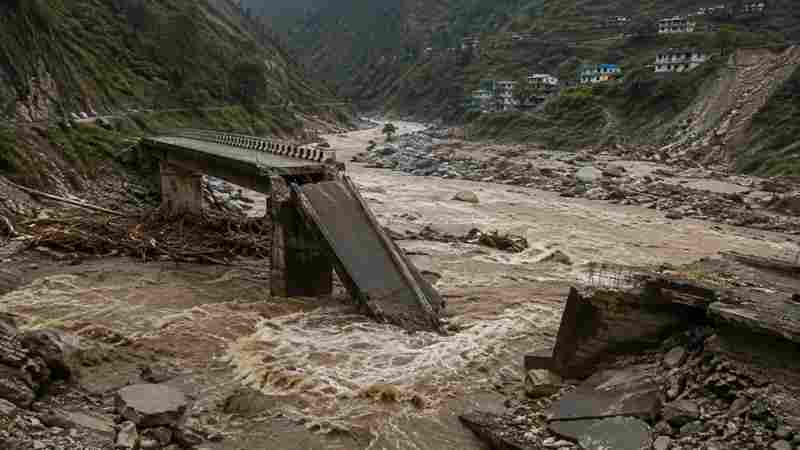
Families are waiting for news as a Himalayan catastrophe lays bare a truth the travel industry can no longer file under future risk.
There are moments when tourism must stop talking about arrivals and start talking about people. This is one of them.
The Nepal–Tibet flood story begins not with a booking or a border crossing, but with absence. Unanswered calls, missing relatives, and families clinging to the hope that someone, somewhere, will bring good news.
As of early 30 August 2026, authorities reported that at least 750 people had died across Nepal and Tibet, while 3,044 remained missing. More than 90,000 people were affected. Among them were residents, workers, pilgrims and foreign visitors caught in a landscape torn apart by water, ice, rock and mud.
The figures are grim, but figures can be tidy in a way grief never is. Each number has a name behind it. Each name has somebody waiting for the telephone to ring.
Rescuers continue to work in foul weather and treacherous terrain while river levels rise and the danger of further floods and landslides persists. The numbers remain time-sensitive and may change as searches continue. Reuters reported the consolidated toll and rescue situation on 30 August.
This is first and foremost a human tragedy. But it is also a warning to an industry that sells the splendour of mountains while sometimes treating their risks as an awkward paragraph near the back of the brochure.
The Himalayas have always rewarded humility. They have little time for swagger.
When the mountain moved
The disaster struck the Gyirong-Rasuwa border area, also spelt Kyirong in some regional sources and surged through the Bhote Koshi and Trishuli river systems.
Early scientific assessments point to a glacier collapse and an ice-and-rock avalanche high above the border. The avalanche appears to have temporarily dammed the Lhende River, unleashing a violent mass of water, mud and boulders downstream. Villages, roads, bridges, hydropower facilities and vital transport links were caught in its path.
When a mountain rearranges itself, the valley below receives no calendar invitation.
The exact chain of events is still being studied, and caution matters. Chinese scientific analysis has linked the glacier instability to the long-term effects of global warming. However, responsible reporting should still distinguish the region’s clear climate trend from the final attribution of every stage of this disaster.
The International Centre for Integrated Mountain Development has highlighted the role of an ice-rock avalanche and the urgent need for better monitoring, early warning systems, resilient infrastructure and cross-border co-operation.
That is not academic housekeeping. It is the difference between a warning reaching a village, lodge or tour group in time and arriving after the river has already done its worst.
Tourism was caught in the current
The affected corridor is more than a line on a map. It carries trade, local traffic, pilgrimage groups and touring programs between Nepal and Tibet, including journeys linked to Mount Kailash and Lake Manasarovar.
For generations, visitors have travelled there in search of faith, beauty, challenge and perspective. This week, grief eclipsed all of that.
The disaster has exposed how quickly a touring route can become a rescue zone. Roads vanish. Bridges fail. Mobile signals go quiet. Carefully timed itineraries, reassuring confirmation emails and neatly printed vouchers suddenly have all the authority of confetti.
For travel agents and operators, duty of care cannot be three cheerful lines in the terms and conditions. It must be a living system that knows where every traveller is, who is leading them, and how to reach them when ordinary channels fail.
A client list is an administrative task on Monday. During a disaster, it becomes a lifeline.
Australia’s warning is serious and specific
Australia’s Smartraveller service advises travellers to reconsider visiting areas within 50 kilometres of the Trishuli River in Rasuwa, Nuwakot, Dhading, Nawalpur and Gorkha districts. It also advises reconsidering travel to Gyirong County in Tibet because of the continuing risk of severe flooding and landslides.
Smartraveller’s crisis alert tells visitors to postpone overland travel between Nepal and Tibet, including Mount Kailash and Lake Manasarovar circuits. Travellers should avoid affected river corridors, follow local orders and check every arrangement with their airline, travel agent or tour operator.
That advice must be taken seriously. It must also be read accurately.
This is not a blanket warning against all travel to Nepal. A country is not a single road, river or valley. Nepal’s Ministry of Foreign Affairs has said the country remains open to international travellers because only a specific area has been affected.
The travel industry therefore has a harder and more useful job than simply shouting cancel or carry on. It must distinguish danger from destination, steer visitors away from affected areas and avoid punishing safe communities with needless panic.
That calls for judgement, an old-fashioned travel skill that remains more valuable than any booking app yet invented.
Climate risk has joined the itinerary
The wider lesson cannot be brushed aside. Rising temperatures, retreating glaciers, unstable slopes and heavy rain can combine with steep terrain to produce fast, complex and deadly disasters.
The World Bank’s Nepal climate assessment says rising temperatures, melting glaciers and more intense rainfall are expected to increase climate-related hazards, particularly floods and landslides.
For years, much of tourism’s climate debate arrived dressed for a conference: carbon targets, sustainability pledges, recycled paper and a refillable bottle on the lectern. All worthwhile. None sufficient.
Climate adaptation is less glamorous. It means stronger bridges, safer road alignments, satellite communications, reliable weather data, trained guides, tested evacuation plans and the courage to cancel a profitable departure when the mountain says no.
The brochure may promise the journey of a lifetime. The mountain retains final editorial approval.
Five changes the travel trade must make
Know where every traveller is. Live manifests, working emergency numbers and a clear contact tree must be standard. A spreadsheet sitting on an unattended office computer will offer little comfort when the power fails.
Assess the route, not merely the country. One district may be dangerous while another remains open. Base decisions on current river, road, weather, and government information, not last season’s risk document with a new date.
Build warnings that cross borders. Rivers and avalanches are famously indifferent to immigration formalities. Nepal and China need rapid data sharing, while operators need systems that can carry warnings to guides, lodges and travellers in remote valleys.
Give guides a genuine Plan B. Agree on safe assembly points, alternative routes, extra supplies, and evacuation limits before departure. Most importantly, guides must have the authority to turn back without arguing with a distant office worried about refunds.
Put insurance and suppliers under proper scrutiny. Travellers need suitable cover for natural disasters, evacuation and disruption. Wholesalers and agents should know how local partners track groups, manage medicines, contact families and account for every client.
This is not bureaucracy for its own sake. It is professionalism with its boots on.
Recovery must come with dignity
Nepal’s visitor economy is not a postcard with a payroll attached. Guides, porters, drivers, lodge owners, cooks, shopkeepers, and families make it human through their knowledge and hospitality, turning a mountain journey into something memorable.
When roads disappear and bookings stop, those people lose income at precisely the moment their homes and communities need it most.
The answer is neither reckless reassurance nor a wholesale retreat from Nepal. It is intelligent, targeted recovery. Safe regions should remain open when authorities say they are accessible. Affected communities must be given time, resources and the courtesy of honest communication.
Tourism businesses can help by supporting verified relief efforts, retaining displaced staff where possible, waiving unfair cancellation charges and rebooking clients with patience rather than pressure. Reconstruction should favour stronger bridges, safer roads, reliable communications and buildings designed to withstand multiple hazards.
There will be time for glossy recovery campaigns and cheerful special offers. Not yet. Rescue, mourning, and rebuilding must set the timetable.
Nepal does not need empty pity. It needs practical help, sensible travellers and an industry confident enough to tell the truth.
Respect is the safest passport
The Nepal–Tibet flood is not an argument against travel to the Himalayas. It is an argument for better travel: prepared, locally informed, properly insured and humble enough to turn back.
Adventure will always contain uncertainty. That is part of its magic. Neglect is something else entirely. It is poor management in expensive walking boots.
The people of Nepal have rebuilt after immense hardship before. They will do so again. When the time is right, tourism should return, not blundering in with slogans, but standing beside communities. It should bring better systems, stronger partnerships and a little more humility than it carried up the mountain.
The Himalayas will remain magnificent, timeless and gloriously unimpressed by our schedules.
Our responsibility is to travel there with wonder, certainly, but also with respect. And respect has always been the soundest passport in the mountains.
By: Michelle Warner – © 2026.
Read Time: 6 minutes.
Author Bio:
 Michelle Warner has always carried stories the way others carry passports lightly, faithfully, and with purpose. She learned her craft in newsrooms, shaping sentences with care, before swapping deadlines for departures as a flight attendant with some of the world’s great airlines. Years aloft sharpened her eye for character and deepened her fondness for the small, dignified rituals of travel, the quiet kindness of strangers, the poetry of arrival, the patience learned between time zones.
Now grounded by choice, Michelle has come home to writing with the same calm authority she once brought to turbulent cabins. Her prose blends an editor’s discipline with a traveller’s wonder, tinged with humour and reverence for the golden age of travel. Each piece feels like a handwritten boarding pass, gracious, observant, and unmistakably alive.











