

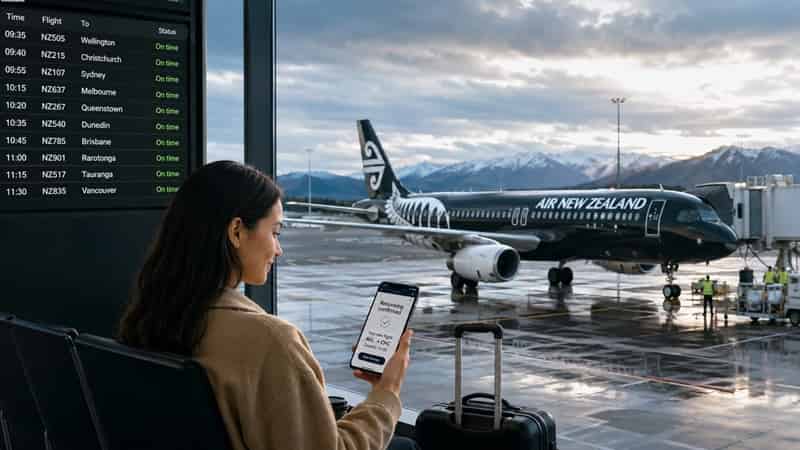
Air New Zealand is turning better operational discipline into something passengers can actually feel. More flights are arriving on time. There are fewer cancellations. And when the weather throws a tantrum, rebooking is becoming much faster.
Reliability improves despite tougher winter weather
The airline’s July 2026 operating figures show 83.1 per cent of flights arrived within 15 minutes of schedule. That was a 6.4 percentage-point improvement on July 2025. The result was below June’s 86 per cent, but the year-on-year gain came despite weather-related delay minutes being 74 per cent higher.
For an airline operating through a New Zealand winter, that matters. Weather cannot be negotiated with, delayed by committee or persuaded to read the timetable. The more useful measure is how quickly an operation can recover once disruption begins.
Air New Zealand Chief Operations Officer, Ground and In-Flight, Kate Boyer said the July figures showed progress where passengers notice it most.
“Compared with July last year, more of our flights arrived on time, and we had 246 fewer cancellations, despite dealing with significantly more weather disruption.”
The improvement was broad, not confined to one corner of the network. International on-time performance rose by more than nine percentage points year on year. Auckland, the airline’s largest and most complex operation, improved by almost 10 percentage points.
“We know reliability is one of the things our customers value most. Our focus is on reducing disruption in the first place, and when it does happen, recovering quickly and making the experience as easy as possible for our customers,” Boyer said.
Knock-on delays cut sharply
That recovery piece is where the numbers become especially interesting.
Reactionary delays are the aviation version of falling dominoes. One late flight creates delays for later services. In July, reactionary delay minutes fell 41 per cent compared with the same month last year. As a result, 1,366 fewer flights were affected by those knock-on delays.
“Reducing reactionary delays is important because it’s not just about the first disrupted flight. The faster we can recover, the better chance we have of preventing that disruption from affecting customers travelling later in the day,” Boyer said.
It is an unglamorous part of airline operations, but a vital one. A shiny aircraft and a good lounge count for little when the departure board slowly turns red.
Cancellations also moved in the right direction. Total cancellations fell 1.6 percentage points year on year to 2.8 per cent. That represented 246 fewer cancellations. Cancellations within Air New Zealand’s control fell 1.2 percentage points to 1.0 per cent, or 184 fewer cancellations.
Those figures build on a stronger June. Air New Zealand reported 86 per cent of flights arriving within 15 minutes of schedule that month. Reactionary delays were also down by more than half compared with June 2025. The airline has been applying schedule changes, tighter day-of-operation execution and broader operational improvements across its network.
APR turns hours into minutes
But reliability is only half the story. When disruption cannot be avoided, the next battle is removing uncertainty for passengers.
Air New Zealand introduced its Automated Passenger Rebooking technology, known as APR, for domestic services in mid-2025. It is now being extended to international cancellations.
Before APR, rebooking passengers after a cancellation could take hours. For some long-haul disruptions, the process could stretch to four to six hours. With the automated system, passengers on more straightforward itineraries can be rebooked in under 20 minutes.
That is a significant change in the customer experience. Instead of waiting in limbo, affected passengers can receive a new itinerary sooner. Where another option is available, they can move themselves onto a flight that better suits their plans.
The technology also gives Air New Zealand’s service teams more time for complicated journeys. It also helps staff focus on passengers who require extra care.
“We’ve had great feedback from both our customers and our teams since APR was first introduced domestically last year, and we’re now hearing the same from the international rollout,” Boyer said.
“Going from potentially hours to minutes for some rebookings is a huge improvement for our customers. It means they have certainty sooner and more control over what happens next, while our teams can focus their time on customers with more complex journeys or those who need extra care and support.”
For travel advisers, corporate travel managers, and passengers, that distinction matters. A cancellation will never be welcome news. But fast, clear recovery can stop one disrupted sector from becoming an entire day or holiday unravelling at the seams.
Cargo keeps moving too
During July, Air New Zealand operated 13,397 domestic and international flights. Its freight operation also carried 14,149 tonnes of cargo. That included 370 tonnes of frozen seafood and salmon exported to North America.
The cargo figure is a useful reminder that airline reliability matters beyond the departure gate. New Zealand’s aviation network carries business, tourism and time-sensitive exports as well as passengers. Operational resilience therefore has a wider economic value.
Air New Zealand is not claiming victory over disruption. No airline can, particularly when winter weather, air traffic restrictions and other external events enter the equation. What July suggests is that the carrier is getting better at containing the damage.
That may not make for the most romantic chapter in aviation. Yet for travellers, “arrived on time” remains one of the finest phrases in the English language.
For current operational information, passengers can check Air New Zealand’s official travel alerts, flight status and Manage Booking services.
By: Michelle Warner – © 2026.
Read Time: 4 minutes.
Author Bio:
 Michelle Warner has always carried stories the way others carry passports lightly, faithfully, and with purpose. She learned her craft in newsrooms, shaping sentences with care, before swapping deadlines for departures as a flight attendant with some of the world’s great airlines. Years aloft sharpened her eye for character and deepened her fondness for the small, dignified rituals of travel, the quiet kindness of strangers, the poetry of arrival, the patience learned between time zones.
Now grounded by choice, Michelle has come home to writing with the same calm authority she once brought to turbulent cabins. Her prose blends an editor’s discipline with a traveller’s wonder, tinged with humour and reverence for the golden age of travel. Each piece feels like a handwritten boarding pass, gracious, observant, and unmistakably alive.











