

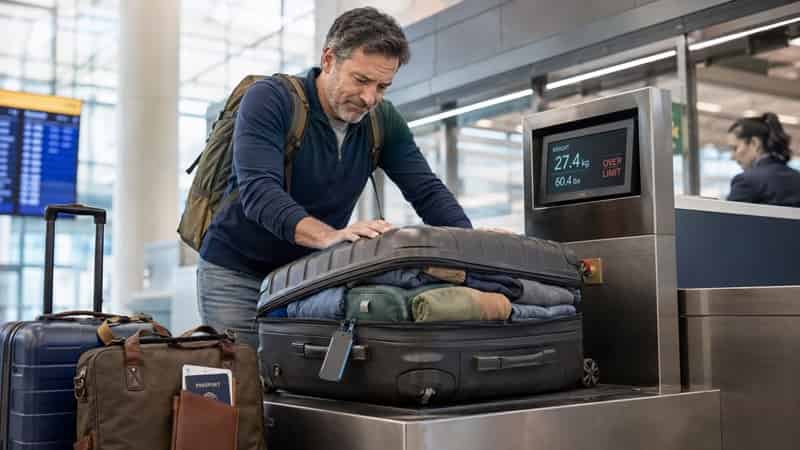
Experienced travellers know the drill. Check the passport. Download the boarding pass. Tag the suitcase. Leave enough time for the connection. Then, with years of hard-won wisdom behind them, many still do one thing they know they should not: pack too much.
The latest Global Rescue Traveller Sentiment and Safety Survey puts overpacking back at the top of the travel-blunder table. Some 38% of experienced international travellers now name excess luggage as their biggest mistake. Global Rescue says the figure was 32% in 2025 and 35% in selected survey waves in 2024 and 2023.
The long-term change is still striking. In February 2020, just before COVID-19 turned global travel on its head, Global Rescue reported that 75% of respondents admitted to overpacking. That is real progress. Yet the suitcase, it seems, remains one opponent the seasoned traveller has not quite conquered.
Dan Richards, founder and CEO of The Global Rescue Companies and a member of the US Travel and Tourism Advisory Board, calls overpacking “the single most consistent preventable mistake we see, year after year”. The US Department of Commerce also confirms his position on the federal advisory board.
There is a serious point beneath the familiar holiday joke.
Heavy bags can add fatigue, reduce balance and make falls or strains more likely. Airports, cruise terminals, railway stations, hotel stairs, cobbled streets, and rough trails become harder when travellers haul more than they need.
The problem can become sharper during an emergency. A traveller who must move quickly because of wildfire, severe weather or civil unrest may be slowed by large or multiple bags. In the worst case, they may have to leave the luggage behind.
The survey also shows a geographic gap. Forty-two per cent of non-US respondents named overpacking as their biggest mistake, compared with 37% of US-based travellers.
Other avoidable errors remain close behind. Nineteen per cent cited booking connections that were simply too tight. Ten per cent regretted over-scheduling their trip and leaving no buffer time. Eight per cent pointed to travelling without offline maps or saved booking documents. Another 8% regretted changing money at costly airport currency counters.
The amusing part is that experienced travellers already know plenty of smart tricks.
Smart tags in checked bags were the most popular travel hack, chosen by 31% of respondents. Sixteen per cent email themselves digital copies of passports and identification. Compression packing cubes and rolling clothes instead of folding them each attracted 10%.
There are useful differences by market. US-based travellers are more likely to favour smart luggage tags. Travellers based outside the US are more inclined to email passport copies to themselves, use compression cubes and download entertainment before leaving home.
For travel advisers, tour operators and airlines, the findings carry a practical lesson. Small pieces of pre-departure advice can improve the whole trip. Sensible baggage limits, realistic connection times, document backups and some breathing room in the itinerary may not sound glamorous. They can, however, save a great deal of grief.
For travellers, the lesson is simpler still: pack for the journey you are actually taking.
A lighter bag means easier transfers, less strain and more freedom when plans change. It may also prevent that familiar check-in ritual in which a traveller stares at the baggage scale as though a little optimism might persuade it to lose three kilos.
Experience may teach us many things. Apparently, knowing when to leave the fourth pair of shoes at home still takes practice.
For more information, visit www.globalrescue.com.
By: Stephen Peters – © 2026.
Read Time: 3 minutes.
Author Bio:
 Stephen Peters has spent much of his career proving that the straight-and-narrow path is considerably overrated. Armed with a Bachelor’s degree in Technology from the University of Queensland and a Master’s in Management, he first ventured into hospitality, working in and helping open several five-star hotels across Sydney and Asia.
After deciding he had experienced quite enough of five-star hospitality from the operational side of the desk, Stephen returned to technology, working with major US tech companies while based between Australia and Asia.
Then came the ultimate change of scenery. Stephen built his own yacht and, with his family aboard, sailed from Florida through the United States and its Great Lakes before crossing the Pacific to Asia. Several memorable years followed, exploring Indonesian waters before the Peters family eventually returned to Australia with considerably more sea miles, stories and perspective than when they left.











