

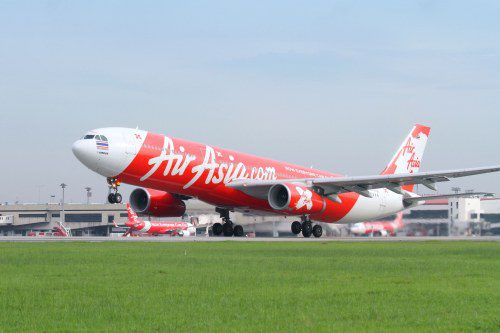
Thai AirAsia has turned a punishing second quarter into something considerably more interesting than a routine red-ink airline result, with parent Asia Aviation Public Company Limited (AAV) reporting higher revenue even as jet fuel costs went through the proverbial roof.
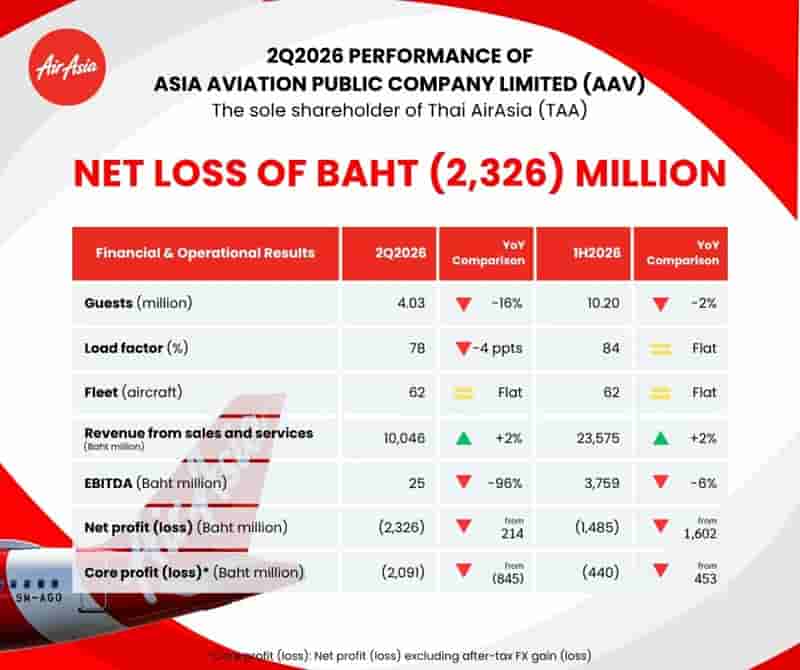
For the three months to 30 June 2026, AAV recorded revenue from sales and services of THB10.046 billion, up 2 per cent year-on-year. Ticket revenue rose 6 per cent to THB8.575 billion, despite Thai AirAsia deliberately reducing seat capacity by 13 per cent to 5.14 million seats during the region’s seasonally softer travel quarter.
Higher fares, fewer seats and revenue still rises
That is the nub of the story. Rather than chase volume for volume’s sake, an old airline habit that can make full aircraft and thin margins uncomfortable travelling companions, Thai AirAsia tightened capacity, concentrated on stronger markets and pushed harder on yield.
Average fares rose an impressive 27 per cent year-on-year, while the overall load factor held at 78 per cent and passenger numbers reached 4.03 million.
In other words, fewer seats did not mean surrender. They meant pricing discipline.
The strategy mattered because fuel delivered the quarter’s nastiest surprise. AAV said jet fuel prices surged 124 per cent year-on-year to US$183 a barrel, sending total fuel expenses 43 per cent higher to THB5.0 billion.
Against that backdrop, Thai AirAsia posted EBITDA of THB25 million, effectively around breakeven, while the net loss stood at THB2.326 billion, including a THB293 million foreign-exchange loss. Core operating loss for the quarter was THB2.091 billion, while the first-half 2026 core loss stood at THB440 million.
Those numbers are hardly cause to break out the airport lounge Champagne. But they also explain why management’s response deserves closer attention than the headline loss alone.
Cost discipline does some heavy lifting
AirAsia’s familiar low-cost discipline was clearly in evidence.
Selling and administrative expenses fell 17 per cent year-on-year, and staff costs dropped 12 per cent. Absolute non-fuel costs were down 8 per cent.
However, cost per available seat kilometre excluding fuel, or CASK ex-fuel, increased 13 per cent to THB1.43. With capacity deliberately reduced, the unit-cost figure remained under pressure even as absolute non-fuel spending declined.
Operationally, the airline also regained some swagger.
On-time performance improved to 88 per cent, from 85 per cent a year earlier. Thai AirAsia said it retained a 37 per cent share of Thailand’s domestic airline market and achieved an 80 per cent domestic load factor a useful sign that higher fares had not sent passengers stampeding towards the opposition.
AAV and Thai AirAsia Chief Executive Officer Phairat Pornpathananangoon summed up the quarter succinctly:
“We made a decisive move in 2Q26 to prioritise yield quality and liquidity during a global fuel crisis.”
The wording and attribution of that quotation have been checked against AirAsia’s official release.
Liquidity, crucially, was not left to wishful thinking.
Thai AirAsia raised THB3.815 billion through a new debenture issue in June while keeping net interest-bearing debt-to-equity at 1.1 times. For an airline navigating volatile fuel markets, that additional financial headroom matters almost as much as an extra aircraft on a peak-season Friday.
Q4 becomes the real test
The next test comes in the second half.
Thai AirAsia plans to keep capacity tight through the third quarter before lifting operating fleet deployment to 52 aircraft in Q4, when year-end holiday traffic should provide a considerably friendlier backdrop.
Management says suspended international routes will return, frequencies will be strengthened across Bangkok’s Don Mueang and Suvarnabhumi hubs, and the carrier intends to take advantage of forthcoming Thai government tourism programs and major international events.
The airline is also managing fuel exposure more cautiously.
The airline said 13 per cent of its third-quarter 2026 fuel requirement had been locked in at US$89 per barrel.
Management’s stated expectation is clear: “TAA expects to return to profitability” as the peak travel season returns in the final quarter.
There is no hiding the fact that this remains a forward-looking target rather than money already in the bank. Q4 will need to deliver both traffic and yield, while fuel prices remain a substantial variable.
Still, the underlying strategy is clear: defend yield now, avoid flooding weaker markets with discounted capacity, keep cash available, and put the aircraft back to work when demand is more willing to pay for them.
It is airline economics without the decorative ribbon.
Sustainability moves beyond the brochure
A broader strategic layer is also emerging beyond fares, fuel and fleet utilisation.
Thai AirAsia has introduced a voluntary carbon-offsetting feature through AirAsia MOVE, allowing passengers to offset either 50 or 100 per cent of the emissions attributed to their flights. The company says proceeds will support certified carbon-reduction projects.
The initiative forms part of Thai AirAsia’s stated Net Zero 2050 ambition and its involvement with Aviation Thailand’s Net Zero 2050 initiative.
At community level, Thai AirAsia is also working with the Tourism Authority of Thailand (TAT) to expand its Journey D tourism initiative under Village to the World Season 5 into Khlong Hoi Khong and Singhanakhon in Songkhla province.
The objective is to direct more tourism income into local communities, a useful reminder that aviation economics eventually needs to land somewhere beyond an Excel spreadsheet.
A quarter of defence with an eye firmly on attack
For the travel industry, AAV’s second-quarter result offers a useful lesson.
Revenue growth alone does not make a profitable quarter, particularly when fuel behaves like a commodity with a grudge. But Thai AirAsia’s combination of higher yields, disciplined capacity, reduced controllable expenditure, improved punctuality and additional liquidity suggests management has chosen defence with purpose rather than retrenchment by panic.
That distinction matters.
A 27 per cent rise in average fares alongside a 78 per cent system load factor suggests the airline retained considerable pricing power. Meanwhile, the 80 per cent domestic load factor gives Thai AirAsia a relatively solid platform as it prepares to restore capacity for the year-end peak.
The fourth quarter will show whether that discipline converts into black ink.
For now, Thai AirAsia has done something airlines rarely receive applause for: it has made fewer seats work harder.
In a quarter when fuel tried hard to steal the show, that may have been the more important performance.
By: Supaporn Pholrach – © 2026.
Read Time: 4 minutes.
Author Bio:
 Supaporn Pholrach came up in advertising when deals were sealed with a handshake, and deadlines lived on scraps of paper, not dashboards. She learned early that people mattered more than process, and it stuck. With solid training and a stubborn work ethic, she built a reputation for delivering results without turning hard or hollow.
Fifteen years at Bangkok Shuho would test anyone’s stamina. Supaporn stayed the distance. These days, as Sales Manager at Global Travel Media, she helps tourism brands cut through the noise with common sense, good humour and genuine warmth.
She doesn’t chase quick wins. She earns trust, builds loyalty and keeps her word. In an industry that rarely slows down, Supaporn is someone you’re quietly glad to have on your side.











