

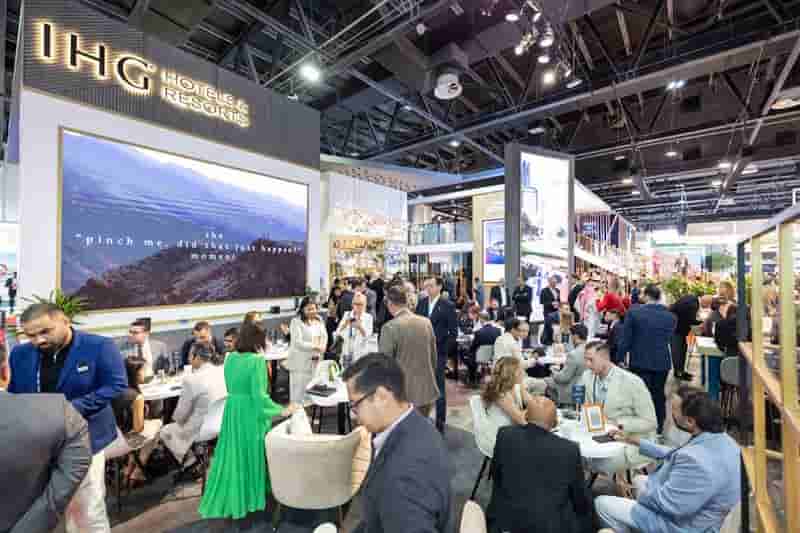
The Middle East’s hospitality industry is preparing to turn resilience into renewed growth as Arabian Travel Market returns to Dubai in September with guest experience, commercial reinvention and technology firmly on the agenda.
Taking place at the Dubai World Trade Centre from 14 to 17 September 2026, ATM will operate under the forward-looking theme, “Travel 2040: Driving New Frontiers Through Innovation and Technology.”
The dates deserve particular attention. ATM’s official website confirms that the event was rescheduled to September, shifting from its traditional northern spring position on the industry calendar. The venue remains the Dubai World Trade Centre, where many a promising partnership has begun over coffee strong enough to negotiate its own contract.
For hotel owners and operators, however, this year’s discussion will reach well beyond room nights and RevPAR. The central question is how hospitality businesses can remain commercially sturdy while satisfying travellers who increasingly want their accommodation to deliver stories, wellbeing, local culture and memorable experiences — preferably before breakfast.
Middle East Investment Builds Hotel Confidence
Confidence in the region remains strong, according to Haitham Mattar, Managing Director, India, Middle East and Africa at IHG Hotels & Resorts.

Haitham Mattar Managing Director India Middle East Africa IHG Hotels Resorts
“We’re extremely confident about the Middle East. It’s one of the fastest-growing tourism regions around the world. We’ve seen continued growth linked to the investment being made in tourism, whether it’s in the UAE, Saudi Arabia or Egypt. These are long-term investments, and that’s what gives us confidence in our people, our owners, our products and our brands across this diverse and complex region.”
That confidence rests on more than an optimistic turn of phrase. Governments across the UAE, Saudi Arabia and Egypt continue to back airports, resorts, cultural attractions, entertainment precincts and wider destination infrastructure.
The result is a hospitality market being built for the long haul rather than the next convenient long weekend. IHG’s own expansion across the region provides further evidence of that commitment, with the company pursuing new luxury, lifestyle, premium and mainstream hotel opportunities.
Mattar also underlined the sector’s capacity to weather difficult conditions.
“The hospitality industry in the region is resilient, and we are confident it will bounce back.”
Resilience, of course, does not mean simply waiting for yesterday’s business model to wander back through the lobby. Hotels are being forced to reconsider what they sell, how they operate and why guests should choose them over an ever-growing field of competitors.
Travellers Want More Than a Bed and Breakfast
The modern traveller is not merely booking a room. They may be seeking a wellness retreat, an outdoor adventure, an excellent meal, a cultural encounter or a closer connection with the place they have travelled halfway around the world to see.
As Mattar explained:
“No two travellers are the same. People are no longer simply looking for a room; they’re looking for experiences. Whether it’s gastronomy, outdoor adventure, wellness, culture or heritage, these experiences have become major motivators for travel. Hotels are responding by becoming experts in creating and recommending experiences that are authentic and meaningful.”
That shift is changing the competitive ground beneath hotel operators. A handsome suite and a well-stocked minibar remain welcome, naturally, but they are no longer the entire performance.
Personalisation, local storytelling, wellness and lifestyle-led programming are becoming core commercial tools. The successful hotel of the future must understand not only who is arriving, but why they have come and what might persuade them to return.
ATM Conference Tackles Hospitality Reinvention
These issues will move to centre stage throughout the ATM 2026 conference program.
The Global Stage session, “Does the Hospitality Industry Need Reinventing?”, will investigate how operators can respond to commercial recalibration across the sector.
Topics will include asset repositioning, branded residences, mixed-use developments, wellness and experience-led programming. Amir Golbarg, Chief Operating Officer at Minor Hotels, is among the industry leaders scheduled to examine how changing investment priorities are influencing hotel development and long-term returns.
Meanwhile, the Future Stage session, “Decoding Hospitality Growth – What Do Today’s Travellers Want?”, will turn its attention squarely towards the customer.
The scheduled panel brings together Hala Matar Choufany, President, Middle East, Africa and South Asia at HVS; Justin Reid, Senior Director of Global Partnerships at Tripadvisor; Jad Shamseddin, Chief Operating Officer at Aleph Hospitality; and Sarah Duignan, Director of Client Relationships at STR.
Their challenge will be to decode travellers whose motivations increasingly overlap. A single guest may want wellness, cultural immersion, value, convenience and digital efficiency all while expecting service to feel genuinely personal.
No pressure, then.
Technology Moves From Novelty to Necessity
Technology will receive its own prominent platform through ATM Travel Tech, the co-located event dedicated to technologies reshaping travel and the guest journey.
Artificial intelligence-powered personalisation, predictive guest services, robotics, immersive technology, and smart hotel systems will be among the leading areas of interest.
For operators, the strongest technology will not be the gadget making the most noise on the exhibition floor. It will be the technology that removes friction, helps staff anticipate genuine guest needs and improves efficiency without turning hospitality into a conversation with a vending machine.
This balance between innovation and human service will be critical. Travellers may appreciate swift digital check-in, intelligently tailored recommendations and responsive room controls, but warmth, judgement and old-fashioned attentiveness remain difficult to automate — and perhaps best left that way.
Global Hotel Leaders Head for Dubai
Major hospitality names expected to exhibit include IHG Hotels & Resorts, Accor, Minor Hotels, Rotana, Hilton, Jumeirah, Mandarin Oriental, Four Seasons Hotels & Resorts, Rixos Hotels and Sofitel.
They will be joined by destinations, tourism authorities, technology providers and decision-makers from international markets.
Danielle Curtis, Regional Portfolio Director, UAE, at RX Global, said the program reflected the forces now transforming hospitality worldwide.
“These insights reflect many of the trends shaping the global hospitality industry today. Across the Middle East, investment continues to accelerate while traveller expectations are becoming increasingly experience-led, personalised and wellness-focused. Through a range of dedicated sessions, ATM provides a platform for the industry’s leading voices to explore these changes, share practical strategies and build the partnerships that will drive the future of hospitality.”
ATM 2026 therefore arrives at an important point for the industry. The Middle East is not simply adding hotels; it is reconsidering what hospitality can become as tourism investment, technology and traveller expectations advance together.
The region’s next phase will belong to businesses that can marry commercial discipline with meaningful experiences. Marble foyers still have their place, certainly, but the lasting luxury may be a hotel that knows its destination, understands its guest and remembers that hospitality was human long before it became “smart”.
By: Octavia Koo – © 2026.
Read Time: 5 minutes.
Author Bio:
 Octavia Koo arrived in Australia in the early eighties with little fuss and a good eye. Sydney suited her. At UNSW, she studied Arts, then found her footing in graphic design before drifting, quite naturally, into the digital side of things, building websites and shaping words that made people want to stay.
Singapore followed, and with it, the fast pace of tourism platforms and ITB Asia. Long before SEO became a buzzword, Octavia understood how stories travelled online. That’s where she met Stephen, and the seed for something more was planted.
A few years later, she joined Global Travel Media.
Today, Octavia works with quiet assurance, blending art, instinct and experience to produce stories that don’t shout; they simply work and linger.











