

GTM SPECIAL INDUSTRY REVIEW 2026.
From Accor’s formidable reach and Marriott’s travel-trade machinery to Minor Hotels’ agent-friendly approach and the gracious Asian hospitality of Shangri-La, Dusit and Centara, Global Travel Media examines which hotel groups really deliver for guests and the travel professionals who put them there.
There are hotel groups that sell rooms. There are hotel groups that sell lifestyles. Then there are the genuinely useful ones: the hotel companies that remember a successful stay involves considerably more than a handsome lobby, a pillow menu and somebody placing a chocolate beside the bed.
Across Asia-Pacific, arguably the world’s most competitive hospitality region, service remains king.
But for Global Travel Media’s 2026 editorial review, excellent guest service is only half the story.
We have looked beyond swimming pools, celebrity chefs and photographs of suspiciously empty beaches to examine what matters to the travel industry: consistent service standards, the quality of guest assistance, distribution strength, loyalty infrastructure, travel-agent commissions, booking support and the willingness of hotel companies to work constructively with advisers, wholesalers, tour operators, corporate buyers and meetings specialists.
Our leading contenders are Accor, Marriott International, Hilton, Minor Hotels, Centara Hotels & Resorts, Dusit Hotels & Resorts, BWH Hotels, IHG Hotels & Resorts, Shangri-La and Pan Pacific Hotels Group.
There is no scientific way to declare one of these businesses universally “best”. A luxury adviser in Sydney, corporate travel manager in Singapore and family-holiday specialist selling Phuket will quite reasonably have different priorities.
So this is not a popularity contest disguised as research.
It is GTM’s editorial assessment of the groups that make particularly compelling partners for both travellers and the travel trade in 2026.
Accor: Asia-Pacific Scale That Is Difficult to Ignore
If hotel groups were department stores, Accor would be the grand emporium with almost an entire floor for every kind of traveller.
Accor encompasses more than 45 hotel brands worldwide and announced approximately 350 new addresses for 2026, providing a range stretching from economy and midscale brands to premium and luxury names including Pullman, Mövenpick, Sofitel, Fairmont and Raffles.
That breadth is particularly useful for travel advisers.
The same hotel ecosystem can potentially accommodate the budget-conscious business traveller, family holiday, conference delegation, premium client and traveller whose definition of “roughing it” involves waiting until after lunch for Champagne.
Accor’s ALL Accor loyalty ecosystem is another formidable piece of machinery. ALL reached 100 million members in 2025, with membership doubling in five years. Accor also reports that members stay at its hotels twice as often as non-members, spend around 10 per cent more per night and are 3.5 times more likely to return.
The scale offers clear advantages in distribution, recognition, and itinerary planning.
It also creates the challenge common to every enormous hotel organisation: the guest experience can differ between brands, owners, countries and individual properties. Travellers should therefore judge the specific hotel as carefully as the flag hanging above the entrance.
GTM assessment: Accor remains one of Asia-Pacific’s strongest choices for breadth, regional reach, varied price points and loyalty infrastructure.
Best suited to: Mixed-budget itineraries, corporate accounts, groups, frequent travellers and advisers needing broad regional inventory.
Marriott International: A Travel-Trade Machine With Enormous Choice
Any review of Asia-Pacific’s leading hotel organisations would be incomplete without Marriott International.
Marriott Bonvoy now encompasses more than 30 brands and approximately 10,000 destinations globally, giving advisers extraordinary scope across luxury, premium, select-service and longer-stay accommodation.
In Asia-Pacific, the Marriott name encompasses an enormous range of hospitality brands from Ritz-Carlton, St. Regis, JW Marriott, and W Hotels through Westin, Sheraton, Le Méridien, Renaissance, Courtyard, Four Points, and numerous collection brands.
For the travel trade, however, Marriott’s infrastructure is particularly interesting.
Marriott’s Preferred Travel Agency programme provides qualifying accredited agencies with a 10 per cent commission on eligible transient commissionable bookings. Standard agencies that have not fulfilled the Preferred Travel Agency criteria generally receive 8 per cent on eligible transient commissionable reservations. Some brands and products are excluded, so advisers still need to check the applicable conditions.
Marriott also provides dedicated commission research and enquiry facilities, together with specialist travel-agent rates for eligible accredited advisers. Its Fam-Tastic programme provides qualifying agents with industry rates designed to encourage first-hand product experience.
That matters.
A hotel company can issue all the glossy trade newsletters it likes, but advisers tend to remember whether commissions arrive, whether enquiries can be traced and whether the booking machinery works when a client is standing at reception.
GTM assessment: Marriott is one of this review’s strongest performers for the combination of brand choice, luxury depth, global distribution and formal travel-agent support.
Best suited to: Luxury advisers, corporate travel, high-frequency international travellers, groups, and agents seeking a strong commission infrastructure.
Hilton: Big, Familiar and Surprisingly Trade-Friendly
Hilton brings another compelling argument to the table.
It passed 1,000 trading hotels in Asia-Pacific in December 2024, illustrating just how deeply the company has embedded itself across the region. Hilton has continued expanding its luxury and lifestyle portfolio, which had more than 160 trading hotels across Asia-Pacific by September 2025 and is expected to exceed 250 properties in the coming years.
The portfolio spans well-known brands including Waldorf Astoria, Conrad, LXR Hotels & Resorts, Hilton Hotels & Resorts, DoubleTree, Canopy, Curio Collection, Hilton Garden Inn and Hampton.
For advisers, Hilton’s trade infrastructure deserves particular praise.
Hilton says more than 99 per cent of its hotels participate in its centralised travel-agency commission programme, with participating hotels paying up to 10 per cent commission on qualifying public and commissionable rates. Eligible agencies need accreditation from recognised organisations such as IATA, TIDS, ARC, or CLIA. Commission levels can vary by country, taxation, and rate conditions.
Hilton also maintains a dedicated travel-agent booking portal and specialist industry rates. Its published travel-agent offers can provide discounts of 25 to 50 per cent for eligible advisers, subject to availability and programme conditions.
At the luxury end, Hilton for Luxury offers an invitation-only preferred programme for qualifying top-producing luxury travel advisers who work with Hilton’s luxury portfolio.
GTM assessment: Hilton combines large-scale regional distribution with unusually visible travel-agent resources, making it a particularly dependable contender for mainstream, corporate and premium travel.
Best suited to: Corporate travellers, luxury specialists, frequent travellers, groups and agents seeking dependable commission processing.
Minor Hotels: The Travel Agent’s Quiet Achiever
Bangkok-headquartered Minor Hotels deserves special attention because it manages to combine distinctly Asian hospitality credentials with increasingly sophisticated international distribution.
Its portfolio comprises more than 560 hotels across six continents, encompassing brands including Anantara, Avani, Elewana Collection, NH, NH Collection, nhow, Oaks and Tivoli. The breadth has transformed Minor from a predominantly regional operator into a genuinely international hospitality group.
Its luxury credentials are particularly strong through Anantara, but it is Minor’s treatment of travel professionals that earns it a particularly high ranking in this review.
For eligible hotels across Asia, the Middle East and Africa, Minor states that agents can earn 10 per cent commission on qualifying direct bookings made through its hotel websites using the appropriate agency credentials.
Its evolving Minor PRO Agencies Programme goes further in selected markets, with programme documentation describing higher commissions, faster payments and additional agency benefits for bookings completed through the dedicated platform.
That is precisely the sort of language travel agents rather enjoy hearing.
No decoding.
No treasure hunt.
No need to sacrifice a goat beneath the GDS terminal.
GTM assessment: Minor Hotels is one of the strongest all-round performers in this review and earns GTM’s highest endorsement for travel-industry partnership among the major Asia-born hospitality groups examined.
Best suited to: Travel advisers, luxury and experiential travel, resorts, Asia specialists and premium leisure clients.
Centara: Thai Hospitality With Travel Agents Still in the Picture
Centara Hotels & Resorts may not possess the vast global scale of Marriott, Hilton or Accor, but bigger does not automatically mean better.
Centara’s strength lies in a combination of Thai hospitality, resort expertise, family-friendly accommodation and strong regional recognition.
More importantly for this review, it makes the travel agent clearly visible within its distribution strategy.
Centara operates a dedicated Travel Agent Portal, through which eligible advisers can access a commissionable rate advertised at a 10 per cent discount before taxes and charges. Agents enter an eligible IATA number, Travel Agent ID or similar credential to access the programme and receive commission payments. Centara also publishes a dedicated sales-support contact for agent enquiries.
It sounds remarkably simple.
The industry could do with more of that.
Centara is particularly well-positioned in leisure and resort markets, where advisers often need practical destination knowledge, family configurations, and local assistance rather than merely another booking engine.
GTM assessment: Centara punches above its international size. Its combination of Thai service culture, leisure expertise and straightforward agent engagement makes it particularly attractive to Asia-Pacific holiday specialists.
Best suited to: Thailand and Maldives specialists, leisure agencies, families, couples and resort holidays.
Dusit: Gracious Hospitality Still Has a Place
There is something refreshingly traditional about Dusit Hotels & Resorts.
While hospitality increasingly embraces apps, digital keys, automated messaging and enough artificial intelligence to have the minibar conducting performance reviews, sometimes what a traveller wants is surprisingly old-fashioned.
A human being who listens.
And fixes the problem.
Bangkok-based Dusit has long built its hotel identity around gracious Thai hospitality, but the company is also expanding more assertively.
In January 2026, Dusit reported that 2025 had produced its highest level of hotel signings to date, positioning the company for further openings and expansion. Its strategy continues to emphasise a balanced portfolio and deliberate growth rather than expansion purely for scale.
The company has also continued to build its presence in markets including India, where a June 2026 signing reflected Dusit’s ongoing South Asian expansion strategy.
Dusit cannot match the global distribution footprint of Marriott or Accor, and that should be recognised when judging travel-industry reach.
Where it competes particularly well is in service personality, destination character and the ability to deliver hospitality that feels culturally connected rather than corporately prescribed.
GTM assessment: Dusit remains one of GTM’s preferred contenders where human service, Thai hospitality and personalised guest attention carry greater weight than sheer network size.
Best suited to: Upscale leisure, Thailand and Asia specialists, culturally focused travellers and clients who value personal service.
BWH Hotels: Never Underestimate Best Western
Anyone who still thinks Best Western represents one largely homogeneous mid-market hotel product has missed several chapters of the story.
Today’s BWH Hotels covers a considerably wider spectrum, while its WorldHotels portfolio extends the organisation’s reach into upscale, luxury and distinctive independent accommodation.
Its strongest qualities for the trade are practicality, distribution and familiarity.
Rather than attempting to impose exactly the same personality on every hotel, parts of the BWH system allow independent character to coexist with global booking infrastructure.
For travel sellers, that can be useful when a client wants something less formulaic without abandoning the reassurance of established distribution.
GTM assessment: BWH Hotels is one of the industry’s quieter achievers, particularly effective for value, geographic diversity, regional accommodation and independent-style properties backed by established distribution.
Best suited to: Value-conscious travellers, regional itineraries, road travel, independent-style hotels and agents wanting broad mid-market choice.
IHG Hotels & Resorts: Serious Business Credentials
IHG Hotels & Resorts is another regional heavyweight.
By March 2024, IHG had reached 1,012 open hotels across Asia-Pacific, a milestone that demonstrated both its scale and long-term commitment to the region.
The portfolio includes names familiar to generations of travellers: InterContinental, Crowne Plaza, Holiday Inn and Holiday Inn Express alongside brands such as Six Senses, Hotel Indigo, voco and Garner.
For corporate buyers and meetings specialists, IHG’s breadth is particularly valuable.
It can offer luxury, upscale, mainstream and select-service accommodation within a single corporate ecosystem, while strong representation in gateway cities makes it practical for multinational accounts.
Its expansion is continuing. In April 2026, for example, IHG announced a four-hotel agreement totalling more than 1,000 rooms for the Vinhomes Green Paradise Can Gio development in Vietnam, covering InterContinental, Crowne Plaza, Holiday Inn Express and Garner.
GTM assessment: IHG remains particularly compelling where corporate consistency, meetings infrastructure, established brands and broad regional availability matter most.
Best suited to: Corporate travel, meetings and events, multinational accounts and mainstream international travellers.
Shangri-La: Asian Luxury With Service at Its Heart
Few names are as closely associated with traditional Asian luxury hospitality as Shangri-La.
The group currently offers more than 100 hotels across more than 22 countries and regions and 76 destinations, according to its current hotel directory.
Unlike some enormous multibrand operators, Shangri-La’s identity remains strongly associated with premium Asian hospitality, substantial city hotels, resort experiences, food and beverage, executive accommodation and polished personal service.
It also maintains a dedicated business travel programme, recognising the importance of connectivity, efficiency and appropriate benefits for corporate travellers.
Shangri-La is not the natural winner if the sole measure is the number of hotels or breadth of budget categories.
That is not its game.
In GTM’s assessment, Shangri-La remains one of Asia-Pacific’s benchmark operators for traditional luxury service, particularly for travellers who value attentiveness, graciousness and a distinctly Asian interpretation of hospitality.
Best suited to: Luxury travellers, executives, premium leisure, special occasions and clients who place service above novelty.
Pan Pacific: The Singaporean Contender Worth Watching
Singapore-headquartered Pan Pacific Hotels Group demonstrates that a hotel company does not need thousands of properties to possess a meaningful regional identity.
The group owns and/or manages more than 50 hotels, resorts and serviced suites across three principal brands: Pan Pacific, PARKROYAL COLLECTION and PARKROYAL operating across more than 30 cities internationally.
Its Asia-Pacific strength is especially apparent through Singapore, Australia and Southeast Asia.
PARKROYAL COLLECTION has also carved out a distinctive position around design, nature and sustainability-led hospitality. The much-photographed PARKROYAL COLLECTION Pickering in Singapore, for example, incorporates more than 15,000 square metres of gardens, waterfalls and planter walls.
Its Pan Pacific DISCOVERY programme participates in the broader GHA DISCOVERY network, giving members access to benefits extending beyond Pan Pacific’s own portfolio.
GTM assessment: Pan Pacific provides an attractive middle ground between international scale and regional personality, with particular strengths in Singapore, premium business travel and design-conscious hospitality.
Best suited to: Singapore and Southeast Asia itineraries, premium business travellers, serviced-suite users and guests attracted to sustainability-conscious design.
So, Who Takes GTM’s Asia-Pacific Hotel Crown?
Here comes the inconvenient bit.
There isn’t one.
Declaring a single universal winner would certainly make a louder headline, but it would make a poorer industry review.
In terms of scale and breadth, Accor, Marriott, Hilton, and IHG are formidable.
For formal travel-agent infrastructure, Marriott, Hilton and Minor Hotels stand out particularly strongly in our research. Marriott offers clearly defined preferred and standard agency commission structures, Hilton operates an extensive centralised commission system, and Minor has made agency benefits a prominent part of its commercial proposition.
In Asia, Minor Hotels, Centara, Dusit, and Shangri-La demonstrate why the region continues to cultivate some of the world’s most admired service cultures.
Pan Pacific brings a smaller but highly recognisable regional identity, while BWH provides the sort of broad, practical hotel inventory that travel professionals should not overlook.
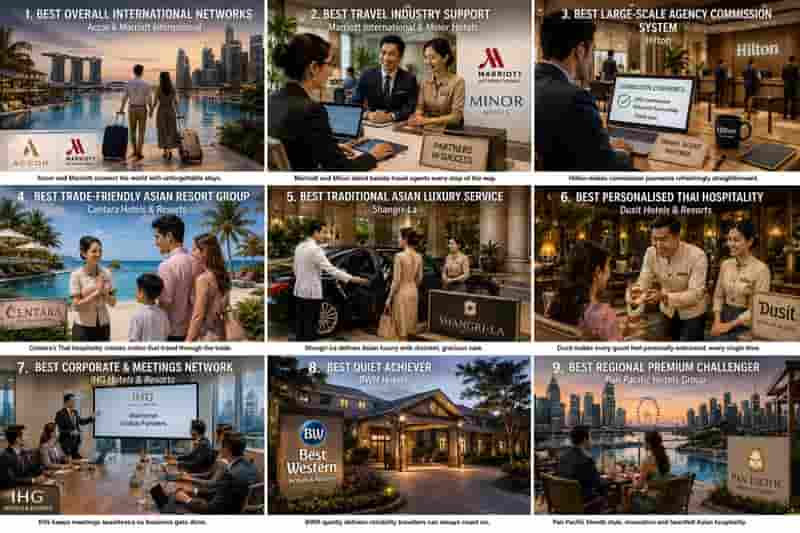
GTM 2026 Editorial Honours
Best Overall International Network in Asia-Pacific: Accor / Marriott International
Accor wins enormous credit for its breadth of brands and regional flexibility; Marriott counters with an exceptionally deep premium and luxury portfolio, plus an impressive travel-agent infrastructure.
Best Travel Industry Support: Marriott International / Minor Hotels
Marriott’s established Preferred Travel Agency system is difficult to overlook, while Minor Hotels earns particular praise for making travel-agent benefits unusually visible and accessible.
Best Large-Scale Agent Commission Infrastructure: Hilton
The fact that Hilton says more than 99 per cent of its hotels participate in its centralised agency commission programme is a significant advantage for professional sellers.
Best Trade-Friendly Asian Resort Group: Centara Hotels & Resorts
Its dedicated agent portal and clear commissionable booking mechanism give Centara a strong trade proposition.
Best Traditional Asian Luxury Service: Shangri-La
A GTM editorial judgement based on its service positioning, premium focus and longstanding strength in Asian luxury hospitality.
Best Personalised Thai Hospitality: Dusit Hotels & Resorts
Dusit’s comparatively focused portfolio helps preserve a clear hospitality personality.
Best Corporate and Meetings Network: IHG Hotels & Resorts
Its enormous regional presence and established business-oriented brands make it particularly compelling for corporate programmes.
Best Quiet Achiever: BWH Hotels
Not always the loudest brand in the room but often one of the most practical.
Best Regional Premium Challenger: Pan Pacific Hotels Group
A focused portfolio, strong Asia-Pacific heritage and increasingly distinctive brand positioning make it one to watch.
The Real Winner? The Traveller and Their Travel Adviser
There is a broader lesson here for hotel companies.
The industry’s best operators increasingly need to look after two customers at once.
The first is obvious: the guest walking through the lobby.
The second may never set foot inside the hotel.
That is the travel adviser, wholesaler, tour operator, corporate buyer, or meetings specialist who researched the product, made the recommendation, explained the rate, managed the booking, dealt with changes, and, frequently, rescued the reservation when something somewhere went sideways.
That professional matters.
Hotel groups that provide reliable commission systems, accessible sales teams, sensible booking channels, useful agent education and prompt problem resolution do more than make themselves pleasant to work with.
They give travel professionals the confidence to recommend them again.
And recommendation remains one of the most valuable currencies in travel.
Technology will continue transforming hotels. Artificial intelligence will become smarter. Mobile check-in will become faster. Loyalty ecosystems will become larger, more personalised and more complicated.
Yet Asia-Pacific’s strongest hotel groups continue to demonstrate an older principle that hospitality should never forget.
Good service is not what happens when everything goes right. It is what happens when something goes wrong, and somebody cares enough to fix it.
The swimming pool helps, naturally.
So does breakfast.
But when a client’s airport transfer has vanished at midnight, nobody has ever phoned their travel adviser in a panic because the eggs Benedict lacked sufficient theatre.
By: May Marclay – © 2026.
Read Time: 12 minutes
Author Bio:
 May Marclay’s career hasn’t followed a straight line, and she’s better for it. She began in real estate, then moved into hospitality, finding her rhythm with Centara in the Maldives. There, she worked the Asian markets the old-fashioned way: building trust, closing deals, and turning conversations into lasting business.
The UAE sharpened its focus. At IHG, supporting an Area General Manager, she saw the machinery of a major travel hub from the inside, no gloss, just how things actually get done.
Now, with her sights set on healthcare, May brings a broader lens than most. She speaks three languages, reads widely, travels with intent, and writes with the calm assurance of someone who understands both the detail and the bigger picture without needing to say so too loudly.











