

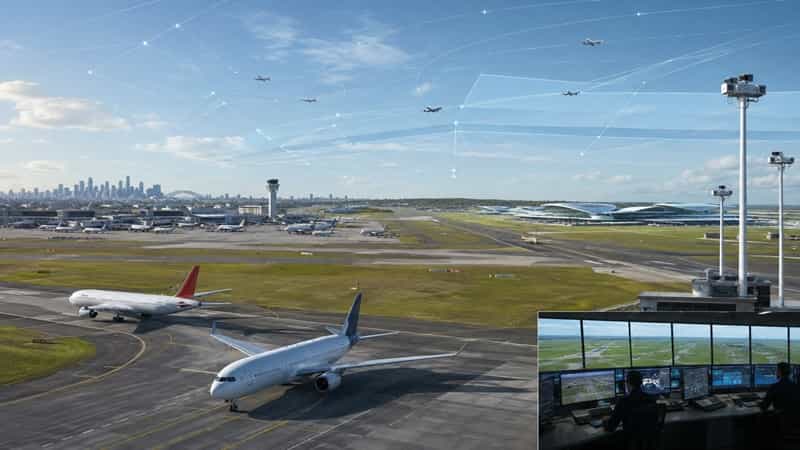
Sydney Airport’s recent air traffic control disruptions and a troubling cluster of safety investigations have landed at an awkward moment for Australian aviation just as Western Sydney International prepares to bring a second major airport into the city’s increasingly complex airspace.
Sydney has done the expensive part: it has built another major airport.
The considerably trickier question may now be whether Australia has the workforce depth, operational resilience, and air traffic management capacity needed to run an increasingly complex two-airport Sydney aviation system without passengers regularly paying for staffing problems in lost hours at the gate.
That question has become difficult to ignore.
More than 150 flights were delayed at Sydney Airport on Saturday, 8 August, as Airservices Australia managed roster constraints within air traffic control. Qantas alone recorded about 95 delays across its network that morning, while Virgin Australia services were also affected. Airservices imposed Air Traffic Flow Management measures, including greater departure spacing, to safely manage available capacity.
The disruption followed problems the previous day and prompted Federal Infrastructure and Transport Minister Catherine King to describe the delays across the three-day period as “unacceptable”.
For passengers, that translated into the familiar airport cocktail nobody ordered: departure boards slipping backwards, connections tightening and aircraft spending considerably longer admiring Sydney Airport’s concrete than their schedules intended.
For the aviation industry, however, the issue is far more serious.
Sydney incidents put safety systems under the microscope
The Australian Transport Safety Bureau is currently investigating four occurrences at or near Sydney Airport between 27 July and 10 August 2026.
Importantly, they should not be bundled together as though they share a proven common cause.
Three concern runway, taxiway, coordination or separation events. The fourth involves a separate aircraft-control occurrence during approach. None of the ATSB’s investigations has concluded that air traffic controller staffing caused the incidents, and any suggestion to the contrary would be premature.
The first occurred on 27 July, involving a QantasLink Bombardier DHC-8 and a Qantas Boeing 737.
According to the ATSB, air traffic control cleared the Boeing 737, which was on runway 25, to cross runway 34L while the DHC-8 was still completing its landing roll on runway 34L. Air traffic control detected the conflict and advised both crews, with the 737 stopping after passing the holding point.
The ATSB has classified the occurrence as a Serious Incident, with categories including breakdown of coordination, information or procedural error, and runway incursion. The investigation remains active.
Then came 9 August.
Jetstar flight JQ402, an Airbus A320 preparing to depart Sydney for the Gold Coast, encountered a Qatar Airways Boeing 777 being moved by an aircraft tug on a crossing taxiway.
The ATSB says the Jetstar crew observed the Boeing 777 in close proximity and both aircraft stopped abruptly. A Jetstar cabin crew member suffered a minor injury. The ATSB has classified the occurrence as a Serious Incident and is investigating it as a near-ground collision.
Just hours later, another incident occurred.
Virgin Australia flight VA555, a Boeing 737 bound for Perth, had been cleared for a full-length take-off from runway 34L when its crew saw Qantas flight QF728 beginning to cross the runway ahead.
The Qantas crew reported having received clearance from air traffic control to cross.
The Virgin crew reduced thrust and brought the aircraft to a stop while air traffic control simultaneously broadcast a cancellation of its take-off clearance. Once the Qantas aircraft had cleared the runway, Virgin was re-cleared for departure.
The ATSB is investigating the event under categories including runway incursion, rejected take-off, loss of separation and information or procedural error.
A fourth ATSB investigation relates to Jetstar flight JQ987 from Perth on 10 August. During its approach to Sydney below about 3,500 feet, the Airbus A321’s autopilot disengaged, and the aircraft began an uncommanded climb. The crew re-engaged the autopilot and subsequently landed without further incident.
That occurrence is being investigated separately as a control issue and should not be presented as evidence of an air traffic control staffing problem.
That distinction matters.
Sensational headlines may win a click; accuracy wins credibility.
Airservices admits Sydney needs greater roster resilience
What is firmly established is that Sydney has experienced problems with air traffic control rostering and workforce resilience.
Airservices Australia CEO Rob Sharp apologised on 10 August for the organisation’s contribution to recent delays and confirmed that when staffing levels create operational difficulties, Airservices reduces traffic levels to maintain safety.
In other words, the safeguard is deliberately conservative: fewer aircraft movements rather than thinner safety margins.
Airservices says it is now building a larger pool of standby controllers for Sydney, increasing staffing contingencies, reducing overtime and working towards more stable rosters.
There is another side to the story.
Airservices says national air traffic controller numbers have reached a record high, while eight additional Sydney Tower controllers have been endorsed during the past 18 months. A new Sydney Tower simulator has also been installed to increase training capacity.
Airservices expects 95 controllers to be endorsed during 2026, with 55 already operational when Sharp issued his statement on 10 August. It also says air traffic control-related disruptions across the national aviation network fell 86 per cent over the previous financial year.
Transport Minister Catherine King has similarly pointed to substantial recruitment efforts, while acknowledging that Sydney presents a particularly demanding challenge.
King described Sydney as Australia’s most complex airspace and said unexpected absences had exposed insufficient roster depth during the recent disruption. She also stressed that training controllers for Sydney takes time because of the work’s specialist nature and complexity.
That is why describing the present situation simply as a nationwide “shortage of air traffic controllers” risks missing the more important issue.
Australia may have more controllers overall, but Sydney’s recent experience raises a different question: does the system have enough qualified people, with the right endorsements and in the right locations, and sufficient reserve capacity when sickness, leave, or unexpected operational pressures hit?
That is a resilience question and one with considerably greater consequences once Sydney has two major airports operating simultaneously.
Enter WSI and a new era for Sydney’s skies
Western Sydney International (Nancy-Bird Walton) Airport is no longer a distant infrastructure promise.
Freight operations officially commenced on 26 July 2026, with Qantas Freight beginning operations from WSI the following day.
Passenger services are scheduled to commence on 25 October 2026, when Jetstar flight JQ362 to the Gold Coast is scheduled to become WSI’s first passenger departure.
Air New Zealand is scheduled to begin Auckland services three times weekly from 26 October, while Singapore Airlines plans to launch daily Singapore-WSI flights from 23 November using Airbus A350-900 aircraft. Vietjet has also signed on, with flights to Ho Chi Minh City planned from January 2027.
And WSI brings another aviation first.
There will be no conventional air traffic control tower standing above the terminal watching proceedings through windows.
Instead, Western Sydney will become Australia’s first airport to use a purpose-built Digital Aerodrome Service in place of a traditional tower.
More than 20 high-resolution cameras monitor the airport and immediate airspace, transmitting real-time images to controllers at a centralised facility at Eastern Creek.
The system incorporates object tracking, night vision, infrared capability, and image enhancement, designed to give controllers improved situational awareness, including in darkness and low visibility.
It is impressive technology.
But even the cleverest digital tower still requires qualified controllers behind the screens.
Airservices said, when announcing the system in 2024, that more than 70 new positions would be created to support Western Sydney across air traffic control, aviation rescue and firefighting, maintenance, and training services.
Meanwhile, WSI has already altered the broader operating environment.
New flight paths and associated Sydney Basin airspace arrangements took effect on 9 July 2026, ahead of freight and passenger operations.
So the debate should not become a simplistic argument about whether WSI itself has “enough controllers”.
The more meaningful question concerns the resilience of the entire Sydney Basin air traffic management system as Kingsford Smith, Western Sydney International and surrounding aviation operations increasingly interact.
Technology is only half the equation
Western Sydney International represents a remarkable technological and infrastructure investment.
Its 24-hour operating capability, digital aerodrome technology and growing airline roster have the potential to reshape aviation across Greater Sydney.
But infrastructure is only as resilient as the people operating it.
Aircraft can be purchased. Terminals can be built. Runways can be poured, painted and opened with suitable ceremonial ribbon-cutting.
Experienced air traffic controllers are rather less accommodating.
They must be recruited, trained, assessed and endorsed for highly specialised operational environments — and Sydney is hardly the training-wheel end of the profession.
That is why August’s disruption matters.
It does not prove Sydney Airport is unsafe.
It does not prove staffing caused the recent ATSB-investigated incidents.
And it certainly does not establish that Western Sydney International will be unable to cope when passengers arrive in October.
What it does establish is that roster depth and workforce resilience at Australia’s busiest aviation gateway remain legitimate concerns, acknowledged by Airservices itself and serious enough for the Federal Government to demand improvement.
Sydney is now approaching one of the biggest changes to its aviation landscape in generations.
For travellers, airlines and the wider tourism industry, the question is therefore straightforward:
Australia has built Sydney another airport. Has it also built enough resilience into the human system responsible for managing the skies above both?
That question deserves an answer well before the first wave of WSI passengers heads for the departure lounge on 25 October.
By: Alison Jenkins – © 2026.
Read Time: 7 minutes.
Author Bio:
 Alison Jenkins has lived most of her working life in the slipstream of aviation, where timetables matter, and people matter more. In airline sales, she built a reputation the old-fashioned way: by knowing her clients, her routes, and never missing the human detail.
Quick with a smile, quicker with a solution, she made deals with warmth and kept her edge intact.
Trade shows, FAMILS, airport lounges and hotel lobbies became her second address. And somewhere along the way, notebook in hand, she began writing the journeys rather than selling them. Her reports grew lively, observant, full of the small truths only travellers notice.
That was the moment it dawned on her: she wasn’t simply travelling. She belonged in its stories.











