

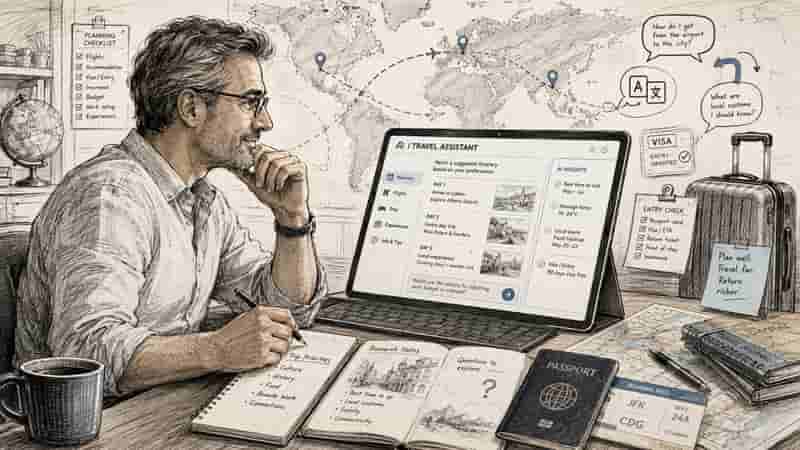
Artificial intelligence has moved from a travel novelty to a practical travel tool at remarkable speed. New research from Global Rescue shows that experienced international travellers are warming to AI fast.
The latest Global Rescue Traveller Sentiment and Safety Survey found that 36% of experienced travellers now use AI to help plan overseas trips. In January 2026, the figure was 22%. That is a rise of 14 percentage points, or approximately 64% growth in just six months.
Resistance is also fading. In January, 40% said they would not use AI for trip planning. That share has now dropped to 35%. Another 29% have not used it yet but say they are interested.
For the travel trade, the signal is clear. AI travel planning is no longer a sideshow. It is becoming part of the normal research process.
The robot is welcome. It is just not getting the room key.
AI earns a place in the travel toolkit
Among current users, 14% say they use AI often. Another 11% use it from time to time, while 11% have tried it once or twice.
“Experienced travelers are becoming more comfortable with AI, but they’re embracing it on their own terms,” said Dan Richards, CEO of The Global Rescue Companies.
Richards says the shift during the past six months has moved from curiosity towards real adoption. Travellers are increasingly using AI to research destinations, compare choices and assemble itineraries, yet they still want control over the decisions that matter.
That distinction is vital. Most travellers are using AI as a research helper, not as an automated booking boss.
Destination research is the leading use at 30%. Building itineraries follows at 22%. Flight or hotel suggestions account for 19%, while visa and entry research sits at 18%. Transport planning is used by 14%, restaurant tips by 11%, translation help by 10% and travel budgeting by only 3%.
So travellers are happy to ask AI where to go, what to see and how to get around. They are less keen to let it take charge of the wallet.
Non-US travellers move faster
The survey also found a clear gap between US and non-US travellers.
Among US-based respondents, 33% have used AI to plan an international trip. A further 31% are interested but have not tried it, while 36% remain uninterested.
Outside the United States, use is much higher. Nearly 48% of non-US respondents have already used AI for trip planning. Another 19% are interested, while 32% say they are not.
“The adoption gap is striking,” Richards said.
Global Rescue says non-US travellers are ahead in several information-heavy tasks, including destination research, itinerary development, and assistance with international entry rules.
Non-US travellers also lead in most individual uses. They are more likely to use AI for destination research, itinerary building, hotel and flight ideas, translation and entry-rule research.
That matters for tourism boards, hotels, airlines and travel sellers. Their information is now being read by people, search engines and AI tools. Clear, current and well-structured content has become even more important.
A hotel page with vague room details was never ideal. In the age of AI, it may also be harder for a machine to explain correctly. The same applies to entry rules, tour inclusions, airline policies and destination advice.
Human judgement keeps its seat
The survey does not support the idea that AI is about to sweep the travel adviser into history.
Asked which AI feature would be most useful during a trip, respondents again chose information over automation. Destination research came first at 18%. It was followed by itinerary building at 16%, translation at 10%, visa and entry research at 7%, and flight or hotel suggestions at 5%.
A notable 26% still said they would not use AI for travel at all.
Richards argues that the story is not about AI replacing travel advisers or traveller judgement. Rather, it is becoming another planning tool. His point is that global travel still calls for experience, context and human judgement, especially when conditions change quickly.
That may be the most useful lesson for the industry.
AI is very good at sorting options. It can compare areas, build a first-draft itinerary and explain transport choices in seconds. It can also help travellers prepare questions before they speak to an adviser.
But travel has a habit of ignoring the best-laid spreadsheet.
Flights cancel. Weather turns. Borders change rules. Rail services stop. Hotels overbook. A ferry may be cancelled just as an app insists the day is running perfectly.
That is where human skill still earns its keep.
Global Rescue says severe weather, geopolitical tension and infrastructure failures are precisely the sort of events where experienced travellers still turn to professional advice, live intelligence and expert human support.
A message for the travel trade
For advisers, the opportunity is not to compete with AI on raw speed. It is to add what the machine cannot guarantee: context, judgement, care, accountability and a real person when things go wrong.
AI can help with first-pass research. Advisers can then test the facts, spot weak points, refine the route and make sure the trip works in the real world.
Tourism boards and suppliers have work to do as well. Product pages should be current. Entry advice should link to official sources. Fees and inclusions should be clear. Hotel, airline and tour information should answer the questions travellers are most likely to ask.
That approach also supports better visibility in AI-led search and answer engines. In simple terms, useful facts need to be easy to find, easy to verify and hard to misunderstand.
Global Rescue’s figures suggest that travellers are not giving away control. They are adding another tool to the kit.
And for the travel trade, that is less a threat than a rather large invitation.
Survey note: Global Rescue says the latest survey covered more than 500 current and former members between 2–8 June 2026. The sample therefore reflects experienced Global Rescue travellers rather than the international travelling public as a whole.
Global Rescue – AI Use for International Trip Planning Jumps 64%
Further information: Global Rescue
By: Michelle Warner – © 2026.
Read Time: 5 minutes.
Author Bio:
 Michelle Warner has always carried stories the way others carry passports lightly, faithfully, and with purpose. She learned her craft in newsrooms, shaping sentences with care, before swapping deadlines for departures as a flight attendant with some of the world’s great airlines. Years aloft sharpened her eye for character and deepened her fondness for the small, dignified rituals of travel, the quiet kindness of strangers, the poetry of arrival, the patience learned between time zones.
Now grounded by choice, Michelle has come home to writing with the same calm authority she once brought to turbulent cabins. Her prose blends an editor’s discipline with a traveller’s wonder, tinged with humour and reverence for the golden age of travel. Each piece feels like a handwritten boarding pass, gracious, observant, and unmistakably alive.











