

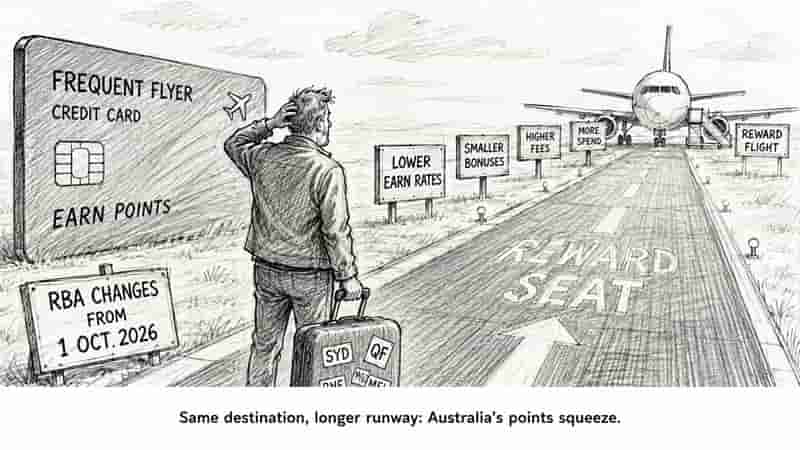
For Australians who have spent years turning groceries, petrol, power bills and the occasional extravagant dinner into an aspirational business-class seat, the great frequent-flyer points party is not necessarily over.
But somebody has certainly turned the music down.
Australia’s lucrative credit-card rewards market is heading for a substantial shake-up as banks and card issuers prepare for a new payments regime taking effect from 1 October 2026. For frequent flyers, the consequences are already becoming visible: smaller promotional bonuses in some markets, lower points-earning rates on some cards, and a greater need to scrutinise annual fees and benefits.
At the centre of the change is the Reserve Bank of Australia’s Review of Merchant Card Payment Costs and Surcharging.
The RBA says most of its reforms will take effect on 1 October 2026, including the removal of surcharging and reductions in interchange caps for domestic card transactions. An interchange cap for foreign-issued cards and some additional transparency measures are scheduled for 1 April 2027.
For domestic-issued consumer credit-card transactions acquired in Australia, the maximum interchange rate will be reduced to 0.3 per cent of the transaction value.
That sounds like the sort of sentence designed to make even an accountant glance wistfully towards the departure lounge.
For points collectors, however, it matters.
Why frequent flyers should care
Interchange fees are part of the revenue generated when card transactions pass through the payments system.
Rewards programs are one of the ways card issuers compete for customers, and the RBA’s review recognises the relationship between interchange revenue and the funding of cardholder rewards.
When interchange revenue is compressed, issuers have less revenue available to support rewards programs, potentially putting pressure on points, bonuses and associated card benefits.
But there is an important distinction.
The RBA is not banning rewards cards.
Nor has it instructed banks to cut Qantas Points, Velocity Points or any other loyalty currency.
The regulation changes the economics of card payments. What individual issuers then choose to do with points, annual fees, bonuses and benefits remains a commercial decision.
And that is where the story becomes particularly interesting for Australian travellers.
ANZ bonuses show how quickly the landscape can move
ANZ’s current Frequent Flyer Black offer provides up to 80,000 bonus Qantas Points.
Eligible new customers can earn 40,000 bonus Qantas Points after spending $6,000 on eligible purchases within three months, with another 40,000 available after retaining the card for more than 12 months. ANZ also currently lists the Black card’s annual fee at $425.
The ANZ Frequent Flyer Platinum currently offers up to 40,000 bonus Qantas Points, split between an initial 20,000 points after meeting the applicable spending requirement and another 20,000 points after retaining the card for more than 12 months. Its current annual fee is $295.
Those figures matter because earlier promotional offers for these products have been substantially more generous.
The safer conclusion, however, is not that every reduction was caused by the RBA.
Credit-card promotions routinely change, and ANZ itself states that it may change or withdraw its offers.
For consumers, the practical lesson is considerably simpler:
Yesterday’s generous sign-up bonus is not a promise of tomorrow’s.
That makes timing, comparison and the fine print more important than ever.
Velocity earners face a very clear reduction
Virgin Money provides an even more concrete example because its forthcoming earn-rate changes have already been published.
Until 30 September 2026, the Velocity Flyer card earns 0.66 Velocity Points per $1 on eligible transactions up to $1,500 per statement period, then 0.5 points per $1 thereafter.
From 1 October 2026, that changes to 0.5 Velocity Points per $1 up to $1,500, followed by just 0.25 points per $1 on spending above that threshold.
The higher-tier Velocity High Flyer also changes.
It currently earns 1 Velocity Point per $1 on eligible transactions up to $8,000 per statement period, then 0.5 points per $1 thereafter.
From 1 October, that becomes 0.75 Velocity Points per $1 up to $5,000, then 0.25 Velocity Points per $1.
That is not the end of frequent-flyer earning.
It is, however, a longer runway.
For households that deliberately channel substantial everyday expenditure through a rewards card, the arithmetic can change quickly.
Lower earn rates mean more spending is required to generate the same number of points.
If annual fees remain substantial, the effective cost of earning each point rises.
And that leads to the question Australian cardholders should arguably have been asking all along:
What are those points actually worth?
The annual-fee equation is becoming more important
A premium rewards card can make perfect sense when the combined value of points, travel insurance, lounge access, flight credits, and other useful benefits exceeds the annual cost.
But the equation is intensely personal.
A lounge pass that is never used is not worth its glossy brochure price.
Travel insurance that does not suit the traveller’s circumstances is not much of a benefit.
And a large points balance can look impressive right up until a redemption requires far more points, cash or flexibility than expected.
ASIC’s Moneysmart service advises consumers seeking points or travel perks to compare the value of those rewards against the higher fees and interest rates. It also warns that rewards cards can cost more, particularly when cardholders do not pay the balance in full each month.
That warning deserves more attention than almost any bonus-points advertisement.
There is little sense earning a few thousand frequent-flyer points while paying hundreds or thousands of dollars in avoidable credit-card interest.
No airport lounge serves champagne good enough to rescue that equation.
The RBA reforms are about more than frequent flyers
It would also be misleading to portray the changes simply as an attack on points collectors.
The RBA’s reforms are aimed at simplifying card payments, reducing payment costs and addressing a surcharging system it says has become increasingly difficult for consumers to avoid and confusing for consumers and businesses.
The RBA has concluded that surcharging on designated eftpos, Mastercard and Visa debit and credit cards should end from 1 October 2026.
For merchants, particularly smaller businesses that have historically faced higher card-acceptance costs, the changes could be meaningful.
For consumers, the familiar irritation of an extra card surcharge at checkout should progressively disappear across the designated networks under the new regime.
So the overall picture is far more nuanced than simply declaring that “the RBA killed the points”.
Consumers may receive fewer points from some credit cards while simultaneously avoiding surcharges they previously paid for using those cards.
Whether they ultimately come out ahead will depend on how they spend, which card they hold and how effectively they use the benefits attached to it.
Qantas and Velocity have plenty at stake
For Qantas Frequent Flyer and Velocity Frequent Flyer, the implications are equally intriguing.
Airline loyalty programs have developed into major commercial ecosystems, and credit cards remain an important way for Australians to accumulate airline points.
If card economics become less generous, airlines and loyalty programs have every incentive to keep members earning through other channels.
Australians already collect points through supermarkets, hotels, car hire, insurance, utilities, shopping portals, retail partnerships and direct airline promotions.
Those channels may become increasingly important if the credit card ceases to be the unquestioned centre of the Australian points-earning universe.
The supermarket trolley, in other words, may have a more interesting aviation career ahead of it than many travellers realise.
The smart traveller’s new points strategy
The answer is not panic.
It is scrutiny.
Before renewing a rewards card, frequent flyers should check the current annual fee, current earn rate, monthly or statement-period spending caps, bonus-point conditions and the benefits actually used during the previous year.
Compare the cost of the card with the realistic value of the rewards — not an optimistic headline valuation.
Check whether points expire.
Check whether reward seats are realistically available on the routes you want.
And check whether taxes, carrier charges or other cash components materially reduce the value of the redemption.
Most importantly, do not spend more simply to earn points.
A frequent-flyer program is supposed to reward expenditure you were going to make anyway.
Turning unnecessary purchases into “free” travel is one of the oldest and most expensive tricks in the loyalty book.
For Australian frequent flyers, 1 October 2026 therefore looks less like the day the points party ends and more like the day the party’s rules change.
The points will remain.
Rewards cards will remain.
Qantas and Velocity will remain formidable loyalty currencies.
But effortless generosity can no longer be taken for granted.
Australia’s frequent-flyer faithful may still get to the pointy end of the aircraft.
They will simply need to become considerably more pointed about how they get there.
By: Stephen Peters – © 2026.
Read Time: 6 minutes.
Author Bio:
 Stephen Peters has spent much of his career proving that the straight-and-narrow path is considerably overrated. Armed with a Bachelor’s degree in Technology from the University of Queensland and a Master’s in Management, he first ventured into hospitality, working in and helping open several five-star hotels across Sydney and Asia.
After deciding he had experienced quite enough of five-star hospitality from the operational side of the desk, Stephen returned to technology, working with major US tech companies while based between Australia and Asia.
Then came the ultimate change of scenery. Stephen built his own yacht and, with his family aboard, sailed from Florida through the United States and its Great Lakes before crossing the Pacific to Asia. Several memorable years followed, exploring Indonesian waters before the Peters family eventually returned to Australia with considerably more sea miles, stories and perspective than when they left.











