

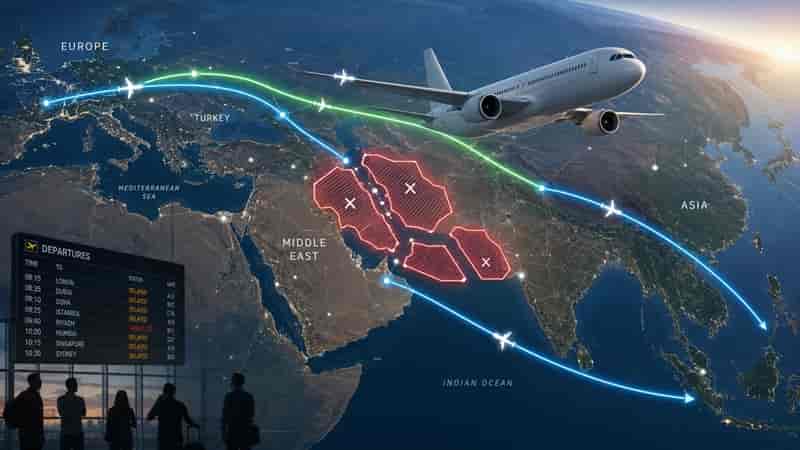
The map of global aviation has always looked deceptively simple from the passenger seat. Sydney to London. Melbourne to Paris. Brisbane to Rome. Preferably with a civilised lounge somewhere in the middle.
In 2026, however, that middle has become the problem.
The Middle East airspace crisis is no longer merely a regional aviation story. It is reshaping long-haul schedules, airline economics, transit strategies and the way travellers think about the journey. That matters especially for passengers moving between Australia, Asia and Europe, because the Gulf sits at the crossroads of some of the world’s busiest intercontinental traffic flows.
A crisis that jumped borders
The scale of the disruption became brutally clear in March.
The International Air Transport Association says attacks on Iran triggered the region’s most severe aviation disruption since the COVID-19 pandemic. During the first seven days of March 2026, roughly 85 per cent of flights arriving at or departing Gulf airports were cancelled. By the end of the month, fewer than half of the flights originally scheduled from those airports were operating.
For airlines built around vast connecting hubs, that was not a timetable tweak.
It was open-heart surgery performed while the patient was still boarding.
The effects did not vanish with the first wave of cancellations. Airlines continued revising forward schedules, and IATA found that around 3 per cent of planned capacity to and from the Middle East had been removed from June-to-August 2026 schedules compared with plans made before the conflict escalated.
As of 11 August 2026, the European Union Aviation Safety Agency has an active conflict-zone advisory covering airspace in Bahrain, Kuwait, Qatar and the United Arab Emirates, as well as specified airspace over the Gulf of Oman. EASA recommends that operators within the advisory’s scope refrain from operating in those areas. The notice is valid until 31 August 2026 unless reviewed earlier.
A separate active EASA advisory recommends that applicable operators refrain from operating within Jordan’s Amman Flight Information Region (FIR). It, too, is valid until 31 August unless reviewed earlier.
That distinction is important.
These are not blanket bans on every airline worldwide. The EASA advisories apply to EASA operators and certain third-country operators when flying under their EASA authorisation. Other carriers remain subject to their national regulators, security assessments and operational risk processes.
The result is an aviation patchwork. One carrier may continue a route. Another may suspend it. A third may serve the same city pair by a different track entirely.
Australian travellers are firmly in the picture
For Australians, this is far from an abstract geopolitical problem.
Smartraveller currently places Israel, Jordan, Oman, Qatar, Saudi Arabia and the United Arab Emirates at Level 3, “Reconsider your need to travel”, and says that advice includes transit. Bahrain, Iran, Iraq, Kuwait, Lebanon, Palestine, Syria and Yemen remain at Level 4, “Do not travel”. The Australian Government also warns that Middle East airspace may close at short notice and flights can change or stop suddenly.
That matters because the Gulf is one of the great bridges between the Asia-Pacific region and Europe.
IATA says that in 2025 around 33 per cent of passengers travelling to or from Asia Pacific transited through the Middle East, roughly three times the comparable share for other regions. Asia Pacific was therefore particularly exposed when connectivity at Middle Eastern hubs was disrupted.
In other words, when the Gulf catches a cold, an Australia-to-Europe itinerary can quickly develop a temperature.
Airlines discover the long way around
Airlines respond to restricted or higher-risk airspace as aviation has always responded: they reroute, reschedule, and adjust capacity.
The trouble is that the long way around is rarely the cheap way around.
IATA says geopolitical restrictions have reduced the airspace available to civil aviation, forcing airlines to find alternative routings and shifting traffic into neighbouring Flight Information Regions (FIRs). That increases pressure on air navigation systems that were not necessarily designed to handle such diverted flows.
Longer routings can mean more fuel, additional crew time, greater aircraft utilisation and less recovery room in a tightly timed network.
A late-arriving widebody does not merely inconvenience the passengers on board. It can affect the aircraft’s next sector, its crew duty limits and an entire bank of onward connections.
For passengers, the operational jargon eventually translates into very ordinary problems: missed connections, longer journeys and fewer convenient alternatives.
IATA also warns that in air cargo, disrupted connectivity at Middle Eastern hubs is producing a more fragmented and less efficient network. Longer routings, lost hub connections and fragmented cargo networks reduce usable lift and extend transit times even when aircraft remain available.
That wording matters. The specific IATA assessment regarding fragmented networks and reduced usable lift pertains to air cargo, not to passenger operations as a blanket finding.
Fuel adds another nasty line to the bill
Then there is fuel.
And fuel, unlike an unhappy passenger, cannot be pacified with a lounge voucher.
IATA’s June 2026 industry outlook forecasts average jet fuel prices of US$152 a barrel for the year, almost 70 per cent above the US$90 average in 2025. Total airline fuel costs are expected to rise from US$252 billion to US$350 billion.
At the same time, IATA expects global airline net profit to fall to US$23 billion in 2026, roughly half its estimated US$45 billion result for 2025. The global net profit margin is forecast at just 2 per cent.
That is a thin cushion for an industry that flies expensive machines through an increasingly complex operating environment.
Passenger ticket yields are expected to rise by 7 per cent in 2026, according to IATA, as airlines attempt to recover part of the oil-price shock. That does not mean every fare will rise by 7 per cent, but it does reinforce the basic commercial reality: higher fuel and operating costs eventually find their way into pricing.
Aviation remains one of those remarkable industries capable of moving billions of passengers around the planet while occasionally earning less per passenger than the cost of an airport lunch.
Capacity becomes precious
The pressure is not confined to cost.
When usable routes narrow and schedules become harder to maintain, capacity becomes more valuable.
IATA found that close to one-quarter of flights to and from the region scheduled for May 2026 were cancelled relative to plans made in February. Airlines outside the Middle East added capacity in response, but not enough to replace all the services lost from Middle Eastern carriers.
Passenger load factors also rose sharply as travellers were redistributed onto unaffected services and alternative routings. IATA reported a three-percentage-point global increase in March, taking load factors to record highs for the month.
For travel sellers, this is where international geopolitics becomes decidedly commercial.
Fewer practical itineraries can mean tighter availability, higher fares and less tolerance for last-minute changes.
Alternative hubs in Asia, Europe or Africa may become more attractive for some journeys, depending on the route and the traveller’s priorities. That is a logical consequence of the traffic reallocation already identified by IATA, rather than evidence that Gulf hubs have somehow ceased to matter.
Quite the opposite.
The Middle East remains structurally important to global aviation because of geography, extensive long-haul networks and the scale of its connecting hubs.
What 2026 has demonstrated is a much older rule of transport economics: geographic advantage can also become geographic exposure.
Travel agents suddenly look rather useful again
The current environment also gives travel advisers an opportunity to demonstrate why professional advice matters.
Smartraveller tells Australians to check advice for their destination and all transit points, speak with airlines or travel agents about alternatives, and check insurance coverage for delays, cancellations and changes in travel-advice levels.
That is sensible guidance.
Clients travelling through the Middle East should monitor airline notifications and government travel advice before departure.
Connection times deserve another look.
So do fare conditions, insurance exclusions and rebooking rights — preferably before reaching an airport service desk with several hundred new friends.
Where flexibility exists, allowing additional connection time may be less glamorous than securing a lounge upgrade.
It could also prove considerably more useful.
A ticket is not carved in stone
Travellers should resist treating a confirmed itinerary as an unbreakable promise.
In volatile airspace, schedules can change quickly.
EASA’s current Gulf advisory identifies risks associated with missiles, drones, interception activity, air defence systems, and military activity occurring with little or no warning. Its Jordan advisory similarly highlights missile and drone activity, interception risks and falling debris.
Airlines and regulators will put safety before punctuality.
That can mean diversions, altered routings, delays or cancellations with little warning.
Frustrating?
Certainly.
Preferable to the alternative?
Absolutely.
Global aviation discovers how connected it really is
The deeper lesson from the Middle East airspace crisis is simple: global aviation is extraordinarily connected and therefore extraordinarily sensitive to regional shocks.
The hubs that made Australia-to-Europe travel faster, more competitive, and more convenient also sit at strategic global air corridors.
When those corridors become constrained, traffic does not simply disappear.
It shifts elsewhere.
Distance, cost and complexity often rise with it.
IATA concludes that Middle East airspace restrictions have produced longer flight paths, higher operating costs and operational disruption, prompting airlines to reroute services, reallocate capacity and substitute alternative routings or markets.
Yet aviation has also proved remarkably adaptable.
Carriers reroute. Capacity moves. Air navigation authorities manage unfamiliar traffic flows. Networks bend rather than simply break.
IATA characterises the current crisis primarily as a supply-side disruption, rather than the demand-led collapse seen during COVID-19. Its assessment is that the underlying appetite for air travel remains present while economic growth holds up.
That is an important distinction for tourism.
People still want Europe. They still want Asia, Africa and the Middle East.
They may simply need a little more patience and perhaps a slightly less ambitious connection.
Expertise becomes valuable when things go wrong
For the travel trade, the upheaval creates both an opportunity and a headache.
Travellers faced with changing advisories, unfamiliar routings and complicated alternatives need informed advice more than they need another search box.
The adviser who can explain the difference between destination risk, transit risk and an airline’s operational decision suddenly becomes worth rather more than the commission line might suggest.
The Middle East will remain central to global aviation because geography has not changed.
What has changed is the industry’s understanding of how quickly access to that geography can change.
For now, airlines are redrawing routes around risk. Passengers are reconsidering how they connect.
And travel sellers are once again proving that expertise becomes most valuable precisely when the timetable stops behaving itself.












