

Carnival Corporation has turned a sustainability victory lap into another lap of the course. The world’s largest cruise company has set a new target to cut greenhouse gas emissions intensity by 25 per cent by 2029, against its 2019 baseline.
The move follows an early win. Carnival says it reached its previous 2030 target five years ahead of schedule. In 2025, it cut GHG emissions intensity by 20 per cent, measured on an available lower berth days basis. It has now lifted the goal by another five percentage points and moved the deadline forward by a year. Carnival’s 2025 annual report also records that the earlier 2030 target had already been exceeded.
There is also a pleasingly old-fashioned business reason for all this efficiency: it saves money.
Carnival says its fuel-efficiency gains are on track to save about US$650 million in 2026 compared with 2019 levels. In a business where fuel bills can make finance directors stare rather too long into the middle distance, using less fuel is both fashionable and financially sensible.
The results are detailed in Carnival Corporation’s newly published 2025 Sustainability Report, now listed on the company’s sustainability reporting portal. Since 2008, Carnival reports a 44 per cent fall in GHG emissions intensity. That reflects almost two decades of fleet renewal, better ship technology, sharper voyage planning and lower-GHG energy options.
Chief executive Josh Weinstein summed up the company’s approach neatly: “But we’re not treating it as a finish line.”
That sentence matters.
Cruise decarbonisation will not be solved by one clever engine, one new fuel or one unusually energetic sustainability committee. It is a long industrial transition. Ships, ports, power grids, fuel suppliers, regulators and large amounts of capital all have a part to play.
Less energy, voyage by voyage
Carnival’s first lever is simple: make every voyage require less energy.
Its operating programme includes itinerary planning, weather routing and voyage optimisation. The aim is to reduce unnecessary fuel consumption without compromising the holiday experience. Cleaner hulls matter, too. Robotic inspection and cleaning can reduce drag. Better arrival planning can also avoid steaming hard only to spend time waiting for a berth.
Then comes the hardware.
Carnival says Power Saver Packs are now installed on about 80 per cent of its ships. These cover areas such as HVAC systems, LED lighting and energy management. The company estimates they have cut annual shipboard energy demand by about 535,000 megawatt-hours compared with 2019.
Air Lubrication Systems are fitted to 13 ships. Carnival says they can reduce propulsion energy requirements by about five per cent. Azipod propulsion is used on more than 40 vessels and can cut fuel use by up to 10 per cent. Waste-heat recovery also captures energy that would otherwise vanish up the stack, never a particularly productive place to put it.
Fleet renewal is another major part of the plan. Carnival says seven new ships due through 2033 should be more than 20 per cent more efficient per passenger than the ships they replace. Since 2019, the group has also retired 27 older, less-efficient vessels.
That is important because efficiency gains from the machinery room are useful; efficiency built into an entire new generation of ships is even better.
The fuel question is harder
The lower-GHG power story is less tidy.
Carnival currently operates 11 LNG-powered cruise ships. Together, they represent about 21 per cent of fleet capacity. The company is also expanding shore power, biofuel use and battery energy storage. Importantly, Carnival does not present any single technology as the final answer.
That caution is sensible.
International shipping will need new fuels and new infrastructure to reach net zero. The IMO itself says technological innovation and the global introduction of alternative fuels or energy sources will be integral to achieving the sector’s long-term emissions ambitions.
Shore power shows particularly well why cruise decarbonisation depends on more than the ship itself.
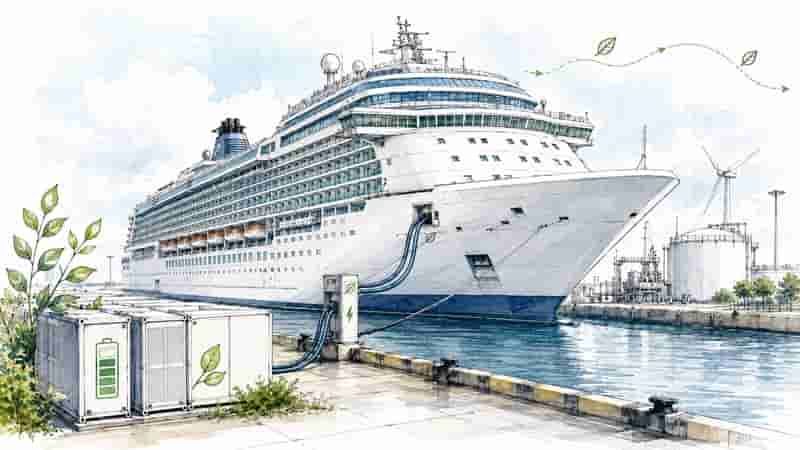
Carnival says 74 per cent of its fleet can now connect to shoreside electricity when a port has suitable infrastructure. Its ships made about 1,460 shore-power connections during port calls in 2025. The company wants 80 per cent of the fleet to have connection capability by 2030.
For ports, the message is hardly subtle.
A greener ship cannot plug into a socket that does not exist.
That point matters in Australia as well. Cruise lines can invest in shore-power-ready ships, but ports still need the electrical capacity and connection systems to serve them. The climate benefit becomes stronger again where that power comes from lower-emissions generation.
Indeed, the IMO identifies shoreside power supply and port infrastructure for zero- or near-zero-GHG fuels as important parts of shipping’s longer-term transition.
Decarbonisation therefore becomes a shared infrastructure task, not simply a cruise-line responsibility.
Carnival is also increasing biofuel use as supply becomes available. It operates a 10 MWh battery energy storage system aboard AIDAprima, which the company describes as the largest in the cruise industry. Batteries cannot yet propel a large cruise ship across an ocean, but they can help manage peak loads and reduce inefficient generator use.
Intensity is not the same as absolute emissions
There is one important distinction in Carnival’s headline target, and it deserves rather more than a footnote.
The 25 per cent goal is an emissions-intensity target. It is not a promise that Carnival’s total corporate GHG emissions will fall by 25 per cent.
The measure is based on available lower-berth days, so it compares emissions to passenger capacity. That means it should not be interpreted as the same thing as a 25 per cent reduction in absolute fleet emissions.
That matters for a growing fleet. A company can improve emissions intensity while total emissions follow a different path. The final outcome depends on the balance among capacity growth, fleet efficiency, fuel choice, and operating practices.
That does not make the target unimportant. Far from it.
Efficiency per unit of capacity is a useful measure for a fleet operator. But the figure should be read for exactly what it is. Clear language matters in sustainability reporting, especially when the numbers are large, and the claims travel considerably faster than most cruise ships.
Regulation is also moving
The wider regulatory direction is unmistakable.
The International Maritime Organization’s 2023 GHG Strategy calls for international shipping’s carbon intensity to fall by at least 40 per cent by 2030 compared with 2008. It also aims for net-zero GHG emissions from international shipping by or around 2050.
The IMO strategy adds another near-term marker. Zero- or near-zero-GHG fuels, technologies, and energy sources should supply at least 5 per cent of shipping energy by 2030, with an ambition to reach 10 per cent.
Carnival’s own 2025 annual reporting says it is pursuing net-zero emissions from ship operations by 2050 in line with the IMO strategy. Crucially, Carnival also acknowledges that alternative low-GHG fuels will be needed and that major supply challenges remain.
That is the hard part of the next chapter.
Efficiency measures can deliver gains now. They can also deliver direct savings. But moving from “less fuel” to scalable low- and zero-GHG fuels will require a global supply chain, steady regulation, and ports prepared for new energy systems.
For the cruise sector, Carnival’s revised target is therefore more than another sustainability announcement. It shows that environmental efficiency is becoming an operating, capital, and destination strategy at the same time.
And when a programme can lower emissions intensity while carving hundreds of millions of dollars from the fuel bill, the green agenda suddenly has a very persuasive chief financial officer sitting beside it.












