

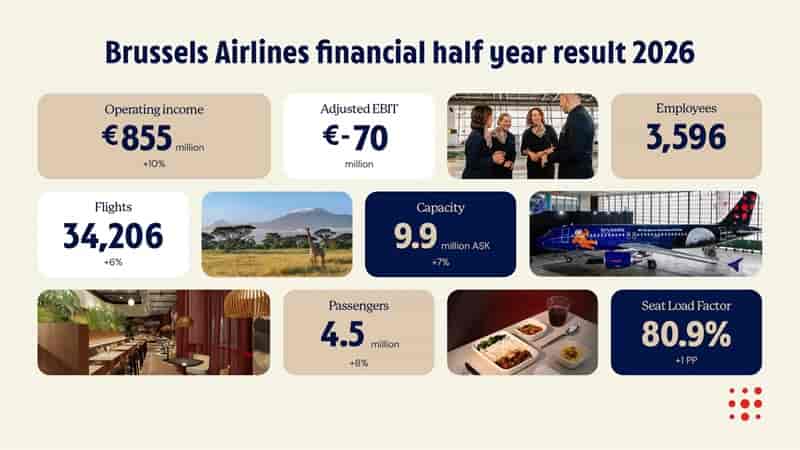
Brussels Airlines has delivered a half-year result that neatly captures aviation’s favourite contradiction: more passengers, more flights, and more revenue, yet a considerably larger loss.
Belgium’s flag carrier reported an Adjusted EBIT loss of €70 million for the first six months of 2026 after higher fuel costs, industrial disruption and the Ebola outbreak affecting parts of Africa weighed heavily on earnings.
The result compares with an Adjusted EBIT loss of € 46 million in the first half of 2025. Brussels Airlines describes the year-on-year movement as a 50% decline, putting extra pressure on the peak European summer to restore some shine to the balance sheet.
Passenger growth, however, remained strong.
Brussels Airlines carried 4.5 million passengers on 34,200 flights during the half-year. Passenger numbers rose 8.1%, flight volumes increased 5.5%, and revenue climbed 9.5% compared with the same period last year.
In other words, the seats were selling. The problem was the cost of keeping them in the air.
Fuel costs land a €64m blow
Fuel delivered the hardest financial hit.
Brussels Airlines said its first-half fuel costs were €64 million higher than a year earlier, with turmoil in the Middle East and the resulting pressure on oil prices adding heavily to expenditure.
For any airline, that is the sort of headwind that makes even a healthy booking curve look considerably less comforting.
Belgium’s industrial unrest added another layer of cost. National demonstrations against government policies disrupted Brussels Airport operations in March and May. Then, in early June, strike action at Belgian air navigation service provider skeyes halted flight movements across Belgium for several hours.
Brussels Airlines estimated those third-party disruptions cut earnings by €3 million.
And while €3 million may look modest beside the fuel bill, airlines rarely enjoy paying millions for aircraft sitting precisely where they earn the least on the ground.
Ebola outbreak complicates African operations
The airline also faced lower demand and added operational complexity linked to the 2026 Ebola outbreak.
The World Health Organisation reports an outbreak of Bundibugyo virus disease in the Democratic Republic of the Congo and Uganda, declared in May. WHO subsequently classified the outbreak as a Public Health Emergency of International Concern.
That point deserves precision.
The outbreak did not mean every East African destination was experiencing local Ebola transmission. Tanzania, where Brussels Airlines launched its new Kilimanjaro service in June, had reported no confirmed Ebola cases as of 29 May, although authorities had strengthened cross-border preparedness.
Brussels Airlines said the health emergency affected demand and created challenges involving crew scheduling and travel restrictions imposed by some countries.
For the travel trade, accurate geography matters. Health alerts can influence bookings hundreds, sometimes thousands of kilometres beyond an outbreak. Facts therefore need to travel considerably faster than fear.
Reliability improves while costs fall
There was better news on the operational front.
Brussels Airlines said improved stability lifted passenger satisfaction and reduced per-passenger irregularity costs by 16%. Those costs can escalate quickly when operational disruptions lead to rebooking, accommodation, passenger care, and other recovery expenses.
The airline also continued to invest in its network and customer products.
It successfully launched flights to Kilimanjaro in Tanzania, introduced new tableware in Premium Economy and unveiled another of its distinctive Belgian Icon aircraft, this time dedicated to Belgium’s world-famous comic hero Tintin.
The contrast is striking. The accounts are under pressure, but Brussels Airlines is certainly not behaving like a carrier preparing to pull up the drawbridge.
Summer becomes the decisive test
Chief Financial Officer Nina Öwerdieck said Brussels Airlines remained optimistic about the rest of 2026, while making it abundantly clear that the summer season now carries unusual weight.
“Brussels Airlines is a robust company, that is not afraid to take on a challenge. We have already navigated some storms this year, and now a successful Summer will be more crucial than ever to achieve positive full-year results. We have more production compared to 2025, therefore we believe we can present stronger Summer results, if we can operate in an operational stable environment. I want to sincerely thank all Brussels Airlines colleagues who went above and beyond to take care for our guests during these demanding past months.”
Nina Öwerdieck, Chief Financial Officer, Brussels Airlines
Her warning is well founded.
Brussels Airlines reported an Adjusted EBIT loss of €55 million in the first quarter of 2026 alone. By the end of June, that had grown to €70 million.
That suggests the later part of the half-year was considerably less damaging than the opening quarter, but it also leaves the airline little appetite for another round of unexpected disruption.
A strong summer, therefore, requires more than full aircraft.
It needs punctual departures, stable operations, manageable fuel costs and a network that is not repeatedly being handed unpleasant surprises before breakfast.
Wi-Fi and lounge investment stay on course
Brussels Airlines plans to keep improving its passenger proposition during the second half of 2026.
High-speed Wi-Fi is due to appear aboard the first aircraft in its fleet, while its fully renovated lounge at Brussels Airport is expected to reopen. The airline is also planning further network expansion.
Those investments matter.
Reliability earns trust, but product quality helps protect fares, particularly among corporate, premium and frequent travellers who have plenty of alternatives across Europe.
Cost control alone does not build a premium airline. Passengers eventually notice when the cheese has disappeared from the sandwich.
Brussels Airlines puts brakes on 2027 growth
The weaker result has already changed Brussels Airlines’ approach to 2027.
Following discussions with parent Lufthansa Group, the airline will no longer add two additional Airbus A330 aircraft in 2027, reversing an earlier expansion plan.
Its long-haul fleet will remain at 11 Airbus A330s for the time being.
Brussels Airlines also does not plan to operate wet-lease capacity during summer 2027.
The four airBaltic aircraft currently deployed in Brussels through the end of October are therefore not expected to return for the following summer season.
Importantly, however, the airline has not shelved its planned multi-million-euro long-haul cabin investment.
New Business Class, Premium Economy, and Economy Class cabins remain scheduled for unveiling in 2027.
That looks less like a retreat and more like a strategic belt-tightening.
Capacity growth is being trimmed while investment in the product Brussels Airlines intends to sell over the longer term remains intact.
The bottom line
Brussels Airlines’ first-half figures tell two very different stories.
Operationally, the airline carried more passengers, flew more services, increased revenue and reduced disruption costs per traveller.
Financially, however, a €64 million increase in fuel costs, Ebola-related effects on demand and operations, and third-party strike disruption helped push Adjusted EBIT to a €70 million loss.
The airline now needs the traditional European summer profit engine to earn its keep.
The passengers appear to be there. The capacity is there. Product investment continues.
What Brussels Airlines needs next is something airlines cannot order from Airbus, Lufthansa or the catering department: a long and gloriously boring spell of uneventful operations.
In aviation in 2026, that may prove to be the most valuable premium product of all.
By: Supaporn Pholrach – © 2026.
Read Time: 5 minutes.
Author Bio:
 Supaporn Pholrach came up in advertising when deals were sealed with a handshake, and deadlines lived on scraps of paper, not dashboards. She learned early that people mattered more than process, and it stuck. Armed with solid training and a stubborn work ethic, she built a reputation for getting results without turning hard or hollow.
Fifteen years at Bangkok Shuho would test anyone’s stamina. Supaporn stayed the distance. These days, as Sales Manager at Global Travel Media, she helps tourism brands cut through the noise with common sense, good humour and genuine warmth.
She doesn’t chase quick wins. She earns trust, builds loyalty and keeps her word. In an industry that rarely slows down, Supaporn is someone you’re quietly glad to have on your side.











