

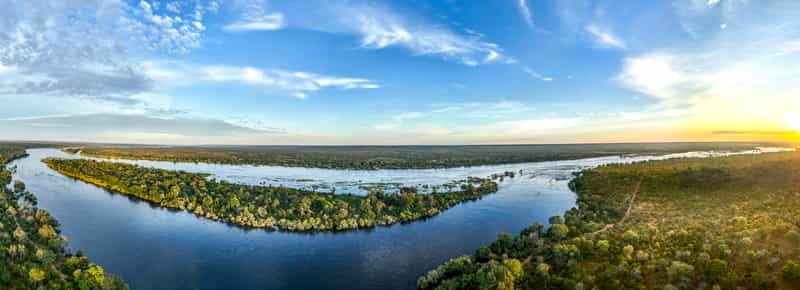
Most safari lodges sell one thing above all: closeness to wildlife. Tsowa Safari Island sells something rarer. It puts guests on a private island on the Zambezi River, within Zimbabwe’s Zambezi National Park, then uses that location as a launch pad for a three-country safari through Zimbabwe, Botswana and Zambia.
That makes Tsowa more than a lodge. It is a quiet base for travellers who want to keep moving without packing a suitcase every second morning.
Victoria Falls is within easy reach. Chobe National Park in Botswana can be visited on a day trip. Zambia sits across the broader river corridor. For travellers who like their safari with more than one passport stamp, the geography is doing some very useful work.
Getting there is part of the fun. Guests travel by road to Tsowa’s private entrance to Zambezi National Park, continue through the park in an open 4×4, then take a short boat ride across to the island. There is no grand hotel driveway and no lobby queue. By the time the boat reaches the bank, the outside world has already become someone else’s problem.
Tsowa is a small 16-bed tented camp set under riverine forest. Century-old baobabs rise through the island, while the Zambezi runs past the decks and tents. The river is not just the view here. It is part of the day.
Canoeing is one of the key activities. Guests paddle on the upper Zambezi with guides, moving through channels where the current can quicken and smaller rapids add some bite. This is not a resort paddle around a roped-off lagoon. Hippos, crocodiles, birds and the flow of the river tend to keep everybody’s attention nicely sharpened.
Back on land, island walks and game drives slow things down. Zambezi National Park is home to elephant, buffalo, lion and leopard, along with giraffe, antelope and rich birdlife. Zimbabwe Parks says the park has more than 400 recorded bird species.
Birders have even more reason to pay attention. Tsowa reports a breeding pair of Pel’s fishing owls on the island. African skimmers, half-collared kingfishers and rock pratincoles are also among the notable local species. In other words, birding here is not the usual brochure footnote added after the lions have had top billing.
The lodge’s green program is also worth noting. Isibindi Africa says its work includes replacing single-use plastics, using more solar power, buying from nearby suppliers and sending unused lodge food to feeding schemes for local creches. Those are real steps. They say far more than putting a green leaf on a website and hoping nobody asks awkward questions.
Yet Tsowa’s strongest selling point is its location.
Isibindi lists Victoria Falls town at about 20 minutes by road from the Tsowa entrance to Zambezi National Park. From there, guests complete the 4×4 and boat transfer back to camp. Tsowa can also arrange a Victoria Falls day trip, with the option to see the Falls on foot or add a helicopter or microlight flight when weather allows.
Devil’s Pool on the Zambian side adds another famous thrill, though nature still writes the timetable. Zambia Tourism says access is guided by water levels, usually during the low-water months from about August to January. It is a remarkable swim, but not the sort of attraction that accepts a stern complaint to management if the river says no.
Then there is Chobe.
Botswana Tourism says the wider Chobe region is home to the largest population of African elephants, estimated at about 120,000. The Chobe Riverfront is famous for large herds of elephant and buffalo, especially in the dry season. Tsowa promotes Chobe as a day-trip option, giving guests a realistic way to add Botswana without turning the holiday into a border-crossing marathon.
The home base still earns its place in the itinerary. Zambezi National Park has about 40 kilometres of river frontage and four of the Big Five: elephant, lion, buffalo and leopard. Guests can spend one day on the river, another on a game drive, another at Victoria Falls, and another crossing into Botswana, then return to the same island each night.
For travel advisers, that is the selling point. Tsowa does not need to compete with Victoria Falls or Chobe. It benefits from them. The lodge is the calm centre of a much bigger journey.
Luxury travel is changing. Space matters. Access matters. Time away from crowds matters. Tsowa offers all three, along with a river that refuses to sit quietly in the background.
The tents may get guests there. The guiding may bring them back. But the real star is the old property rule: location, location, location. Only at Tsowa do the neighbours include three countries, two famous parks, and one waterfall that has never suffered from a lack of publicity.
For more information, visit Isibindi Africa or Tsowa Safari Island, or contact reservations at [email protected].
By: Anne Keam – © 2026.
Read Time: 4 minutes.
Author Bio:
 Anne Keam’s story begins in Queensland, on a grain farm in the state’s wide western reaches, where the days were long and the lessons simple: work hard, look after your own, and don’t make a fuss. Those early years left their mark.
She later studied Arts at the University of Queensland, before doing what felt natural at the time, heading back home to the family property. But the world was calling. Anne packed a backpack and went looking, spending years on the road and finding herself most alive in South America. She wrote everything down along the way. Those notebooks, full of dust, colour, and curiosity, eventually became her blog, a quiet, personal record of seeing the world and learning from it.











