

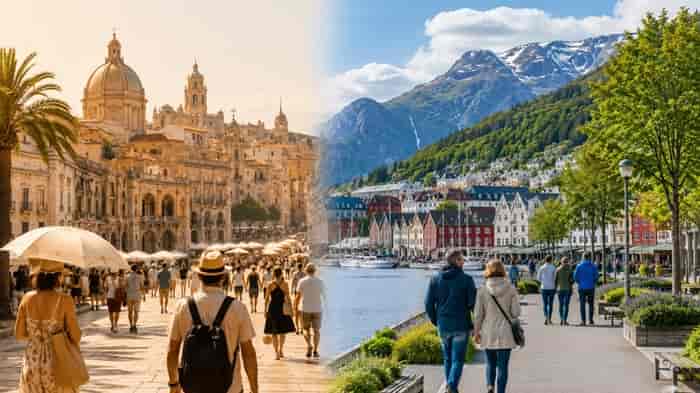
Europe’s summer holiday map is shifting north. This time, nobody can blame a careless fold.
For generations, the European summer formula was beautifully simple: fly south, find the sun, claim a beach chair and repeat next year. Spain, Italy, Greece, Portugal and southern France built tourism empires on that dependable promise.
The sun is still selling. The Mediterranean remains Europe’s dominant holiday region. Yet a run of intense heatwaves, drought conditions and destructive wildfires is changing how travellers judge the traditional peak-season escape.
More holidaymakers are now asking whether they can enjoy Europe without spending the afternoon sheltering beside an air conditioner.
That question has helped turn the once-faddish “coolcation” into serious tourism business.
Air France-KLM has detected a notable change in European travel behaviour, with heatwaves and wildfires encouraging some holidaymakers to avoid overheated areas of southern France and Spain in favour of destinations further north. Airlines often see these shifts before the rest of the industry because searches, bookings and route performance reveal where demand is actually moving.
For travel agents, hotels and destination marketers, the signal is difficult to ignore. Weather is no longer polite conversation at the departure gate. It is becoming a booking criterion.
Western Europe Records Its Hottest June
The climate data lends considerable weight to the trend.
Western Europe recorded its hottest June in the ERA5 dataset in 2026. According to the Copernicus Climate Change Service, the region’s average temperature reached 20.74°C, which was 3.06°C above the 1991–2020 June average. June 2026 was also Europe’s second-warmest June overall and the world’s second-warmest June in the dataset.
The heat did not arrive alone.
Copernicus reported widespread dryness, unusually warm seas and increased wildfire activity, particularly across the Iberian Peninsula and southern France. Below-average river flows affected large parts of France, central Europe and eastern Europe, adding another warning for tourism operators dependent on predictable seasonal conditions.
A hot day does not ruin a holiday. A prolonged heatwave can.
Walking tours become endurance events. Outdoor excursions are rescheduled or cancelled. Roads close. Smoke drifts across resort areas. Hotels discover that a sea view is less persuasive when the room cooling has surrendered before lunch.
Wildfires across parts of France, Spain, Greece and other European destinations have already triggered health warnings, transport disruption and mass evacuations during the summer of 2026. The wider tourism cost extends beyond the immediate danger zone. Images of flames and crowded evacuation routes can unsettle travellers thousands of kilometres away, particularly when they are investing heavily in a long-haul European holiday.
The Mediterranean Still Commands the Market
The northern shift should not be exaggerated into a Mediterranean collapse.
Southern and Mediterranean Europe remains the preferred holiday region for 61 per cent of intended European travellers between June and November 2026, according to the European Travel Commission. Spain, Italy, France and Greece remain the leading destination choices.
The beach holiday is not dead. It is not even having a lie-down.
What is changing is the decision-making process surrounding it.
The same European Travel Commission research found that climate-related factors influence the behaviour of more than three-quarters of European travellers. Among those adjusting their plans, 16 per cent actively seek milder temperatures, while 15 per cent avoid destinations prone to extreme heat or check forecasts before booking.
Pleasant weather is also a leading consideration when choosing a destination. That may sound obvious, but “pleasant” is doing more work than it once did.
For many travellers, it no longer means the highest possible temperature. It means being able to walk, sleep, dine outdoors and complete an itinerary without requiring the constitution of a fire-resistant lizard.
Global research from Booking.com points in the same direction.
Its 2026 Travel and Sustainability Report found that 74 per cent of travellers consider extreme-weather risks when choosing both their destination and travel period. Nearly one-third said such risks had caused them to cancel or change travel plans.
A quarter of respondents said they were seeking cooler destinations, while 55 per cent considered some places too hot to visit at their preferred time. Booking.com search data also recorded year-on-year increases for summer accommodation searches in Norway, Finland and Slovenia during 2025.
Those results do not prove that northern Europe is replacing the Mediterranean. They do show that climate comfort has entered the purchasing conversation.
Coolcations Become Commercial Reality
The word “coolcation” may sound as though it escaped from a marketing meeting armed with a hashtag. The product behind it, however, is straightforward.
Northern Europe offers long daylight hours, lakes, forests, coastlines and generally milder summer conditions.
Norway has fjords and the midnight sun. Finland has lakes, cabins and saunas. Sweden combines sophisticated cities with islands and wilderness. Denmark brings beaches, design and bicycles that appear to understand road rules better than many motorists.
Scotland and Ireland offer green landscapes, historic towns and weather once described apologetically. A cool breeze or passing shower can now be sold as climate-controlled authenticity.
The performance data adds substance, although it does not yet demonstrate a wholesale migration north.
International tourist arrivals across Europe rose 5.6 per cent year-on-year in early 2026, with Ireland, up 30 per cent, and Finland, up 12 per cent, standing out among northern destinations.
Full-year 2025 figures also showed international arrivals rising by 14.1 per cent in Finland and 12.9 per cent in Norway. International overnight stays increased by 22.8 per cent in Lithuania, 10 per cent in Iceland and 8.5 per cent in Latvia.
Those destinations began from different market positions, and not every gain can be attributed to heat avoidance. Improved air access, pricing, major events, nature tourism and post-pandemic recovery also matter.
Nevertheless, the pattern gives northern operators a timely opportunity to position their destinations around comfort, space and seasonal reliability. Interest in Nordic holidays is already rising among travellers searching for alternatives to increasingly hot southern summers.
For Australian travellers, the proposition is especially relevant.
Europe requires considerable time, money and planning. Few people want three carefully saved weeks reduced to smoke alerts, closed roads or afternoons spent staring mournfully at a hotel fan.
A good travel adviser can earn their keep here. The value lies not in declaring southern Europe off limits, but in matching the destination and month to the client.
Mediterranean travel in May, June, September or October may offer a better balance. A Nordic itinerary may suit travellers who want scenery and long days without punishing temperatures. Split-region journeys can provide both.
Hotels Face a Climate Test
The shift also places fresh pressure on accommodation providers.
Booking.com’s industry research found that almost one in four surveyed accommodation businesses had experienced disruptions to guest arrivals or departures due to extreme weather. Forty per cent had adjusted operations in response to existing or potential climate risks.
That adjustment must go beyond placing an optimistic desk fan in the wardrobe.
Reliable cooling, backup power, shaded public areas, drinking-water access and clear emergency procedures are becoming core service requirements.
Hotels also need transparent change policies when official warnings, fires or transport closures make a journey unsafe or impractical.
Staff welfare belongs in the same conversation.
Housekeepers, cooks, guides, drivers and ground crews endure the heat alongside guests, usually while working. Heat-safe rostering, adequate rest breaks and reliable hydration plans are not optional extras. They are basic operational discipline.
Long-term modelling by the European Commission’s Joint Research Centre suggests that rising temperatures could redistribute European coastal tourism demand through to 2100.
Under stronger warming scenarios, some southern coastal regions are projected to lose summer demand, while northern coastal regions are projected to gain it. The modelling also points to possible growth in demand in spring and autumn in parts of southern Europe.
That is a projection, not a declaration that the Mediterranean’s summer supremacy has already ended.
It does, however, reinforce the business case for adaptation and a longer, less concentrated visitor season.
Airlines Follow the Demand Line
Airlines will be watching closely.
Traditional southern routes will remain central to European summer networks, but demand may become more evenly spread across the calendar.
May, June, September and October could grow in importance, while Nordic capitals, regional gateways and northern cruise ports attract additional peak-season capacity. This remains an industry implication rather than a confirmed wholesale shift in scheduling, but airline observations and current traveller-intent data give carriers ample reason to watch the pattern.
Carriers with flexible fleets and strong network data will be best placed to respond. The challenge will be separating a lasting behavioural shift from a single extraordinary season.
Northern destinations must also avoid becoming victims of their own success.
Smaller communities, fragile landscapes and limited hotel markets can be overwhelmed quickly. Moving overtourism north does not solve overtourism. It merely gives the coaches a longer drive.
Destinations promoting cooler summers will need to manage visitor numbers, infrastructure and community consent with care.
The most credible pitch will not be, “Come before everyone else does.”
It will be, “Come responsibly, stay longer and spend well.”
Europe’s Summer Holiday Is Being Redrawn
Europe’s great summer holiday is not disappearing. It is becoming less rigid.
The Mediterranean still has the beaches, cities, cruise ports, air capacity, and cultural pull that helped build one of the world’s most successful tourism regions. Millions will continue to travel south and have splendid holidays.
But more travellers are widening the map, adjusting the month and asking harder questions before paying the deposit.
Can the hotel keep the room cool? Is the destination exposed to wildfire? What happens if transport is disrupted? Would a northern itinerary offer a more comfortable and dependable experience?
These are no longer fringe concerns. They affect conversion, customer confidence and brand trust.
The industry’s winners will not be those that simply sell the highest temperature. They will be the businesses that provide the right conditions, offer honest advice, and respond quickly when those conditions change.
Europe’s holidaymakers are not abandoning the south. They are reconsidering summer.
And as the mercury rises, the coolest destinations may become the hottest tickets in town.
By: Bridget Gomez – © 2026.
Read Time: 7 minutes.
Author Bio:
 Bridget has never been built for stillness. Of Portuguese heritage, she began as a nurse, tending to veterans at the Repatriation Hospital, listening to stories as colourful as the life she was yet to live. It was worthy, steady work, but wanderlust, as always, proved louder than routine.
So she traded starch for a backpack and disappeared for a year, chasing trains, sunsets and the occasional regrettable glass of wine. She wrote everything down: the dust, the laughter, the missteps, the magic. Those notebooks became a travel blog, then a habit, then a calling.
Eventually she found Global Travel Media, or perhaps it found her.
Today Bridget writes with heart, humour and a dash of mischief, still travelling, now with words.











